
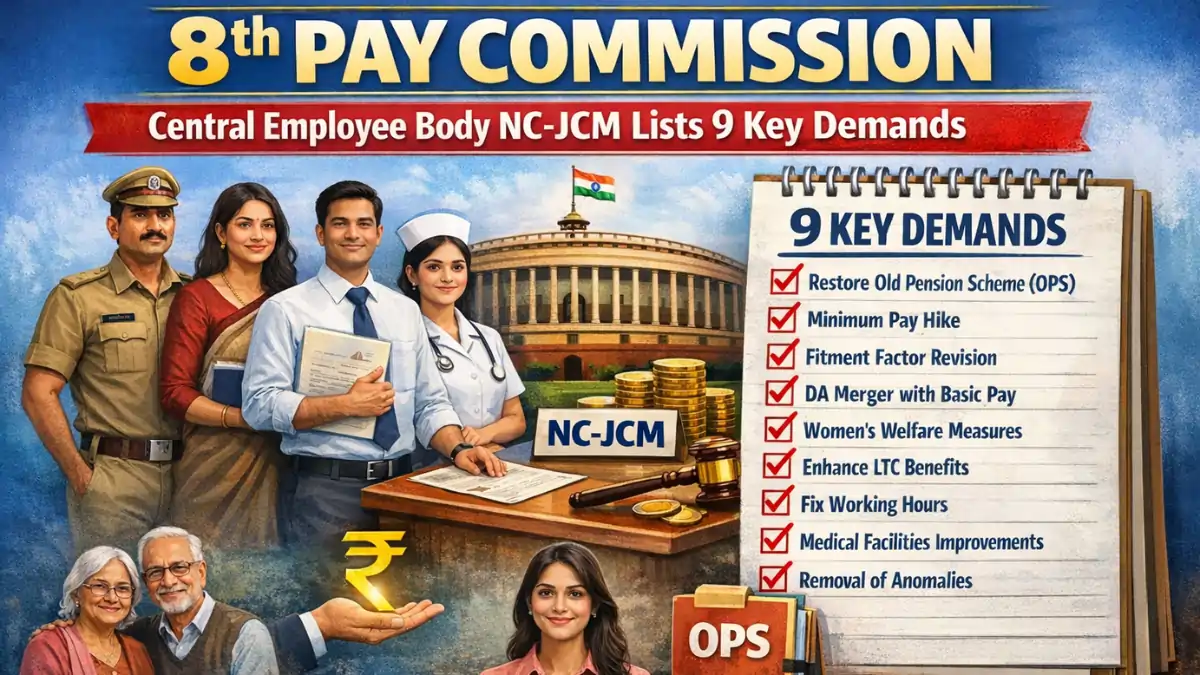
The 8th Pay Commission demands from central government employees have sharpened significantly as the memoranda submission window approaches its close. In a letter dated 01 April 2026, Shiva Gopal Mishra, Secretary of the National Council (Staff Side) – Joint Consultative Machinery (NC-JCM), the umbrella body of central government employee unions, formally wrote to the 8th Central Pay Commission (8th CPC) listing nine specific concerns that must be addressed before NC-JCM submits its joint memorandum on behalf of all affiliated unions.
The demands are not about salary figures — at least not directly. NC-JCM is asking the Commission to fix the very system through which employees and pensioners submit their demands. Its argument: if the submission format is broken, even the most legitimate grievances may never reach the Commission in usable form. From pension rights and women’s welfare to response word limits and email-based submissions, the nine points collectively form one of the most detailed procedural critiques any employee body has made in this pay commission cycle.
At a Glance
| Detail | Information |
|---|---|
| Issuing Body | NC-JCM Staff Side (National Council – Joint Consultative Machinery) |
| Letter Date | 01 April 2026 |
| Addressed To | Pankaj Jain, Member Secretary, 8th Central Pay Commission |
| Memoranda Deadline | 30 April 2026 (via 8cpc.gov.in portal) |
| Applicable To | All central government employees and pensioners |
| Official Portal | 8cpc.gov.in |
Why the 30 April Deadline Makes This Letter Urgent
The 8th CPC, formally constituted on 03 November 2025 under Chairperson Justice Ranjana Prakash Desai, has an 18-month mandate to submit its recommendations to the government. Those recommendations will determine the salary, pension, and allowances of approximately 50 lakh serving central government employees and nearly 70 lakh pensioners. For an overview of how the Commission is structured and what it covers, read our 8th Pay Commission 2026 guide.
Since March 2026, the Commission has been collecting formal memoranda through an online portal at 8cpc.gov.in. Associations, unions, individuals and pensioners can all submit their representations, but only online — and only until 30 April 2026. The MyGov questionnaire that preceded this portal (which closed on 31 March 2026) was structured around 18 themes, with a 3,500-character limit per response and a 2 MB attachment cap.
NC-JCM’s letter argues that these structural constraints — the word limits, the missing themes, the online-only format — are preventing employee bodies from making comprehensive representations. The Commission’s recommendations will be shaped by what it receives during this phase. Getting the inputs right, NC-JCM says, is not a technical detail. It is a matter of fairness.
The 9 Key Demands — What NC-JCM Is Asking For
1. A Dedicated Section for NPS/UPS Review and OPS Restoration
The single most politically significant demand. NC-JCM writes that employees governed under the National Pension System (NPS) and those who have switched to the Unified Pension Scheme (UPS) are facing what it describes as “innumerable problems, grievances and issues.” The confederation’s position is clear: government employees should not be on a contributory pension scheme at all. NC-JCM wants the 8th CPC questionnaire to include a dedicated provision where stakeholders can formally submit views calling for the restoration of the non-contributory, defined-benefit pension under the Central Civil Services (Pension) Rules, 1972 (now 2021). Without such a provision, this demand — which is the most widely held position among central employees — has no formal channel in the Commission’s framework. For a detailed comparison of the current schemes, see our NPS vs UPS comparison 2026.
2. A Dedicated Section for Pensioners’ Issues
There are nearly 70 lakh central government pensioners in India today — nearly 40% more than the number of serving employees. Yet NC-JCM points out that the Commission’s current questionnaire does not have a section specifically addressing pensioner concerns. The confederation has asked for a dedicated space to raise issues including restoration of the commuted value of pension after 15 years, pension enhancement, revision parity between pre- and post-retirement beneficiaries, and other welfare measures for retirees.
3. Women Employee Welfare — A Separate Section
NC-JCM is asking for a standalone section in the memorandum format to cover issues specific to women in government service. The concerns listed include workplace safety, maternity benefits, menstrual leave, Child Care Leave (CCL) anomalies, and workplace equity provisions. This is a notable step forward: women’s welfare has historically been absorbed into general service condition discussions at Pay Commissions rather than addressed as a distinct category. A dedicated section would allow women employees and their associations to formally place these demands on the record.
4. Department-Specific Issues Must Have a Submission Path
Central government departments are not homogeneous. A Railway accounts official, a CGHS doctor, a Kendriya Vidyalaya teacher, and a CAPF soldier face entirely different operational realities. NC-JCM argues that a one-size-fits-all questionnaire cannot capture the cadre-specific issues and unique operational challenges across India’s ministries and departments. It has asked for a distinct provision in the memorandum format to allow department-level submissions that go beyond the common 18-question framework.
5. Extend the Deadline to 31 May 2026
NC-JCM has formally requested that the deadline for submitting department-specific memoranda be extended to 31 May 2026. The reason is practical: NC-JCM’s affiliates are spread across the length and breadth of the country, and the Staff Side, federations, unions and associations need time to consult their constituent organisations before finalising their joint submission. A 30 April deadline, the letter implies, does not give geographically dispersed bodies adequate time for meaningful consultation.
⚠️ Note: As of the date of NC-JCM’s letter, the memoranda portal deadline stands at 30 April 2026. Any extension will be notified on 8cpc.gov.in.
6. Increase the Response Word Limit
The current system allows 3,500 characters — roughly 500 words — per theme. NC-JCM has described this as “insufficient to adequately present detailed views, logic, data and justifications on complex matters.” The confederation has asked for the limit to be raised to at least 1,000 words per theme.
There is already partial movement on this. C. Srikumar, General Secretary of the All India Defence Employees’ Federation (AIDEF), one of NC-JCM’s key units, informed members that the 8th CPC has responded to industry pressure by increasing the character limit from 3,500 to 10,000 per theme and raising the attachment size from 2 MB to 6 MB. NC-JCM’s formal letter, however, was written before this update was publicised, which suggests the Commission is already listening — even if the response came informally first.
7. Structured Sub-Questions Within Each Theme
NC-JCM writes that the current questionnaire format does not clearly facilitate responses to all sub-questions or sub-titles under each main theme. When a theme covers multiple distinct issues, the respondent currently has no structured way to address each one individually. The confederation has asked for a provision that allows respondents to answer each sub-question systematically, without being forced to compress everything into a single response block. This is a drafting and usability issue, but it matters: a poorly designed form produces incomplete data, and the Commission will use that data to build its recommendations.
8. Increase the Attachment Size Limit to 10 MB
The existing 2 MB attachment cap, NC-JCM argues, is restrictive when employee bodies want to submit detailed reports, historical data, court judgements, or statistical annexures. The confederation has asked for this to be raised to at least 10 MB. As noted under Demand 6 above, AIDEF has already confirmed that the 8th CPC has increased the limit to 6 MB — an improvement, though still short of what NC-JCM has requested.
9. Allow E-mail and Hard Copy Submissions
The most fundamental process demand. The 8th CPC’s current position is that all submissions must be made through the online portal — email or paper-based responses are explicitly excluded. NC-JCM is asking the Commission to allow E-mail submissions and physical hard copies at least for the Staff Side, federations, unions and associations. The reasons are straightforward: technical barriers exist for some affiliates, older employee and pensioner associations may not have the digital infrastructure for portal-based submissions, and alternative modes ensure no legitimate representation is accidentally excluded.
Why This Matters More Than It Might Appear
NC-JCM’s letter is procedural in nature, but its implications are substantive. The 8th Pay Commission will make recommendations that govern central government salaries and pensions for the next decade. The quality of those recommendations depends directly on the quality of inputs the Commission receives.
If the OPS restoration demand has no formal submission path, the Commission can note it was not formally raised. If pensioners’ specific issues are bundled into a general category, the nuances of pension parity and commutation may be glossed over. If women’s welfare is not a separate theme, there is no forcing function for the Commission to address it systematically.
The timing also matters. This letter came on 01 April 2026, less than a month before the memoranda deadline closes. NC-JCM is not just stating preferences — it is applying pressure while there is still time for the Commission to act.
💡 For context on the 8th CPC’s full timeline and what comes after the memoranda phase, see our 8th Pay Commission timeline.
What This Means for You as a Central Government Employee
If you are a serving central government employee or pensioner, here is what NC-JCM’s letter means in practical terms.
The OPS demand is the one to watch most closely. If the Commission creates a formal submission path for OPS restoration, it signals that the demand will at least be considered on the record, rather than dismissed as outside the questionnaire’s scope. That is not a guarantee — but it keeps the possibility alive.
On pensions, the demand for a dedicated section means the 69 lakh-plus pensioners currently navigating the NPS/UPS system may finally have their concerns formally documented and analysed, rather than absorbed into broader salary discussions.
If you want to submit your own memorandum before 30 April 2026, you can do so at the official 8th CPC portal at 8cpc.gov.in. Individual submissions are permitted. You do not need to route them through a union or association. Use our 8th CPC salary calculator to understand how different fitment factor scenarios could affect your pay.
The 8th CPC team is also scheduled to hold stakeholder meetings in Dehradun on 24 April 2026. Associations wishing to participate must apply by 10 April 2026.
What Comes Next — The Road to Mid-2027
The Commission has 18 months from 03 November 2025 to submit its report, putting the final recommendations due around May 2027. After the memoranda portal closes on 30 April 2026, the Commission will enter a phase of reviewing all submissions, holding regional consultations, and commissioning its own analysis.
Cabinet approval of the recommendations typically follows the report by three to nine months. If the 7th Pay Commission’s timeline is any guide, implementation could land in late 2027. Employees will receive arrears backdated to 01 January 2026, meaning even a delayed implementation carries a substantial lump-sum component.
For the latest DA hike update and how your current salary stands while the 8th CPC deliberates, check our dedicated post.
Important Links
| What | Link |
|---|---|
| 8th CPC Official Website | 8cpc.gov.in |
| Memoranda Submission Portal | innovateindia.mygov.in/8cpc-memorandum-submission |
| 8th Pay Commission Guide | Read Here |
| 8th CPC Timeline | Read Here |
| NPS vs UPS Comparison | Read Here |
Frequently Asked Questions
What are the 9 demands NC-JCM has listed to the 8th Pay Commission?
NC-JCM has asked the 8th CPC to: create a submission path for OPS restoration and NPS/UPS review; add a dedicated pensioners’ section; include a women employees’ welfare section; allow department-specific submissions; extend the memoranda deadline to 31 May 2026; raise the response word limit to 1,000 words per theme; allow structured sub-question responses; increase the attachment size limit to 10 MB; and permit email and hard copy submissions alongside the online portal.
What is the last date to submit a memorandum to the 8th Pay Commission in 2026?
The current deadline for online memoranda submission is 30 April 2026, via the official portal at 8cpc.gov.in. NC-JCM has requested an extension to 31 May 2026 for department-specific submissions. Any change to this deadline will be notified on the Commission’s official website.
Will the Old Pension Scheme (OPS) be restored under the 8th Pay Commission?
No decision has been taken. NC-JCM is asking the 8th CPC to create a formal provision in its questionnaire so that stakeholders can at least submit their views on OPS restoration. Whether the Commission ultimately recommends OPS, NPS, or UPS-related reforms will depend on its own analysis and the government’s acceptance of its report.
What fitment factor are employee unions demanding for the 8th Pay Commission?
NC-JCM and affiliated bodies have been pushing for a fitment factor in the range of 3.0 to 3.25. Under the current 7th Pay Commission, the fitment factor is 2.57. A 3.0 factor would raise the minimum basic pay from ₹18,000 to ₹54,000. The final factor will be the Commission’s recommendation, subject to government acceptance.
What is NC-JCM and why does its letter matter?
The National Council (Staff Side) – Joint Consultative Machinery (NC-JCM) is the umbrella body that represents central government employee unions in formal consultations with the government. Its joint memorandum, submitted before every Pay Commission, carries the collective position of all major central employee bodies. When NC-JCM writes to the 8th CPC, it is speaking for lakhs of employees across all departments, services, and levels.
Why are women employee welfare demands being raised at the 8th Pay Commission?
Women employee welfare issues — including maternity benefits, menstrual leave, Child Care Leave (CCL) anomalies, and workplace safety — have historically been addressed within general service condition discussions at Pay Commissions rather than as a distinct category. NC-JCM is asking for a dedicated section to ensure these concerns are formally documented and specifically considered, rather than absorbed into broader allowance or benefit reviews.
When will 8th Pay Commission recommendations be implemented?
The Commission has 18 months from 03 November 2025 to submit its report — meaning recommendations are expected around May 2027. After Cabinet acceptance and notification, revised salaries and pensions will be effective from 01 January 2026, with arrears paid for the intervening period. Actual implementation in payslips could come in late 2027.
Final words..
NC-JCM’s nine demands to the 8th CPC are a reminder that the battle for a fair pay revision does not begin with the fitment factor — it begins with the quality of the process through which employees get to be heard. A submission format that cannot accommodate OPS demands, pensioners’ specific grievances, or women employees’ concerns is not a neutral tool. It is a structural disadvantage.
The 30 April 2026 deadline is approaching fast. If you represent an association, union, or simply want your individual views on the record, the portal at 8cpc.gov.in is your only formal channel right now. Use it.
Bookmark Govtserviceinfo.com and join our Telegram channel for instant alerts on DA hikes, pay revision orders, and 8th CPC updates.
Disclaimer: This article is based on the NC-JCM Staff Side letter dated 01 April 2026 addressed to the Member Secretary, 8th Central Pay Commission, and publicly available reports from India.com, GConnect.in, and AIDEF circulars. All details are subject to official announcements from the 8th CPC and the Government of India. Govtserviceinfo.com is not affiliated with the Ministry of Finance, NC-JCM, or the 8th Central Pay Commission. Readers should verify current information from official government sources at 8cpc.gov.in before acting on any information published here.


2 thoughts on “8th Pay Commission: Central Employee Body NC-JCM Lists 9 Key Demands — Pension, OPS, Women Welfare and More”