
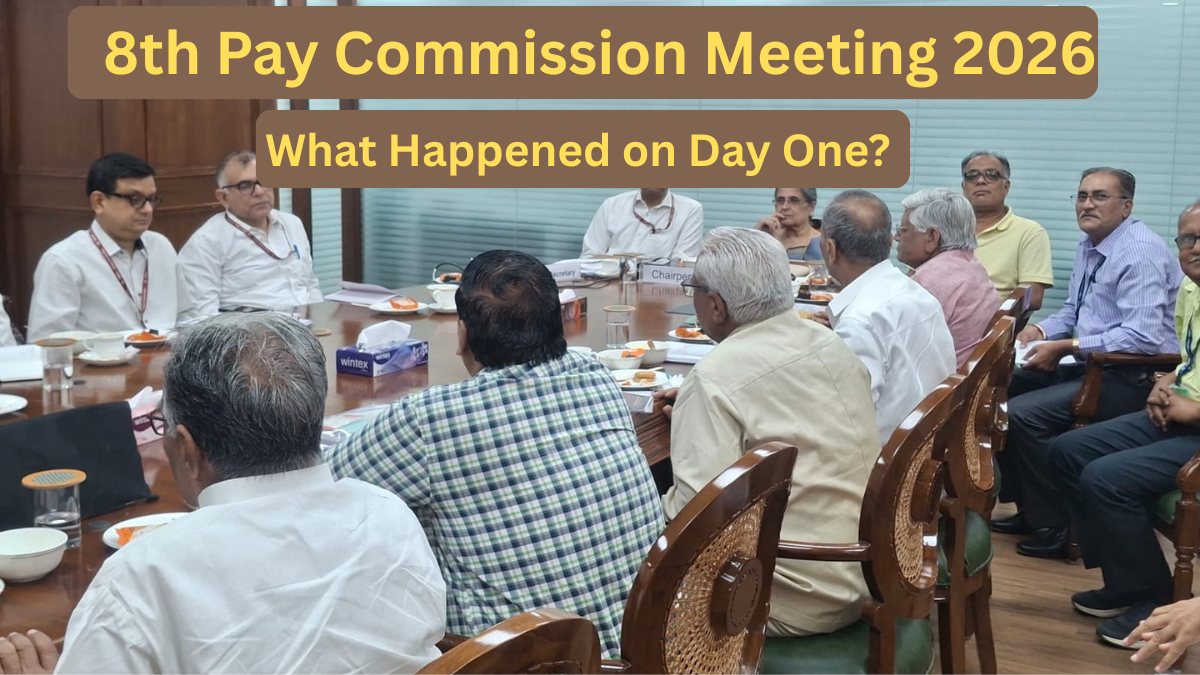
The 8th Pay Commission Meeting 2026 officially commenced in Delhi on 28 April 2026, marking the first direct interaction between the commission and central government employee unions after months of written memorandums. For approximately 48 lakh serving central government employees and 68 lakh pensioners, what happens inside Chanderlok Building on Janpath over these three days will shape salaries, pensions, and allowances for the next decade.
The first day did not produce decisions — it was never going to. But it produced something arguably more important: a clear picture of what unions are asking for and how the commission is responding. The core demands are a minimum basic pay of ₹69,000, a fitment factor of 3.83, an increase in annual increments from 3% to 6%, and a threefold rise in allowances. Whether the government accepts, modifies, or ignores these demands will be known only when the final report arrives — expected within 18 months of the commission’s constitution in November 2025.
8th Pay Commission Meeting 2026 — At a Glance
| Detail | Information |
|---|---|
| Commission Body | 8th Central Pay Commission (CPC) |
| Meeting Dates | 28–30 April 2026 |
| Venue | Chanderlok Building, Janpath, New Delhi |
| Member Secretary | Pankaj Jain |
| Staff Side Representative | Shiva Gopal Mishra, NC-JCM Secretary |
| Employees Represented | ~48 lakh central govt employees, ~68 lakh pensioners |
| Memorandum Deadline | 30 April 2026 |
| Expected Report Timeline | 18 months from November 2025 |
| Expected Implementation | Retroactive from 01 January 2026 |
| Official Website | 8thpaycommission.gov.in |
Why the Commission Is Sitting Right Now
The 8th Central Pay Commission (CPC) was formally constituted by the Government of India in November 2025. Its brief is straightforward: review the pay structure, allowances, and pension arrangements of central government employees and pensioners, and recommend a revised framework. The commission follows a cycle that has historically run every ten years — the 7th Pay Commission was constituted in 2014 and implemented with effect from 01 January 2016.
The April 2026 meetings are the commission’s first round of direct consultations with the staff side. Before these meetings, unions, federations, and employee associations submitted written memorandums, and the public — including individual employees and pensioners — could submit feedback through the MyGov portal, a window that closed on 31 March 2026. The April 28 to 30 meetings bring those written demands face to face with the commission for the first time.
The timing is not coincidental. With the memorandum deadline set for 30 April 2026 and the political calendar of several state elections in play, the government has signalled that it wants the consultation process to move at pace. For the 1.2 crore people whose livelihoods the commission will determine, these three days mark the moment when their demands stop being paper and start being heard.
The Numbers on the Table: Fitment Factor, Minimum Pay, and Increments
The central demand in the National Council – Joint Consultative Machinery (NC-JCM) memorandum, finalised on 13 April 2026, is a minimum basic pay of ₹69,000 per month. This figure is derived by applying the 15th Indian Labour Conference (ILC) norms to 2026 consumer prices, recalibrated for a five-member family unit. The 7th Pay Commission had used a three-member family unit; unions argue that the modern central government employee is legally and financially responsible for a broader household — including dependent elderly parents — and that the pay calculation must reflect this.
The fitment factor of 3.83 is mathematically linked to that ₹69,000 figure. Under the 7th Pay Commission, the entry-level pay was fixed at ₹18,000. If ₹69,000 is the new minimum, the multiplier needed to get there from ₹18,000 is 3.833. This is how the NC-JCM arrives at its figure. To understand what that means in practical salary terms: an employee currently at Pay Level 6 with a basic pay of ₹35,400 would, at a fitment factor of 3.83, see their basic pay rise to approximately ₹1,35,582. That is before Dearness Allowance (DA), House Rent Allowance (HRA), and other components are added.
It is worth being direct about the gap between demand and expectation. Analysts and fiscal observers broadly consider a fitment factor in the range of 2.5 to 3.0 to be more realistic, given government budget constraints. The 7th Pay Commission approved a factor of 2.57. The unions’ figure of 3.83 is their opening position — not the expected outcome. The actual number will emerge from the commission’s analysis and government’s fiscal calculus.
📌 Also Read: 8th Pay Commission Salary Hike, Fitment Factor & Pay Matrix — Complete Guide
Beyond Basic Pay: Increments, Allowances, and the Old Pension Question
The salary demand is only one part of a broader package of reforms presented to the commission. Annual increments are currently fixed at 3% of basic pay under the 7th Pay Commission framework. The NC-JCM is demanding this be doubled to 6%. Over a 30-year service career, the difference between 3% and 6% annual increments compresses significantly — this is the quiet compound interest of a government career, and doubling the increment rate would materially change take-home pay within a few years, not just at the start.
On allowances, the demand is for a threefold increase across HRA and transport. Currently, HRA is paid at 27%, 18%, and 9% of basic pay for X, Y, and Z category cities respectively. The NC-JCM is proposing revisions to 40%, 35%, and 30%. For an employee posted in Delhi — an X-category city — on a basic pay of ₹35,400, this would mean HRA rising from approximately ₹9,558 to roughly ₹14,160 per month.
The most politically charged demand remains the restoration of the Old Pension Scheme (OPS). The government’s current position, reinforced by the launch of the Unified Pension Scheme (UPS) on 01 April 2025, is that the UPS — which provides an assured pension of 50% of the average basic pay of the last 12 months — is its final answer to employee concerns about retirement security. The NC-JCM wants OPS restored at 67% of last drawn pay. Whether the commission takes this up substantively or defers to the government’s UPS position is one of the most watched questions of this consultation process.
💡 For a detailed comparison of NPS and UPS: NPS vs UPS — Which Is Better for Central Government Employees in 2026?
The Gender Calculation Demand: A Structural Reform Hidden in Plain Sight
One of the less-reported but significant demands from Shiva Gopal Mishra, the NC-JCM’s Secretary, concerns how the family unit is calculated for determining minimum pay. Under older pay commission frameworks, the family unit assigned a value of 1.0 to a male employee and 0.8 to a female employee — a differential that produced lower calculated minimum pay for women.
The NC-JCM is demanding this distinction be abolished entirely. The proposal treats every employee — regardless of gender — as contributing a unit value of 1.0. Additionally, the memorandum argues for children to count as full units in the family calculation, rather than fractions, and for dependent parents to be included. This is not merely a gender equity argument — it is a mathematical one that directly raises the floor from which minimum pay is calculated. If the commission accepts this framework, the ₹69,000 minimum pay demand becomes harder to dismiss on the grounds of calculation methodology.
This demand is notable because it would represent the first explicit rejection of gender-differentiated pay calculation in Pay Commission history — a structural reform dressed in the language of arithmetic.
What This Means If You Are a Central Government Employee
If you are a central government employee, here is what Day One of the 8th Pay Commission consultations actually means for your payslip — and what it doesn’t.
Nothing has been decided. The commission made no commitments on the first day, and it would have been unusual if it had. As Shiva Gopal Mishra described it after the meeting, the commission’s response was that it had received the memorandum, heard the explanation, and would try its best. That is the appropriate tone for a first meeting.
What has changed is that the union’s demands are now formally on the table and have been heard in person. The NC-JCM represents approximately 36 lakh central government employees. Their memorandum — a 51-page document covering pay structure, allowances, pension, and service conditions — is now part of the official record of the commission’s consultations.
For employees in difficult or hazardous postings — particularly in railways, where Mishra specifically noted that hundreds of workers die or face serious risks each year — the demand for increased risk and hardship allowances is explicitly on the agenda. For employees who have waited years for officiating allowances when taking on higher responsibilities, that demand too is in the memorandum.
⚠️ Important: No salary change takes effect until the commission submits its report, the government accepts the recommendations, and issues formal orders. Based on current timelines, the earliest realistic implementation date remains early 2027, with arrears payable from 01 January 2026.
📌 Also Read: 8th Pay Commission Timeline — When Will Salaries Actually Change?
The 5-Year Commission Cycle Demand: A Reform That Could Change Everything
One demand that received less attention but could have the longest-lasting impact is the union’s request to reduce the Pay Commission cycle from 10 years to 5 years. Currently, salary revisions happen once a decade — which means an employee who joins shortly after one Pay Commission implementation may wait nine years for their first structural revision. In banking and the private sector, wage negotiations happen every 3 to 5 years.
Mishra put the case plainly: ten years is too long when living costs rise annually. The proposal is not just about the next revision — it is about changing the architecture of how central government pay is determined going forward. If accepted, it would mean the 9th Pay Commission would be constituted around 2031, not 2035. The government has not responded to this demand, but it is now formally before the commission.
The timing of this demand is also strategic. With digitalisation making data collection, analysis, and computation dramatically faster, the commission itself acknowledged that its 18-month timeline could potentially be shortened. The NC-JCM is using that very logic to argue that a shorter review cycle is operationally feasible — not just desirable.
Proposed Salary Changes — Impact Scenarios
These figures are based on the NC-JCM’s proposed fitment factor of 3.83. They are demands, not confirmed decisions. Actual revisions will depend on the commission’s final report and government acceptance.
| Pay Level | Current Basic Pay | If Fitment = 3.83 | If Fitment = 2.86 (Realistic Mid) |
|---|---|---|---|
| Level 1 (MTS) | ₹18,000 | ₹69,000 | ₹51,480 |
| Level 4 (LDC) | ₹25,500 | ₹97,665 | ₹72,930 |
| Level 6 (UDC/JSA) | ₹35,400 | ₹1,35,582 | ₹1,01,244 |
| Level 8 (Inspector) | ₹47,600 | ₹1,82,408 | ₹1,36,136 |
| Level 10 (Gazetted) | ₹56,100 | ₹2,14,863 | ₹1,60,446 |
⚠️ These are indicative projections only. Do not use for financial planning. Final figures will be notified by the Government of India after the commission submits its report.
What Comes Next
The consultation meetings run from 28 to 30 April 2026. After this round, the commission will continue meeting other staff federations, defence employee associations, pensioner groups, and departmental representatives. The memorandum deadline of 30 April 2026 will be followed by a period of analysis, regional consultations, and expert input.
The commission has an 18-month deadline from its November 2025 constitution, which puts the report submission window around April to May 2027. Implementation — including the notification of revised pay matrices, allowance tables, and pension calculations — would follow the government’s acceptance of the report, likely in the latter half of 2027. Arrears are expected to be calculated from 01 January 2026, but this too is subject to the final government order.
What to watch in the coming weeks: whether the commission extends the memorandum deadline (the NC-JCM has requested until 31 May 2026), which other union federations present their demands, and whether the government signals a position on any of the demands — particularly on OPS restoration.
📌 Also Read: 8th Pay Commission 2026 — All You Need to Know
Important Links
| What | Link |
|---|---|
| 8th Pay Commission Official Website | 8thpaycommission.gov.in |
| 8th CPC Salary Calculator | Use Calculator |
| NPS vs UPS Comparison 2026 | Read Here |
| DA Calculator | Open Tool |
| 8th Pay Commission Timeline | View Timeline |
Frequently Asked Questions
What happened at the 8th Pay Commission meeting on 28 April 2026?
The commission held its first round of consultations with the staff side at Chanderlok Building, New Delhi. Shiva Gopal Mishra, representing the National Council – Joint Consultative Machinery (NC-JCM), presented the union’s key demands in person, including ₹69,000 minimum basic pay, a fitment factor of 3.83, and a 6% annual increment. The commission responded positively but made no firm commitments on the first day.
What is the 8th Pay Commission’s proposed fitment factor?
The NC-JCM (staff side) has demanded a fitment factor of 3.83, which is mathematically derived from the proposed minimum pay of ₹69,000 divided by the current minimum of ₹18,000. This is a demand, not a confirmed decision. Analysts consider a factor between 2.5 and 3.0 more realistic based on fiscal projections.
What is the proposed minimum basic pay under the 8th Pay Commission?
The NC-JCM memorandum proposes a minimum basic pay of ₹69,000 per month, up from the current ₹18,000 set by the 7th Pay Commission in 2016. This figure is calculated using the 15th ILC norms updated for 2026 prices and based on a five-member family unit including dependent parents.
Will the Old Pension Scheme (OPS) be restored under the 8th Pay Commission?
The NC-JCM has formally demanded OPS restoration at 67% of last drawn pay. However, the Government of India launched the Unified Pension Scheme (UPS) on 01 April 2025, which it positions as the final resolution to retirement security concerns. OPS restoration remains a demand, not a confirmed outcome.
When will 8th Pay Commission salaries be implemented?
The commission has an 18-month timeline from its November 2025 constitution, placing the expected report around April–May 2027. Government processing and implementation orders would follow, making actual revised salaries realistically payable from late 2027. Arrears are expected to be calculated from 01 January 2026.
Are annual increments going to increase under the 8th Pay Commission?
The NC-JCM has demanded an increase in annual increments from the current 3% to 6% of basic pay. This is among the most significant structural demands beyond the fitment factor. The commission has not yet indicated whether it will accept this proposal.
What is the NC-JCM demand on HRA under the 8th Pay Commission?
The NC-JCM proposes revising HRA to 40%, 35%, and 30% for X, Y, and Z category cities respectively, up from the current 27%, 18%, and 9%. This is approximately a threefold increase in cities like Tier-2 and Tier-3 towns, and a significant rise even in metros.
Conclusion
The 8th Pay Commission Meeting 2026 got off to a cautious but substantive start. Day One was about presenting demands clearly, not about getting commitments — and on that measure, the staff side succeeded. The NC-JCM’s case for ₹69,000 minimum pay, a 3.83 fitment factor, 6% annual increments, and restructured allowances is now formally before the commission.
Whether the commission moves toward the staff side’s numbers or the government’s fiscal comfort zone will become clearer over the coming months of consultations. For now, central government employees and pensioners should watch this space closely — the decisions made in these meetings will determine pay for a decade.
Bookmark Govtserviceinfo.com and join our Telegram channel for instant alerts on DA hikes, pay revision orders, and 8th CPC updates.
Disclaimer: This article is based on information reported from the 8th Pay Commission consultations held on 28 April 2026, including statements made by NC-JCM Secretary Shiva Gopal Mishra. All salary figures and projections in this post are based on union demands and independent analysis — they are not confirmed government decisions. Govtserviceinfo.com is not affiliated with the 8th Central Pay Commission or the Government of India. Readers should verify current information from official government sources before acting on any information published here.




1 thought on “8th Pay Commission Meeting 2026: Unions Demand ₹69,000 Minimum Pay and 3.83 Fitment Factor — What Happened on Day One”