
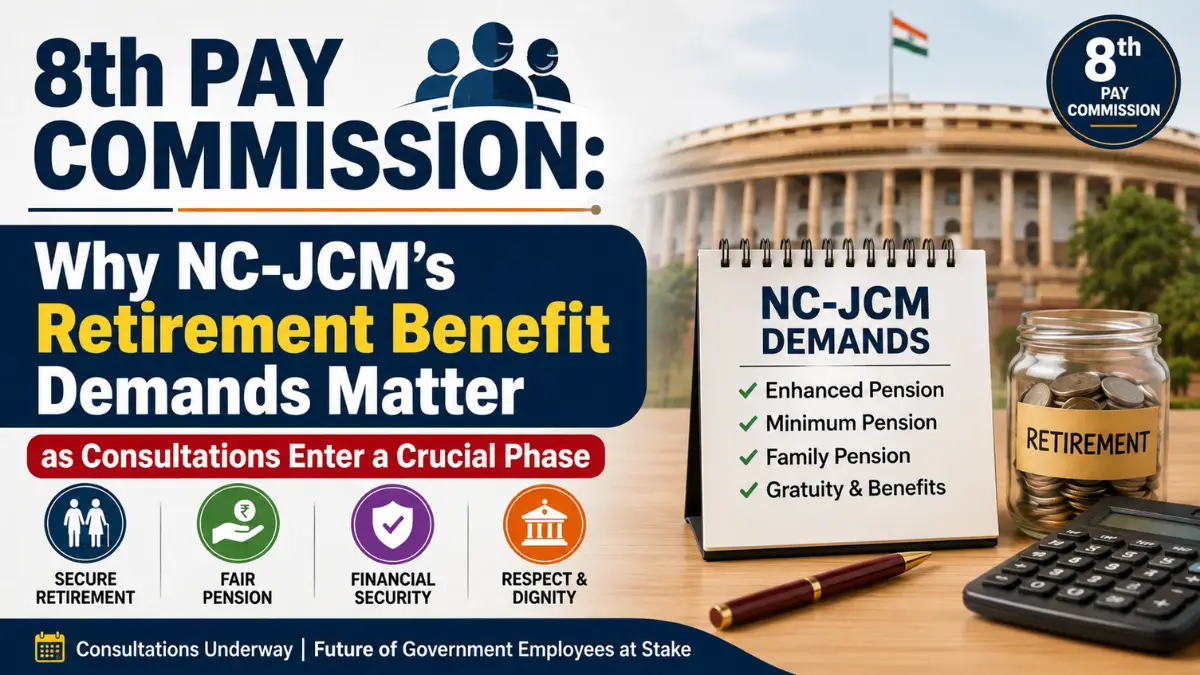
The 8th Pay Commission’s consultations on retirement benefits and pension reforms are entering what could be their most consequential phase — and the demands submitted by the National Council–Joint Consultative Machinery (NC-JCM) are expected to sit at the centre of discussions over the coming months. From a near-tripling of the gratuity ceiling to the contentious push for restoring the Old Pension Scheme (OPS), the union’s memorandum represents the most comprehensive statement of what lakhs of central government employees and pensioners want from this once-a-decade exercise.
The commission, constituted by the Centre on 3 November 2025 and chaired by Justice Ranjana Prakash Desai, has now crossed the halfway mark of its 18-month tenure. More than nine months of stakeholder consultations are behind it. The months ahead — with meetings scheduled in Delhi, Chennai, Puducherry, Chandigarh and Jaipur through August and September 2026 — carry proportionately greater weight. This is the phase where positions harden, where the commission begins synthesising what it has heard, and where the foundations of the final report start taking shape.
How the 8th Pay Commission Got Here — and Why the Second Half Is Different
A Pay Commission is not a short sprint. The 7th Pay Commission, constituted in February 2014 under Justice Ashok Kumar Mathur, took well over two years to deliver its report. The current commission is working to an 18-month schedule, with a report expected around May or June 2027. At that pace, every consultation round from here on directly feeds the drafting process.
The panel’s other members — Professor Pulak Ghosh and Member-Secretary Pankaj Jain — have been conducting regional meetings across India, gathering feedback from employee unions and associations on everything from basic pay and allowances to pension structures and post-retirement welfare. The next round of Delhi discussions begins on 7 August, wrapping up on 10 August, followed by meetings in Chennai, Puducherry, Chandigarh, and then Jaipur on 31 August and 1 September 2026.
The first half of the tenure was largely a listening phase. The second half is where what was heard starts to be weighed and tested. That shift makes the NC-JCM memorandum — and the retirement benefit demands it contains — a document worth understanding in detail.
The NC-JCM Memorandum: Eight Retirement Demands That Could Define the Report
The National Council–Joint Consultative Machinery represents the largest formal platform through which central government employees engage with pay revision exercises. Its memorandum to the 8th Pay Commission covers salaries, allowances and much more — but on retirement benefits specifically, it has put forward eight proposals that range from the administratively straightforward to the politically significant.
Death-cum-Retirement Gratuity (DCRG): The NC-JCM wants the formula for calculating gratuity changed from the current 30-day basis to 25 working days per year of service. More significantly, it wants the current ceiling of ₹25 lakh raised to ₹75 lakh — a tripling — and the 16.5-times cap on the calculation removed. To understand what this means in practice: an employee retiring at Pay Level 10 with 33 years of service currently runs into the ₹25 lakh ceiling well before the formula reaches its natural limit. Raising the ceiling to ₹75 lakh would allow that employee to receive the full calculated amount, potentially ₹30–40 lakh more at retirement. The NC-JCM also wants these revised benefits extended equally to employees under the Old Pension Scheme (OPS), National Pension System (NPS), and Unified Pension Scheme (UPS).
One Rank One Pension (OROP) for Civil Pensioners: Currently, OROP — where all retirees of the same rank receive the same pension regardless of when they retired — applies to defence personnel but not to civilian government employees. The NC-JCM is pushing for this principle to be extended to civil pensioners. Combined with a demand that pension revisions use the same fitment factor applied to serving employees, this would ensure that a pensioner who retired ten years ago sees their pension revised in line with current pay scales, not frozen at the rate applicable when they left service.
Leave Encashment: The union wants the ceiling on Earned Leave (EL) encashment raised from the current 300 days to 600 days at retirement. It also wants the full balance of Half Pay Leave (HPL) reimbursed at retirement — currently not encashable at all. For an employee at Pay Level 8 drawing ₹47,600 basic pay, an increase from 300 to 600 days of leave encashment could add ₹9–10 lakh to retirement proceeds, depending on accumulation.
Pension Commutation: At retirement, employees can commute up to 40% of their pension — receive it as a lump sum upfront in exchange for a lower monthly pension for a fixed period. Currently, the commuted portion is restored after 15 years. The NC-JCM wants this restored after 11 years or at age 71, whichever comes first. For many retirees who commute at 60, the difference between waiting 15 years versus 11 years means four additional years of receiving a reduced monthly pension. The financial value of that gap compounds significantly.
Pension and Family Pension Rates: The union wants full pension raised from 50% of last pay drawn to 67%, and family pension from 30% to 50% of last pay. It also wants the enhanced family pension — currently available for the first seven years after the employee’s death — extended until the family pensioner turns 70. Additionally, the memorandum proposes age-based higher pension rates starting from age 65. These demands, taken together, represent a fundamental shift in how retirement income is structured for government employees and their dependents.
Parity for Existing Pensioners: One of the more significant equity demands in the NC-JCM memorandum is that all 8th Pay Commission pension revisions should apply to existing pensioners and family pensioners without any cut-off based on retirement date. In past Pay Commission implementations, pensioners who retired before a certain date have sometimes received lower revision benefits than those who retired closer to the implementation date — a disparity that retirees’ associations have long challenged. The NC-JCM wants this resolved definitively in the 8th CPC.
Welfare Measures: The union’s memorandum goes beyond pure pension arithmetic to propose a set of welfare enhancements: House Rent Allowance (HRA) for pensioners, Leave Travel Concession (LTC) restoration, a caretaker allowance for disabled and very senior pensioners, income tax exemption on pension income, and the restoration of railway travel concessions that were curtailed in recent years. These are not trivial asks — for a pensioner drawing ₹30,000 per month, income tax exemption on that pension alone could mean saving ₹12,000–15,000 per annum.
OPS, NPS and UPS: The NC-JCM’s most politically charged demand is the withdrawal of both NPS and UPS and the full restoration of the defined, non-contributory Old Pension Scheme for all central government employees. This is not new — it has been the union’s consistent position for years — but within the 8th Pay Commission consultation framework, it carries added weight. The government introduced UPS as a compromise in 2025, and the commission will need to take a formal view on whether that compromise is sufficient or whether further changes are warranted.
Why These Demands Carry More Weight Than They Might Appear To
The NC-JCM’s retirement benefit proposals are not being made in a vacuum. They come at a moment when the government is simultaneously managing the fiscal implications of UPS implementation, the political pressure from state governments that have reverted to OPS (or variants of it), and the analytical framework of a Pay Commission that will need to assess affordability alongside equity.
Read alongside the pension reform trajectory of the past two years — the introduction of UPS in August 2025, the enhanced government NPS contribution, and the growing chorus of state-level OPS restorations — the NC-JCM memorandum reflects a broader shift in how retirement security is being framed in Indian public discourse. The question is no longer whether retirement benefits need improvement. The question is how far the 8th Pay Commission will go in recommending that improvement.
The timing is also significant. With nine months remaining in the commission’s tenure, the next few rounds of consultations are likely to be the last opportunity for employee unions to present fresh arguments or respond to counter-positions the commission may have developed internally. After that, the drafting phase effectively begins — and the window for influence narrows considerably.
What This Means If You Are a Serving Employee or a Pensioner
If you are a central government employee currently in service, the retirement benefit demands in the NC-JCM memorandum directly affect what your exit from service will look like. A higher gratuity ceiling could add several lakh rupees to your retirement corpus. The leave encashment revision could substantially change the financial calculation of when to take voluntary retirement versus serving until superannuation. And the OPS question — if resolved in the union’s favour — would fundamentally change the nature of your retirement income from a market-linked corpus to a guaranteed monthly benefit.
If you are already a pensioner or a family pensioner, the parity demand and the pension rate revision proposals are the most directly relevant. The question of whether existing pensioners will receive the same fitment-factor benefit as those who retire after 8th CPC implementation is one that retirees’ associations have fought through multiple Pay Commissions. The NC-JCM has explicitly made this a central demand, not a footnote.
You do not need to do anything specific right now — the commission’s recommendations are not yet out, and implementation will follow government approval of the final report, expected after mid-2027. What this period does require is attention: monitoring whether these demands are acknowledged, partially accepted, or set aside in the final report will tell you a great deal about what your post-retirement finances will look like.
💡 To track the 8th Pay Commission’s progress, recommended fitment factor scenarios, and salary revision tables, refer to our 8th Pay Commission 2026 tracker and the 8th CPC salary calculator updated for the latest consultation developments.
The Timeline: What to Watch Between Now and Mid-2027
The commission’s current schedule gives a clear picture of the road ahead. Delhi meetings run from 7 to 10 August 2026. Chennai and Puducherry follow, then Chandigarh, then Jaipur on 31 August and 1 September. After that, the commission is likely to complete its remaining regional consultations before moving into the consolidation and drafting phase in early 2027.
The 6th Pay Commission, constituted in July 2006 under Justice B.N. Srikrishna, recommended a fitment factor of 1.86. The 7th, constituted in February 2014 under Justice Mathur, recommended 2.57. For the 8th, employee unions have demanded fitment factors ranging from 2.57 to 3.68 — the commission’s own recommendation on this figure will be one of the most closely watched outputs of the entire exercise, alongside its stance on pension reforms.
Once the report is submitted — tentatively around May or June 2027 — the Centre will examine the recommendations on fitment factor, allowances, pension structure, gratuity limits and the OPS question before deciding whether to approve and implement them. That final step is not automatic. The government retains the discretion to accept, modify or defer any recommendation. Which is why the NC-JCM — and every union that has submitted a memorandum — understands that the strength of their position during consultations is the primary lever they have. For employees on a NPS vs UPS comparison, the commission’s final word on OPS will be a decisive factor in that long-running debate.
📌 Also Read: 8th Pay Commission — Salary Hikes, Fitment Factor and Pay Matrix
Frequently Asked Questions
What is NC-JCM and why does its memorandum matter for the 8th Pay Commission?
The National Council–Joint Consultative Machinery (NC-JCM) is the principal negotiating body representing central government employees’ unions in their dealings with the government on service-related matters. Its memorandum to the 8th Pay Commission is one of the most comprehensive stakeholder submissions and serves as a reference document for the commission’s deliberations on salaries, allowances and retirement benefits. While the commission is not bound by NC-JCM’s demands, the memorandum carries significant weight in shaping what gets discussed and how.
Will the gratuity limit definitely increase to ₹75 lakh under the 8th Pay Commission?
NC-JCM has demanded a revision from ₹25 lakh to ₹75 lakh, but the commission has not yet made any recommendations. The final gratuity ceiling will depend on what the commission recommends and what the government approves. The current ₹25 lakh limit was set by the 7th Pay Commission, so a revision is widely anticipated — but the final figure has not been confirmed.
What is the NC-JCM’s demand on the Old Pension Scheme (OPS)?
NC-JCM has formally demanded the complete withdrawal of both the National Pension System (NPS) and the Unified Pension System (UPS) and the full restoration of OPS — the defined, non-contributory pension scheme that was discontinued for new recruits from 2004. This is the union’s most politically significant ask, and the commission’s response will directly affect all employees who joined government service after January 2004.
When will the 8th Pay Commission submit its final report?
The commission is expected to submit its report to the central government around May or June 2027, completing an 18-month exercise that began in late 2025. After submission, the government will review and decide on implementation. Based on past timelines, implementation — if approved — would likely take effect from 1 January 2026 (the standard reference date), with arrears calculated from that date.
What does the pension commutation restoration demand mean in practice?
Currently, when an employee commutes a portion of their pension at retirement, the commuted amount is “restored” — meaning their full pension resumes — after 15 years. NC-JCM wants this reduced to 11 years or age 71, whichever comes first. For a government employee who retires at 60 and commutes part of their pension, this change would mean receiving their full pension from age 71 rather than age 75 — four additional years of higher monthly income.
Will existing pensioners benefit from the 8th Pay Commission revisions?
NC-JCM has explicitly demanded that all 8th CPC pension revisions apply to existing pensioners without any retirement-date cut-off. Whether the government accepts this demand in full, partially, or not at all will be determined after the commission submits its report and the Centre reviews the recommendations. Past commissions have applied parity provisions with varying degrees of completeness.
How does OROP for civil pensioners differ from what defence personnel currently receive?
One Rank One Pension (OROP) for defence personnel ensures that all retirees of the same rank receive the same pension, regardless of when they retired — and that pension is revised periodically with serving pay. NC-JCM is demanding an equivalent structure for civil pensioners, which would mean a pensioner who retired in 2010 and one who retires in 2027 at the same pay level receive the same revised pension. Currently, civil pension is not revised in this manner — it is updated only when a new Pay Commission revision comes into effect.
The Next Few Months Will Matter More Than Most
The 8th Pay Commission is not a routine administrative exercise — for the approximately 50 lakh central government employees and over 65 lakh pensioners, it is the single most significant determinant of financial security for the next decade. The NC-JCM’s retirement benefit demands, from the gratuity ceiling to OPS restoration, represent the most ambitious set of asks put before any Pay Commission in recent memory.
Whether the commission endorses these demands in full, accepts them partially, or recommends more conservative revisions will shape not just individual retirement calculations but the broader trajectory of government pension policy in India. The consultations entering their crucial phase now are, in a very real sense, the last chance to influence what that trajectory looks like.
Bookmark Govtserviceinfo.com and join our Telegram channel for instant alerts on DA hikes, pay revision orders, and 8th Pay Commission updates as the consultation phase unfolds.
Important Links
| Resource | Link |
|---|---|
| 8th Pay Commission — Official Information | https://8cpc.gov.in/ |
| NC-JCM Official Memorandum | Download PDF |
| 8th CPC Salary Calculator | govtserviceinfo.com/8th-cpc-salary-calculator/ |
| NPS vs UPS Comparison 2026 | govtserviceinfo.com/nps-vs-ups-comparison-2026/ |
| 8th Pay Commission Timeline | govtserviceinfo.com/8th-pay-commission-timeline/ |
Disclaimer: This article is based on publicly available information regarding NC-JCM’s memorandum to the 8th Pay Commission and official consultation schedules. The demands discussed are proposals submitted by the union and have not been accepted, recommended, or implemented. Final recommendations will be made by the commission in its report, subject to government approval. Readers are advised to refer to official government notifications for authoritative guidance.




1 thought on “8th Pay Commission: Why NC-JCM’s Retirement Benefit Demands Matter as Consultations Enter a Crucial Phase”