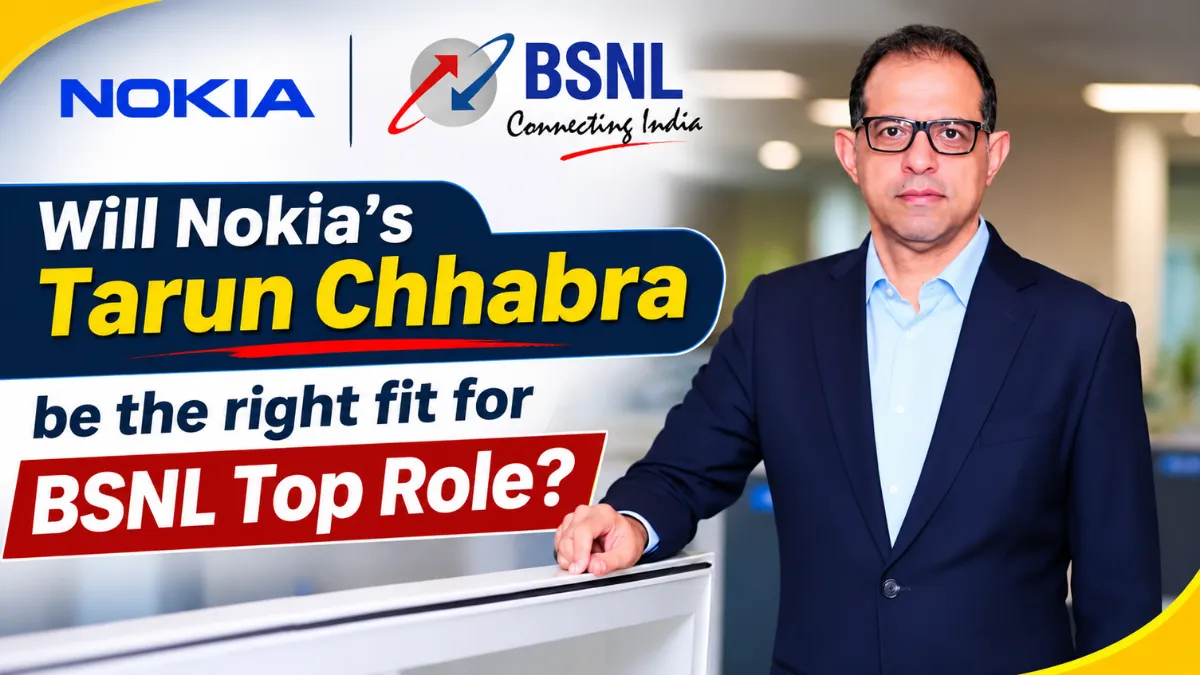
The Tarun Chhabra BSNL CMD 2026 story moved a step closer to a decision this month, with reports saying a five-member Search-cum-Selection Committee (SCSC) has chosen the Nokia executive to be Chairman and Managing Director (CMD) of Bharat Sanchar Nigam Limited (BSNL). The Appointments Committee of the Cabinet (ACC) must still approve the name, and no formal order has been issued as of 22 November 2026. If it goes through, BSNL would get a CMD from the private sector for the first time, ending more than two years of interim charge.
For BSNL’s roughly 50,000 employees, the question is less about Nokia and more about timing. They are waiting for a wage revision pending since 2017, their unions deferred a nationwide strike only on 19 November, and the company lost ₹1,532 crore in the September quarter alone. Whether an outsider can change that picture is the debate now running through BSNL offices, union circulars and former officers’ interviews.
📌 Read More: BSNL Strike Postponed 2026: Unions Pause 20 November Walkout as DoT Agrees
Table of Contents
Tarun Chhabra BSNL CMD 2026: Key Facts
| Particulars | Details |
|---|---|
| Post | Chairman and Managing Director (CMD), BSNL |
| Reported selection | Tarun Chhabra, Nokia executive, by the SCSC |
| Final approval | Appointments Committee of the Cabinet (ACC) – [Check official notification] |
| Current head | A Robert J Ravi (ITS 1990), additional charge since July 2024 |
| Ravi’s extension | Reportedly till 15 January 2027 |
| Employees affected | About 50,000 BSNL employees and officers (as per the source report) |
The table shows a selection, not an appointment. Until the ACC clears the file, everything written about Chhabra’s tenure is an expectation, and this article treats it that way.
Join WhatsApp
Join NowJoin Telegram
Join NowBSNL CMD Appointment: How a Private-Sector Name Reached the Top of the List
The road to this point has been long. The Public Enterprises Selection Board (PESB) interviewed about ten candidates on 27 March 2025 and found none suitable, which pushed the job to a Search-cum-Selection Committee headed by the PESB chairman. In June 2026, the Department of Telecommunications (DoT) invited applications from both government and private-sector candidates. Two members of the five-member committee come from the private sector, according to the ETTelecom report on the selection.
The eligibility terms, as reported, set an age band of 45 to 59 years and required a private-sector applicant to have held a board-level, whole-time position in a company with average annual turnover of at least ₹2,000 crore. The pay scale listed is ₹80,000 to ₹1,25,000. Those conditions explain why senior executives at large telecom vendors qualified, and why the search was widened in the first place.
The timing is not coincidental. BSNL has run on interim charge since July 2024, while it deployed a 4G network at scale and pushed towards 5G. A company spending that much on technology without a permanent head was always going to face pressure to fill the chair.
That matters because the government has opened the top job beyond its own service cadre, and the committee has reportedly used that freedom.
Who Is Tarun Chhabra, the Nokia Executive Behind the BSNL Private Sector CMD Call?
A Press Information Bureau (PIB) release dated 11 August 2025 listed Chhabra as Country Head of Nokia India. Some reports now call him Nokia’s Chief Technology Officer, while others, including the article that prompted this piece, describe him as a former Nokia executive. We have not found an official confirmation of his current designation, so treat the title as unverified.
What is clear is his background. He comes from the business-to-business side of telecom, selling and supporting network equipment to operators rather than serving millions of consumers directly. Nokia was also one of BSNL’s long-standing equipment partners before the company shifted to indigenously designed gear for its 4G network.
Critics read that history as a reason for caution. Supporters read it as proof that he understands how operators buy, deploy and pay for networks. Neither reading settles the question, because BSNL’s problems sit in procurement, pay and service quality at least as much as in technology.
In short, his résumé tells employees what he knows, not how he will behave with a workforce he has never managed.
BSNL Employees News: Fear, Hope and a Wait-and-Watch Mood
Reaction inside BSNL has been sharp and divided. Some employees, speaking anonymously, say a private-sector appointment cuts against the Atmanirbhar Bharat (self-reliance) idea the government attaches to BSNL. Others say an executive who has handled contracts and commercial negotiations could speed up decisions that now take months.
Former officials split along similar lines. PK Jain, a former president of the Indian Telecom Services Association (ITSA), told ETTelecom that an outsider lacks domain knowledge and will lean heavily on subordinates. RK Upadhyay, a former BSNL chairman, argued that an Indian Telecommunications Service (ITS) officer understands how government departments work, and BSNL deals with them constantly.
Ravi Shil Verma of the All India Graduate Engineers and Telecom Officers Association (AIGETOA), a Bhartiya Mazdoor Sangh-affiliated body, took a middle path. He said private telecom experience could improve service quality, but the new head must adapt to the rules of a wholly government-owned company. Mahadev Adasul of the Sanchar Nigam Executives Association (SNEA) said the competent authorities in the DoT are better placed to judge the CMD’s output, while the unions will keep pursuing members’ issues.
📌 Employees have heard management promises before. Our earlier report on how BSNL employees accused management of double standards shows why trust, not technology, is the scarce resource.
The mood, then, is neither welcome nor rejection. It is a wait for evidence.
The BSNL 3rd PRC Wage Revision Test Chhabra Cannot Dodge
Here the analysis gets uncomfortable for any new CMD. The Third Pay Revision Committee (PRC) recommendations for BSNL have been pending since 2017, and unions say officers’ scales were last revised about a decade ago. Employees want a 15% fitment and arrears from 1 January 2017. A wage agreement was signed between unions and management in October 2025 and sent to the DoT, but approval has not come, and the unions say the present agreement lapses in December.
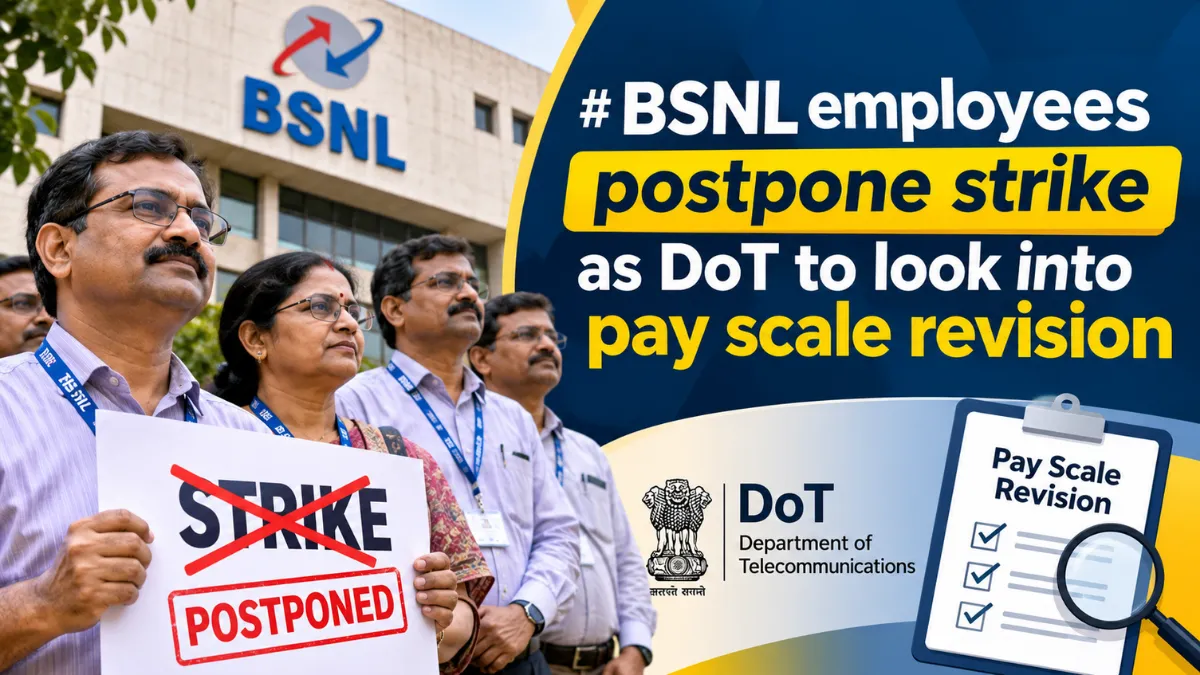
The All Unions and Associations of BSNL (AUAB) planned a one-day nationwide strike for 20 November 2026. After a conciliation hearing before the Deputy Chief Labour Commissioner on 19 November, it deferred the strike and gave the DoT 20 days to obtain approval, which falls around 9 December 2026 if counted from that hearing. The AUAB has said it will restore the strike if approval does not arrive.
Take a purely illustrative example. A 15% fitment on a basic pay of ₹40,000 would add ₹6,000 per month, before arrears. That is the scale of what a delayed decision costs a single employee every month, which is why unions will judge the new CMD first on this file.
What the appointment does not settle is who decides. The wage revision needs DoT approval, and reports point to an affordability condition tied to a public sector company’s profit record, which BSNL does not meet. A CMD can push the proposal hard, but he cannot approve it alone.
Whether he can make the case to the DoT is likely to define his first 100 days.
Can He Fix the Business? BSNL 4G 5G Rollout, Losses and the ARPU Gap
The business case for an outsider rests on numbers like these. BSNL’s consolidated net loss for the September 2026 quarter was ₹1,532 crore, against ₹1,106 crore a year earlier, which is a rise of about 38.5%. That works out to roughly ₹17 crore lost every day. Revenue from operations fell 4.1% to ₹5,032 crore while expenses rose 8.8% to ₹7,732.7 crore, so spending ran ₹2,700 crore ahead of income.
The sharpest gap is in average revenue per user (ARPU). BSNL earned about ₹108 per user in the quarter, against ₹218.8 at Reliance Jio, ₹198 at Vodafone Idea and ₹271 at Bharti Airtel. A Jio subscriber, in other words, brings in roughly double what a BSNL subscriber does. In wireless subscribers, the three private operators together held 92.74% in September 2026, against 7.26% for BSNL and Mahanagar Telephone Nigam Limited (MTNL) combined, according to the Telecom Regulatory Authority of India (TRAI).
On the network, the government told Parliament that 97,906 sites had 4G equipment as of 28 February 2026, of which 96,103 were operational. A Tata Consultancy Services-led consortium is behind the indigenous rollout. A report from August 2026 says BSNL has proposed about ₹77,000 crore of capital expenditure over five years to add 200,000 4G sites, expand 5G and reach operating break-even by FY29. Experts quoted in the source article also note that the 700 MHz band offers coverage, not capacity.
None of this is a technology problem a new CMD solves alone. Procurement delays, which Upadhyay says make BSNL’s buying process slow even when due diligence is maintained, and the gap between plans and field execution are management problems. That is exactly where an executive from outside the system could add value, or stumble.
BSNL Privatisation Fear or Fresh Thinking? What the Government Has Said
Some employees fear the appointment is a first step towards privatisation. The government has said otherwise. Scindia told the Lok Sabha on 18 March 2026 that there is no question of privatising BSNL and that it will remain a public enterprise. He has also ruled out foreign vendors in BSNL’s 5G rollout, which keeps the indigenous technology policy intact.
Read alongside that, the choice of a Nokia executive looks like a management hire, not an ownership signal. A CMD runs the company, but ownership changes need Cabinet decisions, and none has been announced. Employees are right, though, to ask about safeguards, because a former equipment-vendor executive will draw scrutiny whenever BSNL buys from suppliers.
⚠️ Employees should separate two questions: who runs BSNL, and who owns it. The first may change soon. On the second, the only official position on record says nothing is changing.
What a Private-Sector CMD Means for You as a BSNL Employee
If you work in BSNL, the appointment does not change your pay or service conditions on its own. Your scale, your pending increments and your promotion cycle remain governed by existing rules until the DoT and the board decide otherwise. You do not need to apply for anything or change any paperwork because of this news.
If you are a non-executive employee stuck at the top of a 20-year-old pay scale, the revision file is your priority. The SNEA says employees recruited after 2007 have not seen a revision at all, so watch whether the new CMD meets unions early and takes the wage file to the DoT in his first weeks.
If you are an officer, expect closer attention to performance and costs. BSNL’s first voluntary retirement scheme in 2020 took out about 80,000 employees, and unions opposed talk of another round, so the question of a second voluntary retirement scheme will return the moment cost-cutting is discussed. Ask your association for a clear position on it.
💡 One practical step: keep your service records, increment history and promotion papers up to date. They will matter in any wage settlement and any restructuring.
The catch is simple. Do not assume a private-sector CMD means either a pay windfall or job cuts, because neither follows from the appointment itself.
What Comes Next in the BSNL CMD Appointment
The ACC decision is expected within a couple of weeks, according to the report that prompted this article. If the committee approves, a formal order will name the CMD and the date he takes charge. Ravi’s additional charge currently runs to 15 January 2027, so the handover could happen before then.
Three dates matter for employees. The AUAB’s 20-day window with the DoT ends around 9 December 2026. The present wage agreement lapses in December. Parliament’s upcoming session is where AUAB leaders have asked MPs to raise the Third PRC and pension revision.
For readers tracking recruitment into the same company, the senior executive trainee recruitment shows how the next generation of BSNL managers is being hired. The new CMD will shape that pipeline too.
One note on scope. BSNL staff are covered by the public sector enterprise framework, so the 8th Pay Commission timeline for central government employees does not decide their wage revision.
Important Links
| Link | URL |
|---|---|
| Department of Telecommunications (official) | DoT official website |
| BSNL official website | bsnl.co.in |
| Scindia on no BSNL privatisation, 18 March 2026 | Business Standard report |
| BSNL Q2 FY27 results | Lapaas Voice report |
| CMD selection report | Hellobanker report |
Frequently Asked Questions
Who is Tarun Chhabra and why is he being named BSNL CMD?
Tarun Chhabra is a senior Nokia executive who was listed as Country Head of Nokia India in an August 2025 PIB release. Reports say the Search-cum-Selection Committee has finalised his name for BSNL CMD after the earlier PESB round found no suitable candidate. His current designation is reported differently across sources.
Is Tarun Chhabra officially appointed as BSNL CMD?
No. As of 22 November 2026, the committee has reportedly selected him, but the Appointments Committee of the Cabinet has not announced its approval. A formal order from the government is needed before he can take charge.
Will a private-sector CMD lead to BSNL privatisation?
There is no official sign of it. The Communications Minister told the Lok Sabha on 18 March 2026 that there is no plan to privatise BSNL. Choosing a CMD from the private sector changes who manages the company, not who owns it.
Will the new CMD get BSNL’s pending 3rd PRC wage revision approved?
Not by himself. The wage revision needs approval from the Department of Telecommunications, and reports point to an affordability condition linked to profit. A CMD can press the case, but the decision sits above him.
Who is BSNL’s CMD right now?
A Robert J Ravi, a 1990-batch Indian Telecommunications Service officer, holds additional charge as CMD since July 2024. Reports say his charge has been extended until 15 January 2027.
Why did unions defer the 20 November 2026 BSNL strike?
After a conciliation hearing on 19 November 2026, the All Unions and Associations of BSNL agreed to defer the strike and gave the DoT 20 days to get the Third PRC wage revision approved. The unions say they will restore the strike if approval does not come in that time.
Conclusion
Tarun Chhabra’s reported selection gives BSNL its first real chance in more than two years to have a permanent head, and its first outsider at the top. His private-sector experience may help with procurement, vendor negotiations and service quality. It cannot, on its own, deliver the wage revision employees have waited for since 2017 or close an ARPU gap of more than ₹100 per user.
The fair test is practical. Does he meet the unions early, push the pay file to the DoT, and show a plan for the 4G-to-5G transition that employees can believe? Bookmark Govtserviceinfo.com and join our Telegram channel for instant alerts on the ACC decision, BSNL pay revision orders and 8th CPC updates.
Disclaimer: This article is for general information and is based on media reports and sources available on 22 November 2026. The selection of Tarun Chhabra is not yet officially confirmed. Please verify details with the official DoT or BSNL notification before acting on them.