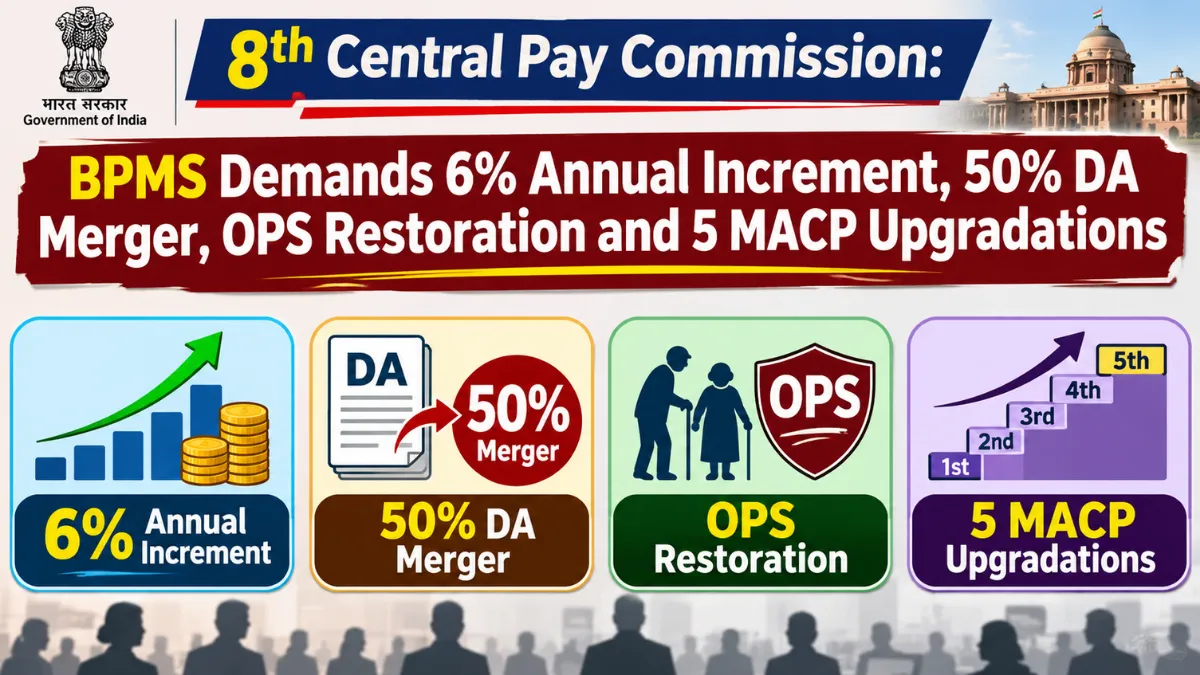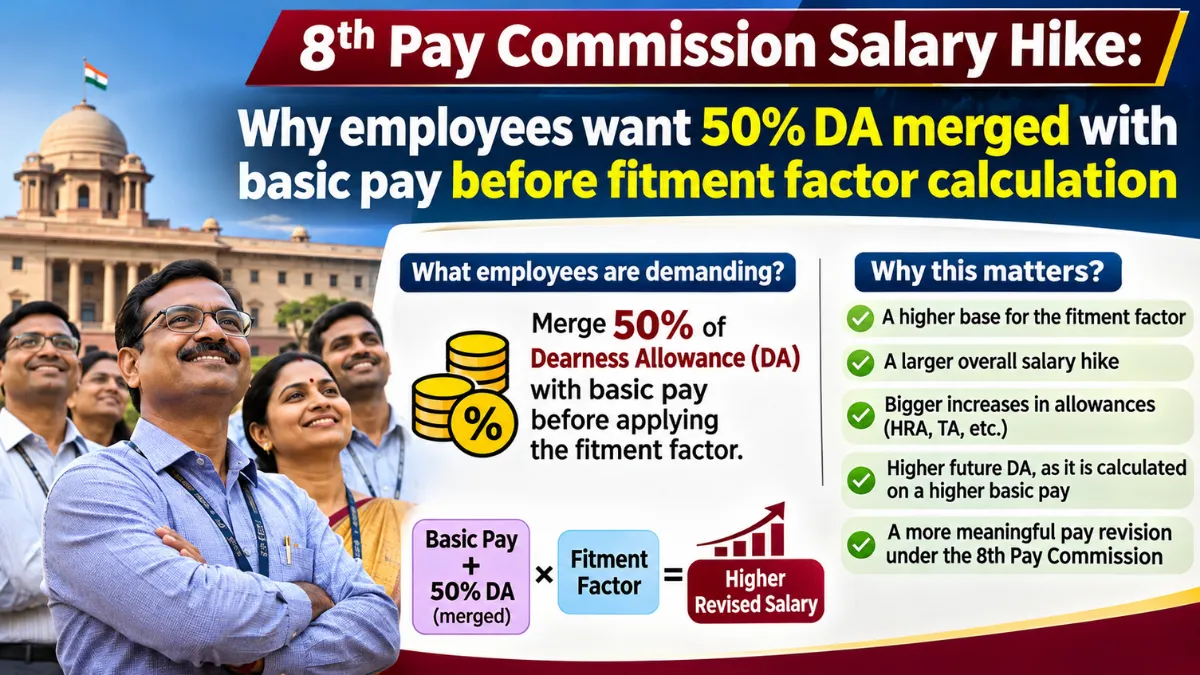
The 8th Pay Commission DA merger 2026 demand is easy to state: employee unions want 50% of Dearness Allowance (DA) added to basic pay before the fitment factor is applied to calculate new salaries. It is a demand, not a decision. The Government told the Lok Sabha on 1 December 2025 that it has no proposal to merge DA with basic pay, and the 8th Central Pay Commission (CPC) has not recommended anything on the subject yet.
The stakes sit in a single multiplication. DA now stands at 63% of basic pay, after the Cabinet approved a 3% hike on 28 October 2026 with effect from 1 July 2026. The order in which two numbers are combined can move a revised basic pay by tens of thousands of rupees, which is why this one demand dominates every union memorandum.
Join WhatsApp
Join NowJoin Telegram
Join NowTable of Contents
8th Pay Commission DA Merger 2026 – Key Facts
| Particulars | Details |
|---|---|
| The Demand | Merge 50% DA/DR with basic pay and pension before applying the fitment factor |
| Raised By | FNPO, NC-JCM, IRTSA and other employee bodies |
| Government Position | No proposal at present (Lok Sabha reply, 1 December 2025) |
| Current DA | 63% of basic pay from 1 July 2026 |
| 8th CPC Constituted | 3 November 2025 (Justice Ranjana Prakash Desai) |
| Report Due | Within 18 months, around May 2027 |
| Effective Date of Revision | [To be announced] |
What Unions Are Asking For – and Who Is Asking
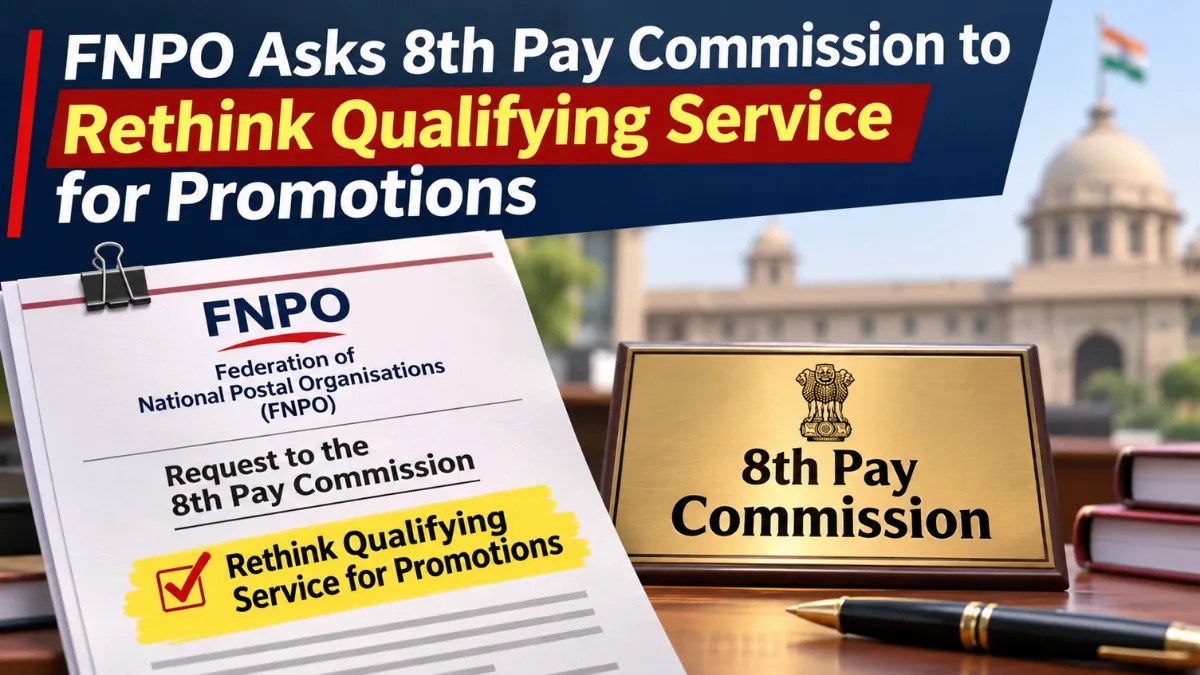
The Federation of National Postal Organisations (FNPO) wrote to Justice Ranjana Prakash Desai, Chairperson of the 8th CPC, seeking the merger of 50% DA and Dearness Relief (DR) with basic pay and pension from 1 January 2026. It framed this as interim relief, subject to final adjustment once the Commission reports. Its reasoning is that allowances and retirement benefits are calculated on basic pay, so an unmerged DA leaves real improvement stuck.
FNPO is not alone. The staff side of the National Council of Joint Consultative Machinery (NC-JCM) has pressed the same point within its wider list of nine key demands, and the Indian Railway Technical Supervisors’ Association (IRTSA) wants 50% DA merged before final calculations alongside a graded fitment factor between 2.92 and 4.38. The Maharashtra Old Pension Organisation has asked for merger at 50% and a minimum pay of ₹65,000 per month. FNPO’s broader pay demands go further, including a rule that a revised fitment factor follows within 90 days whenever DA touches 50%.
The logic is easy to follow. DA crossed 50% in January 2024 and has kept climbing, so unions argue the trigger point has long passed. For a Group C employee, that is not an abstract argument: it is the difference between a pay revision that catches up with prices and one that only appears to.
The Arithmetic Behind the Demand: Why Order of Operations Matters
The fitment factor is the multiplier that converts old basic pay into new basic pay in the revised pay matrix. The union demand changes what the multiplier is applied to. Take an employee with a basic pay of ₹18,000 (the Level 1 entry figure) and the 7th CPC factor of 2.57, purely as an illustration.
| Scenario | Calculation | Revised Basic Pay |
|---|---|---|
| A: Factor on unmerged pay | ₹18,000 × 2.57 | ₹46,260 |
| B: 50% DA merged, then 2.57 | (₹18,000 + ₹9,000) × 2.57 | ₹69,390 |
| C: 50% DA merged, lower factor | (₹18,000 + ₹9,000) × 1.71 | ₹46,170 |
Scenario B is the figure that circulates in viral posts, and it is also the one least likely to survive contact with a Finance Ministry. It nearly doubles the revised basic pay on the back of one extra step. Scenario C shows the other possibility: the merged base is bigger, but the Commission chooses a smaller multiplier, and the employee ends up almost where Scenario A leaves them.
That matters because the headline number alone tells you nothing. A merged base paired with a lower factor, or an unmerged base paired with a higher one, can land in the same place. What changes is everything calculated afterwards.
The 2004 Precedent and the 7th CPC’s 2.57 – What History Tells Us
Employee groups point to 2004, when the Government merged 50% of DA with basic pay, as proof the idea is not new. The comparison is attractive but incomplete. The 7th CPC’s factor of 2.57 already carried DA inside it: analysts reconstruct it as basic pay plus roughly 125% DA, which gives about 2.25, followed by an uplift of around 14%.
Read alongside that, the merger demand and a high fitment factor are not two separate wins. They are two routes to the same destination, and a Commission that agrees to one has reason to trim the other. Union leaders quoted in April 2025 reports said as much: a merger could lead to a lower factor, offset by higher allowances because those are computed on a larger base.
The timing is not coincidental. Unions are making the argument now, while the Commission is still collecting evidence, because the base on which the factor is applied is far easier to change before a figure is announced than after. There is also a practical point: when a new pay structure takes effect, DA is normally reset to nil in any case. So the real fight is over how much of the accumulated inflation catch-up is built into the new base.
What the Government Has Said – and the Viral Claim That Isn’t True
Minister of State for Finance Pankaj Chaudhary replied in writing to a Lok Sabha question from MP Anand Bhadauria on 1 December 2025. He said the Government currently has no proposal to merge DA with basic pay. In the same reply he confirmed that the 8th CPC was constituted by a resolution dated 3 November 2025.
A later claim made the rounds that a 50% DA merger from 1 January 2026 had been approved. According to a 25 October 2026 report, the 8th Pay Commission’s own verified social media account flagged the claim as fake and said no such order exists. Treat any “approved” message that does not cite an official order as false.
What the reply does not say is as important as what it does. It describes the Government’s position on the day it was given, not a ruling on what the Commission may recommend. Employees’ bodies have separately sought changes to the Commission’s terms of reference to cover merger explicitly, so the question stays open until the report arrives.
If You Are a Serving Employee or Pensioner, Here Is What This Means for You
Take a Level 6 employee drawing ₹35,400 basic pay. At today’s 63% DA, that employee receives ₹22,302 a month as DA on top of basic. If 50% DA were merged, the new base would be ₹53,100, and HRA, TA and future DA would all be computed on that larger figure. That is the case unions are making, and it is real money if it happens.
You do not need to file anything or apply for anything. The demand is being argued by unions and federations before the Commission, and no form, option or deadline attaches to it. The one thing you should avoid is planning a loan or a purchase around “merged base times 2.57” figures, because that combination double-counts DA.
Pensioners face the same logic with a different base. Pension is calculated as 50% of basic pay, so a higher revised basic lifts it directly, and FNPO has asked for DR to be merged with pension on the same footing. If you want to test scenarios yourself, the 8th CPC salary calculator lets you try different factors. Remember that every figure it returns is an estimate, not an order.
The Timeline: What to Watch Between Now and May 2027
The Commission has 18 months from 3 November 2025 to submit its recommendations, which puts the outer deadline around May 2027. Its memorandum window closed on 15 June 2026, and the Commission called that the final timeline. The Government has not confirmed any earlier submission date. A submitted report is also not an implemented one: the Government examines it first and fixes the effective date afterwards.
Until the report lands, DA continues under the existing formula and is revised twice a year, so the next revision falls due from 1 January 2027. In practice, that means employees will see one more DA step before the merger question is settled, and that step will itself change how large the merged amount would look.
Important Links
| What | Link |
|---|---|
| Ministry of Finance (official) | finmin.gov.in |
| Press Information Bureau (official) | pib.gov.in |
| Report on the Lok Sabha reply | Free Press Journal |
| FNPO letter on 50% DA merger | Upstox report |
Frequently Asked Questions
Has the government approved merging 50% DA with basic pay under the 8th Pay Commission?
No. The Government told the Lok Sabha on 1 December 2025 that it has no such proposal at present. The merger is a union demand before the 8th Pay Commission, and no DA merger takes effect unless the Commission recommends it and the Government accepts it.
What is the current DA rate for central government employees?
DA is 63% of basic pay from 1 July 2026. The Cabinet approved the 3% hike on 28 October 2026, raising it from 60%. Pensioners receive the same increase as Dearness Relief.
Will DA become zero when the 8th Pay Commission is implemented?
Under the usual procedure for a new pay commission cycle, DA is reset to nil and is built into the new pay structure. DA then restarts from zero on the revised basic pay. The exact treatment will be fixed only after the 8th CPC reports and the Government decides.
How does DA merger change the fitment factor calculation?
Merging DA first means the fitment factor is applied to a larger base, such as basic pay plus 50% DA. If the factor stays at 2.57, the result is much higher. If the Commission lowers the factor to compensate, the final basic pay can end up close to what an unmerged calculation gives.
When will the 8th Pay Commission submit its report?
The Commission has 18 months from 3 November 2025, so the outer deadline is around May 2027. The Government has not confirmed any earlier date. Implementation is a separate decision taken after the report is examined.
Will pensioners get the benefit of DA merger?
Unions have asked that DR be merged with pension on the same terms as DA with basic pay. Since pension is linked to basic pay, any rise in revised basic pay would flow through to pension. No decision has been taken yet.
Conclusion
The 8th Pay Commission DA merger 2026 question will be settled by arithmetic, not slogans. Unions have a clear case for a larger base, the Government has said it has no proposal, and the Commission has until about May 2027 to weigh both. Until then, the safest reading is that merger and fitment factor will be decided together, not stacked.
Bookmark Govtserviceinfo.com and join our Telegram channel for instant alerts on DA hikes, pay revision orders, and 8th CPC updates.
Disclaimer: This article is based on a Lok Sabha written reply dated 1 December 2025, a Cabinet decision dated 28 October 2026, and published news reports. All figures in the worked examples are illustrative and not official. Govtserviceinfo.com is not affiliated with the Ministry of Finance or the 8th Central Pay Commission. Readers should verify current information from official government sources before acting on it.