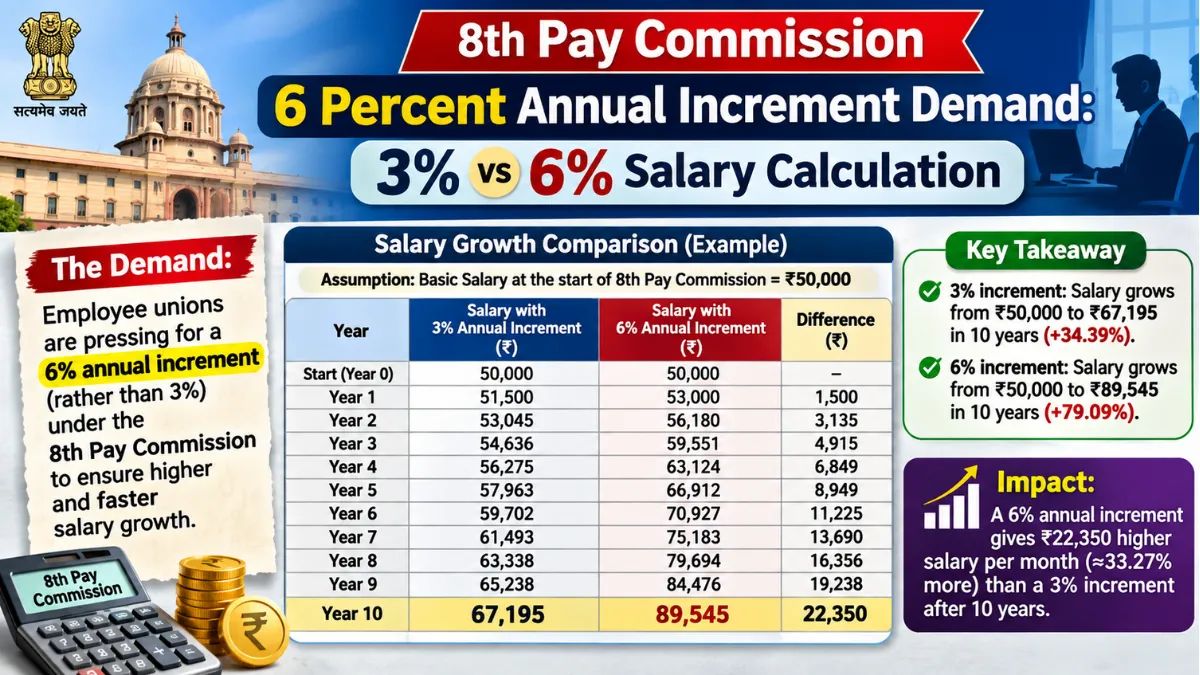
The 8th Pay Commission 6 percent annual increment demand has returned to the table. The Bharatiya Pratiraksha Mazdoor Sangh (BPMS), a federation of defence workers, has asked the commission to double the yearly increment on basic pay from 3% to 6%. Business Today reported on 25 November 2026 that BPMS placed its 73 proposals before the commission at a second-round interaction on 18 November 2026.
The demand is a proposal, not a decision. But the arithmetic shows why it draws attention: on an illustrative Pay Level 7 entry basic of ₹44,900, the 6% rate would leave an employee drawing ₹8,035 more per month than the 3% rate after five increments.
📌 Also Read: 8th Pay Commission 2026: Expected Salary, Fitment Factor, Pay Matrix & Latest News
Join WhatsApp
Join NowJoin Telegram
Join Now8th Pay Commission 6% Increment Demand – Key Facts
| Particulars | Details |
|---|---|
| Demand | Raise annual increment from 3% to 6% of basic pay |
| Demanded by | BPMS; the same rate is also sought by NC-JCM, AIDEF and FNPO |
| Placed before the commission | 18 November 2026 (second-round interaction, per Business Today) |
| Current rate | 3%, applied through the 7th CPC pay matrix |
| Status | Proposal only; not approved |
| Commission report | Reported to be due between February and May 2027 |
Why BPMS is demanding a 6% annual increment
BPMS argues that Dearness Allowance (DA) protects an employee against price rise, while the annual increment is the only assured way to improve real income during a pay cycle. In its draft memorandum, in April 2026, the federation called for the increment rate to go from 3% to 6%. Upstox reported that the 3% rate was standardised by the 6th Central Pay Commission (CPC), and reports say the federation considers it out of step with living costs and private sector pay.
The increment demand does not stand alone. BPMS has also asked for a minimum pay of ₹72,000 with a fitment factor of 4.0, a merger of 50% of DA with basic pay and pension, and restoration of the Old Pension Scheme (OPS). A higher increment would matter most to employees who stay in one pay level for years, because they have fewer promotions to lift their pay.
Existing annual increment under the 7th CPC
Central government employees get an annual increment of 3% of basic pay under the 7th CPC. In practice the pay matrix does the work: the employee moves to the next cell in the same pay level, which lands close to 3% but rarely exactly on it. Every figure in this article is a plain percentage calculation and will differ slightly from your actual matrix cell.
That gap matters when you check your own numbers. Use the 8th CPC salary calculator for a fitment-based estimate and your pay slip for what you are paid today.
Salary comparison at 3% and 6%
The table below uses a Pay Level 7 entry basic pay of ₹44,900 as the starting point. At 3%, the first increment is ₹1,347. At 6%, it is ₹2,694. Each later year applies the same percentage to the revised basic pay.
| Year | Basic pay at 3% (existing) | Basic pay at 6% (proposed) | Monthly gap |
|---|---|---|---|
| Starting basic | ₹44,900 | ₹44,900 | ₹0 |
| After year 1 | ₹46,247 | ₹47,594 | ₹1,347 |
| After year 2 | ₹47,634 | ₹50,450 | ₹2,816 |
| After year 3 | ₹49,063 | ₹53,477 | ₹4,414 |
| After year 4 | ₹50,535 | ₹56,685 | ₹6,150 |
| After year 5 | ₹52,051 | ₹60,086 | ₹8,035 |
Illustrative percentage calculations only, rounded to the nearest rupee. Actual increments under the 7th CPC follow the pay matrix. The 6% demand has not been approved.
⚠️ The starting figure is today’s pay level and does not include any 8th CPC fitment revision. If the commission recommends a higher fitment factor, the same percentage would apply to a larger base and the rupee amounts would rise for both rates.
Long-term impact on basic pay
The first-year gap is modest, at ₹1,347 a month. The gap widens every year because 6% compounds on a base that is already growing faster. By the fifth year, basic pay at 6% is about 15% higher than at 3%, and the monthly difference is ₹8,035.
Add the monthly gaps for the five years and treat each as a full 12 months, and the difference in basic pay received comes to about ₹2.73 lakh over the period. That figure excludes DA, House Rent Allowance (HRA) and any other pay component that moves with basic pay, so the effect on gross pay would be larger.
Over a full career the effect grows sharply. Pure compounding at 3% multiplies basic pay by about 2.4 over 30 years, while 6% multiplies it by about 5.7. A real career will not follow that path, since actual increments follow the pay matrix and promotions move employees between levels. The comparison still shows the scale of what the demand asks for, and why the cost to the exchequer is the central question.
Who else wants a higher increment
BPMS is one of several bodies. Other proposals reported so far:
| Organisation | Proposed annual increment |
|---|---|
| BPMS | 6% |
| NC-JCM (Staff Side) | 6% |
| AIDEF and FNPO | 6% |
| IRTSA | 5% |
| All India NPS Employees Federation | 7% |
The Staff Side of the National Council-Joint Consultative Machinery (NC-JCM) made the 6% case in its April 2026 memorandum, according to Business Today. Our report on the NC-JCM key demands covers the Staff Side’s wider list. The Indian Railways Technical Supervisors Association asked for 5% in its memorandum to the 8th CPC. When several unions converge on one number, the commission is likely to examine it closely, though that is no indication of what it will recommend.
If you are a central government employee, here is what this means for you
Nothing changes in your pay today. The 3% increment continues until the government accepts a new rate, and any change would come only after the commission submits its report and the Union Cabinet approves it.
If you are at an entry or mid-level pay band with few promotion chances, you are the group a higher increment helps most. Keep your pay level and current basic pay handy, run them through the DA calculator and the salary calculator, and compare scenarios rather than relying on a single headline figure.
Will the 8th Pay Commission accept the proposal?
No one outside the commission can say. The commission has not published any view on the increment rate, and no official statement on the 6% demand has been reported. Previous pay commissions have kept the increment at 3%, and a doubling would raise the government’s wage bill every year.
What is clear is that the demand has company. Unions with different memberships have asked for 5% to 7%, which makes some increase in the rate a live topic in the consultation.
Latest official status
The 8th Pay Commission was constituted on 3 November 2025 under Justice Ranjana Prakash Desai and has 18 months to submit its report. Reports point to a submission window between February and May 2027. The commission is still holding consultations, and reports describe the demands before it as proposals that are not binding. Read our 8th Pay Commission timeline for the schedule as it develops.
Important Links
| Link | URL |
|---|---|
| BPMS draft memorandum | 8th CPC draft memorandum by BPMS |
Frequently Asked Questions
What is the 6 percent annual increment demand in the 8th Pay Commission?
BPMS has asked the 8th Pay Commission to raise the yearly increment on basic pay from 3% to 6%. NC-JCM, AIDEF and FNPO have asked for the same rate. It is a demand placed before the commission and has not been approved.
What is the current annual increment rate for central government employees?
The rate is 3% of basic pay under the 7th CPC. It is applied through the pay matrix, so the employee moves to the next cell in their pay level, and the actual rupee amount can differ slightly from an exact 3%.
How much more salary will a 6% annual increment give than 3%?
On an illustrative Level 7 entry basic of ₹44,900, the gap is ₹1,347 a month after the first increment and ₹8,035 a month after the fifth. This is a plain percentage calculation and does not follow the pay matrix, so your actual figure will differ.
Has the government approved a 6% annual increment?
No. The 8th Pay Commission is still consulting and has not submitted its report. Any change to the increment rate would need the commission’s recommendation and approval from the Union Cabinet.
When will the 8th Pay Commission submit its report?
The commission was constituted on 3 November 2025 and has 18 months to report. Media reports point to a submission between February and May 2027. Implementation dates will be decided by the government after that.
Conclusion
The 6% proposal is one of the simplest demands before the 8th Pay Commission, and one of the costliest if accepted. The five-year table shows how quickly a higher rate separates two employees who start on the same pay. Track the commission’s consultation schedule, and check your own pay level in the salary calculator so you know what each scenario would mean for you.
Disclaimer: This article is for general information and is based on media reports and union memoranda available on the date of writing. The salary figures are illustrative percentage calculations, not official projections. Please verify details with the official notification or your department before acting on them.