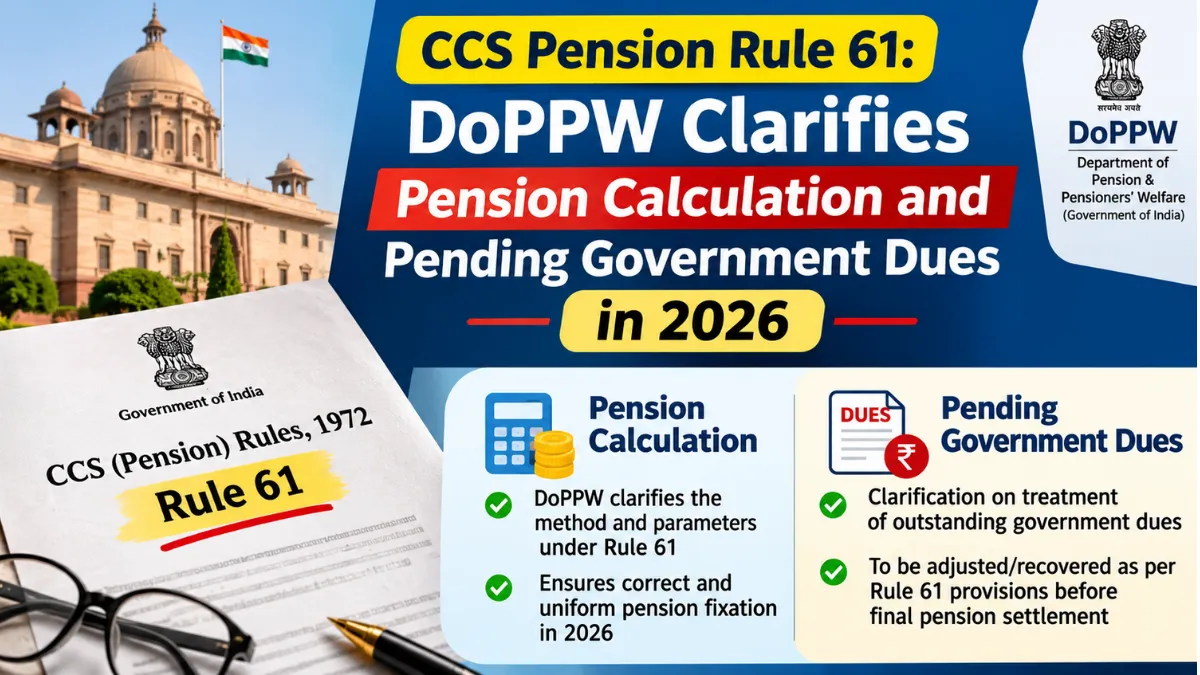
CCS Pension Rule 61 is back in focus after the Department of Pension and Pensioners’ Welfare (DoPPW) told all Ministries and Departments to follow it strictly. An Office Memorandum (OM) dated 26 October 2026 reminds them of the Central Civil Services (Pension) Rules, 2021.
If something affecting an employee’s pension happens after the pension case has gone to the Accounts Officer, the Head of Office must report it promptly. The same applies to extra government dues found after the first submission.
Track every open notification & never miss a deadline
The memorandum does not introduce a new pension formula, change pension rates or add retirement benefits. It matters most to Central Government employees close to retirement, because a missed update can delay or distort their pension and gratuity.
📌 Also Read: Life Certificate 2026: 30 November Deadline and Six Ways to Submit
📌 Also Read: 8th Pay Commission 2026: Expected Salary, Fitment Factor, Pay Matrix & Latest News
Join WhatsApp
Join NowJoin Telegram
Join NowTable of Contents
DoPPW Pension Clarification 2026: Key Highlights
| Particulars | Details |
|---|---|
| Issuing department | Department of Pension and Pensioners’ Welfare |
| Office Memorandum number | 11/1/2025-P&PW(H)-I |
| Date of issue | 26 October 2026 |
| Earlier memorandum | 31 October 2025 |
| Applicable rules | CCS (Pension) Rules, 2021 |
| Relevant provision | Rule 61 |
| Who is covered | Central Government civil employees under the CCS Pension Rules |
| Responsible authority | Head of Office |
| Change in pension rates | No |
| Official website | doppw.gov.in |
What Is Rule 61 of the CCS Pension Rules, 2021?
Rule 61 covers what happens after a pension case has been forwarded to the Accounts Officer. It requires the Head of Office to report later changes in pension entitlement and any additional government dues.
Pension papers are usually prepared months before retirement, and facts can change in that gap. An employee may receive a retrospective pay fixation order, a service record may be corrected, or the department may find dues it had not reported earlier. Each of these can change the pension or gratuity payable.
Without Rule 61, processing could carry on with outdated information.
What Does the DoPPW Office Memorandum Dated 26 October 2026 Say?
The memorandum refers back to the department’s instructions of 31 October 2025 under the same file number and repeats two requirements under Rule 61.
1. Reporting Changes Affecting Pension Entitlement
Under Rule 61(1), if an event affecting admissible pension occurs after the documents were sent under Rule 60, the Head of Office must tell the Accounts Officer without delay.
Depending on the facts and the applicable rules, such events could include:
- Retrospective pay fixation affecting pensionable emoluments.
- Correction of qualifying service details.
- Changes to the retirement date.
- Errors in the pension calculation sheet.
- Other authorised changes affecting pension entitlement.
These are illustrations of where Rule 61 may apply. The memorandum itself does not list them.
2. Reporting Additional Government Dues
Rule 61(2) covers dues found after the department has already sent the initial details to the Accounts Officer under Rule 60(2). The Head of Office must report them promptly so the Accounts Officer can act under the applicable recovery provisions.
All Ministries and Departments must pass these instructions to the officials who handle pension cases, including those in attached and subordinate offices.
Difference Between Rule 60 and Rule 61 of CCS Pension Rules
Rule 60 governs the first forwarding of the pension case. Rule 61 governs what comes after.
| Provision | Purpose |
|---|---|
| Rule 60(1) | Forwarding pension forms, calculation sheets and service records |
| Rule 60(2) | Communicating assessed government dues and gratuity withholding details |
| Rule 61(1) | Reporting later events affecting pension entitlement |
| Rule 61(2) | Reporting additional dues found after the first submission |
| Rules 67 to 69 | Assessment, adjustment and recovery of government dues |
Rule 61 does not decide how much pension an employee gets or how a particular due is recovered. Other provisions of the CCS Pension Rules handle both.
Does Rule 61 Change the Central Government Pension Calculation Formula?
No. The October 2026 memorandum leaves the existing formula untouched.
Under Rule 44 of the CCS (Pension) Rules, 2021, an employee eligible for full pension is generally entitled to 50% of emoluments or average emoluments, whichever is more beneficial, subject to the applicable limits and conditions. Pension for shorter qualifying service is proportionate.
For an eligible employee with pensionable emoluments of ₹78,800, the illustrative basic pension would be:
Basic pension = ₹78,800 × 50% = ₹39,400 per month
Dearness Relief (DR) and other admissible benefits are calculated separately. Rule 61 comes into play only if a later development changes the basis of this calculation.
Pension Calculation Example: Pay Fixation After Submission of Pension Papers
Take a Central Government employee whose pension papers were forwarded to the Accounts Officer on pensionable emoluments of ₹78,800. Before retirement, an authorised retrospective pay fixation raises the relevant emoluments to ₹81,200.
Assuming the revised emoluments are admissible and the employee meets all eligibility conditions, the calculation changes as follows:
| Particulars | Original calculation | Revised calculation |
|---|---|---|
| Pensionable emoluments | ₹78,800 | ₹81,200 |
| Applicable pension rate | 50% | 50% |
| Monthly basic pension | ₹39,400 | ₹40,600 |
| Monthly difference | Not applicable | ₹1,200 |
| Annual basic pension difference | Not applicable | ₹14,400 |
Here the Head of Office must report the pay revision to the Accounts Officer, who can then examine the revised entitlement under the applicable rules. A missed report could leave the employee on the lower figure.
These figures are illustrative. They are not a pension increase announced by DoPPW or the 8th Pay Commission.
What Are Government Dues Under CCS Pension Rules?
Government dues are recoverable amounts outstanding against an employee that must be dealt with under the retirement settlement provisions. Rules 67, 68 and 69 of the CCS (Pension) Rules, 2021 govern their assessment and recovery.
Examples may include:
- Unpaid licence fee for government accommodation.
- Recoverable government advances.
- Established overpayments of pay or allowances, where recovery is legally permissible.
- Electricity, water or other charges for government accommodation.
- Other dues that fall within the relevant rules.
Whether a due is recoverable, and how, depends on its nature and the applicable legal provisions. A disputed or unverified amount is not automatically a recoverable due just because it has been reported under Rule 61.
Can Pending Government Dues Be Deducted From Pension?
The October 2026 memorandum does not give a general power to deduct dues from monthly basic pension.
Under the applicable provisions, assessed dues may ordinarily be adjusted against retirement gratuity. Government accommodation dues fall under specific recovery provisions in Rule 68, which may allow recovery from Dearness Relief in prescribed circumstances. Rule 61 sets only the reporting requirement; the authority and method of recovery come from elsewhere.
Example of Additional Government Dues Affecting Gratuity
Suppose an employee’s gross retirement gratuity is ₹15 lakh and the department first reports recoverable dues of ₹20,000. After the papers are forwarded, another recoverable amount of ₹10,000 turns up.
| Particulars | Amount |
|---|---|
| Gross retirement gratuity | ₹15,00,000 |
| Initially reported government dues | ₹20,000 |
| Subsequently identified dues | ₹10,000 |
| Total recoverable dues | ₹30,000 |
| Illustrative net gratuity | ₹14,70,000 |
The Head of Office must report the extra ₹10,000 to the Accounts Officer. The table assumes both amounts were properly assessed and are legally recoverable from gratuity. Actual payment can differ because of recoveries and individual service conditions.
Responsibilities of the Head of Office Under Rule 61
The Head of Office keeps the pension case accurate after the forms have gone. In practice, that means five things.
| Responsibility | Required action |
|---|---|
| Pension-related developments | Identify and promptly report relevant changes |
| Pay or service corrections | Communicate anything affecting pension entitlement |
| Additional government dues | Report newly identified recoverable amounts |
| Pension processing | Coordinate with the Accounts Officer |
| Departmental compliance | Bring Rule 61 to the notice of pension-processing staff |
The memorandum sets no numerical deadline. It asks for prompt communication in both situations.
What Should Central Government Employees Check Before Retirement?
The reporting duty sits with the Head of Office, but you can cut the risk of errors by checking your own file before retirement. Look at:
- Personal and service details in your service book.
- Basic pay and any pending pay fixation orders.
- Qualifying service used for the pension calculation.
- Pending promotion or MACP-related pay revisions.
- Outstanding government advances and accommodation dues.
- The pension and gratuity calculation sheets.
- Whether recent changes have reached the Pay and Accounts Office.
If you spot an error after your papers have been forwarded, write to your establishment or administrative section and attach supporting documents. You can also ask for confirmation that the matter has been communicated to the Accounts Officer.
Pensioners and retirees who want a broader picture of pension services can read the Dirghayu app and CPAO pensioners guide.
What Happens If an Error Is Discovered After the PPO Is Issued?
The Pension Payment Order (PPO) authorises pension payment on the sanctioned entitlement. If you find an error in pay, qualifying service or entitlement after the PPO is issued, approach the concerned department for examination and correction.
Depending on the correction, the competent authority may need to sanction a revised pension or issue a corrigendum PPO. Rule 61 covers reporting before that stage and does not replace the separate rules on revising pension after authorisation.
Pensioners with unresolved complaints can also use the Centralised Pension Grievance Redress and Monitoring System (CPENGRAMS) on the Pensioners’ Portal.
Who Is Covered by the DoPPW Clarification?
The instructions apply to Central Government civil employees under the CCS (Pension) Rules, 2021, particularly those whose retirement cases are being processed. They also concern:
- Heads of Office.
- Establishment and administrative sections.
- Pay and Accounts Officers.
- Pension-processing officials.
- Ministries and their attached or subordinate offices.
Employees under the National Pension System (NPS), the Unified Pension Scheme (UPS), state government pension schemes or separate statutory arrangements should check the provisions of their own scheme. The NPS vs UPS comparison for 2026 and the explainer on which is better, UPS or NPS cover the main differences. The memorandum does not extend CCS pension provisions to every government or public sector employee.
Official Order and Important Links
| Document or resource | Link |
|---|---|
| DoPPW OM dated 26 October 2026 | Download scanned OM PDF |
| Earlier OM dated 31 October 2025 | Read earlier instructions |
| Department of Pension and Pensioners’ Welfare | Official website |
| Pensioners’ Portal | Visit website |
| Central Pension Accounting Office | Visit website |
Frequently Asked Questions
What is Rule 61 of the CCS Pension Rules, 2021?
Rule 61 requires the Head of Office to inform the Accounts Officer promptly about developments affecting pension entitlement, or additional government dues, that come to light after the pension documents were first submitted.
What is the date of the latest DoPPW memorandum on Rule 61?
The Office Memorandum with reference number 11/1/2025-P&PW(H)-I is dated 26 October 2026. It refers to an earlier memorandum dated 31 October 2025.
Has the government changed the pension calculation formula in October 2026?
No. The memorandum repeats an existing administrative requirement. It does not revise pension rates, eligibility or the calculation formula.
Does Rule 61 prescribe a 15-day reporting deadline?
No. Rule 61 asks for prompt reporting, and the October 2026 memorandum sets no separate 15-day deadline.
Can government dues be recovered from retirement gratuity?
Yes, where the applicable pension rules authorise recovery and the dues have been properly assessed.
Do employees need to submit a new pension form under Rule 61?
The memorandum prescribes no additional form. You may still need to give supporting documents if an individual correction or revision is being examined.
Is this clarification related to the 8th Pay Commission?
No. The memorandum deals with administering the existing CCS Pension Rules, 2021. It is not an 8th Pay Commission pension revision.
What Employees Should Do Next
If you are close to retirement, check that your latest authorised pay fixation, qualifying service and outstanding dues are correctly reflected in your pension records. If a relevant change occurs after your papers have been submitted, inform your administrative section in writing and ask for action under Rule 61 before the retirement settlement is finalised.
Disclaimer: This article explains the provisions of the CCS (Pension) Rules, 2021 and the DoPPW Office Memorandum dated 26 October 2026. Calculation examples are illustrative. Individual pension entitlement and recovery of government dues remain subject to applicable rules and verification by the competent authority.