
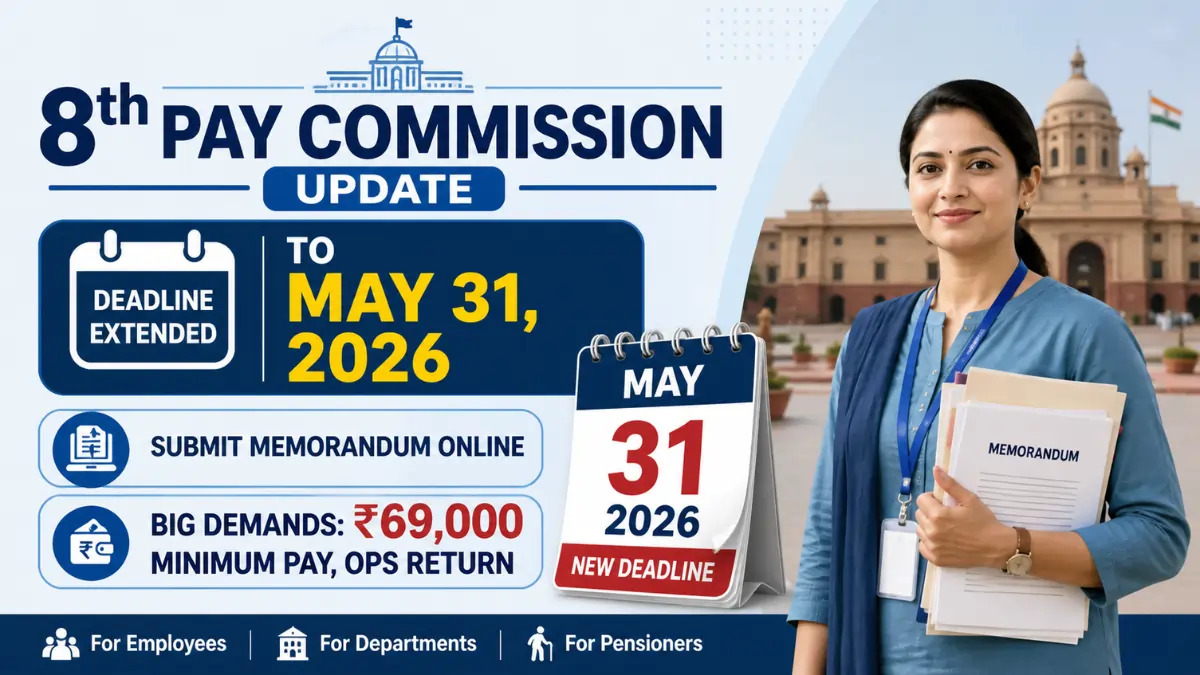
The 8th Pay Commission memorandum submission deadline has been officially extended to 31 May 2026 — giving central government employees, pensioners, and service associations an additional month to formally place their demands before the Commission. The earlier cutoff was 30 April 2026. For the roughly 50 lakh central government employees waiting for the next salary revision, this extension is more than an administrative convenience — it arrives at a moment when the Commission has entered active consultations with the largest staff body in the country.
The announcement came directly from the 8th Central Pay Commission’s (CPC) official website on 29 April 2026, just a day before the original deadline would have lapsed. The timing was not accidental.
Why the Deadline Was Extended — and Why It Matters That It Came from NC-JCM
The extension followed a crucial meeting held on 28 April 2026 between 8th CPC Chairperson Justice Ranjana Prakash Desai and representatives of the National Council – Joint Consultative Machinery (NC-JCM) Staff Side. The NC-JCM is the apex body representing central government employees during every Pay Commission cycle — it is the official collective voice through which employee concerns reach the Commission.
During that April 28 meeting, the NC-JCM formally requested the Chairperson to push the deadline from 30 April to 31 May 2026. The Commission agreed, and the updated date was published on the official portal within 24 hours. That the extension was granted on the heels of the first formal NC-JCM consultation is significant: it signals that the Commission is taking the staff side’s concerns seriously and is willing to create space for more detailed, structured submissions.
There was another practical reason behind the extension that the Commission did not officially spell out. As the 30 April deadline approached, the online submission portal experienced significant technical difficulties due to heavy traffic — a direct consequence of thousands of individuals and associations attempting to submit simultaneously. The one-month extension effectively resolves that bottleneck.
One Rule Has Not Changed: Online Only, No Exceptions
While the deadline has moved, the Commission has maintained a firm stance on the mode of submission. The 8th CPC website states clearly that all memoranda must be submitted through the designated online link on the official portal — physical submissions, hard copies, PDFs, and emails are not being considered under any circumstances.
This matters because several employee associations had separately requested that the Commission accept PDF and MS Word copies of their memoranda alongside the digital submission. That request was declined. The Commission’s position is that a single, structured online format ensures consistency and makes it easier to process the large volume of representations received from across the country.
⚠️ Important: If your association or federation has already submitted a memorandum via email or by post, that submission will not be counted. Only entries made through the official portal at 8cpc.gov.in will be acknowledged.
Who Can Submit a Memorandum to the 8th CPC?
The 8th Pay Commission has opened the memorandum process to a wide range of stakeholders — not just permanent central government employees. The following categories are eligible to submit representations, memoranda, or suggestions by 31 May 2026:
Industrial and non-industrial central government employees are eligible, as are All India Services officers, Defence Forces personnel, and employees posted in Union Territories. Officers and employees of the Indian Audit and Accounts Department, Judicial Officers of subordinate courts in Union Territories, and employees of the Supreme Court and High Courts in Union Territories can also participate. Members of Regulatory Bodies constituted by Acts of Parliament (excluding the Reserve Bank of India) may submit. Service associations and unions, central government Ministries and Departments, and pensioners and their associations are all within the eligible category.
💡 Tip: Individual employees can also submit suggestions separately from their associations. Even if your union has already filed a memorandum, you may submit your personal views through the online portal.
What NC-JCM Is Demanding — The Biggest Numbers on the Table
The NC-JCM formally submitted its 51-page memorandum to the 8th CPC on 14 April 2026, making it the most detailed and comprehensive demand document the Staff Side has produced for any Pay Commission. The headline numbers have attracted significant attention.
The NC-JCM has proposed a minimum basic pay of ₹69,000 per month — nearly four times the current minimum of ₹18,000 set by the 7th Central Pay Commission (CPC). To arrive at this figure, the Staff Side has proposed a fitment factor of 3.83, meaning every employee’s current basic pay would be multiplied by 3.83 to arrive at the revised figure. For context, the 7th CPC approved a fitment factor of 2.57. If ₹69,000 is accepted as the minimum, a Level 1 employee currently drawing ₹18,000 in basic pay would see that number climb to ₹69,000.
For a government employee at Pay Level 6 currently drawing a basic pay of ₹35,400, applying a 3.83 fitment factor would push the revised basic to approximately ₹1,35,582. That is the scale of revision the unions are demanding — and it would be the largest pay revision in the history of Indian central government service.
The NC-JCM memorandum goes beyond salary. It proposes an increase in the annual increment rate from the current 3% to 6%, two additional increments at the time of each promotion with a minimum financial benefit of ₹10,000, and five assured financial upgradations across a 30-year career — at 6, 12, 18, 24, and 30 years of service. The NC-JCM also demands a Higher Dearness Allowance (DA) revision formula and revised House Rent Allowance (HRA) rates of 40%, 35%, and 30% for X, Y, and Z category cities respectively.
The pension demand is equally ambitious. The NC-JCM is pushing for the complete withdrawal of the National Pension System (NPS) and the Unified Pension Scheme (UPS) in favour of the restoration of the Old Pension Scheme (OPS) for all employees recruited after 1 January 2004. This is the most politically sensitive demand in the memorandum, given that the government launched UPS on 1 April 2025 as what it considers a definitive resolution to the pension debate. Whether the 8th CPC recommends partial or full OPS restoration — or upholds UPS — will be one of the most consequential decisions of this Commission.
You can review the full structure of 8th CPC salary projections and pay matrix changes on our 8th Pay Commission salary hikes, fitment factor and pay matrix guide.
What This Means for You — If You Are a Central Government Employee
If you are a serving central government employee, this extension gives you — and your department’s service association — additional time to compile and submit a structured memorandum. The submission process requires responses to a specific set of questions through the portal, with a character limit of approximately 10,000 characters per field and an option to upload supporting documents.
If you are a pensioner or a member of a pensioners’ association, 31 May 2026 is your window to formally place pension-related demands before the Commission. This includes concerns about Dearness Relief (DR) revision, minimum pension floors, and the parity gap between pre-2016 and post-2016 retirees — issues that the NC-JCM has also raised in its memorandum.
If you are a member of a service union or federation, note that the Commission has held separate meetings with various employee bodies in Delhi from 28 to 30 April 2026. If your association has not yet been called for a meeting, the window for written submission remains open until 31 May 2026. Do not wait for a meeting invitation before submitting your memorandum.
You can use our 8th Pay Commission salary calculator to model what a 3.83 fitment factor would mean for your specific pay level — and to understand the potential gap between the union demand and a more conservative estimate.
The Portal Glitch Problem — and What It Signals
The technical difficulties experienced in the days before 30 April 2026 are worth noting. The online portal, which accepts structured submissions through a designated link, struggled under the volume of concurrent users as the original deadline approached. This is not simply an IT administration issue. It suggests that the level of participation in this memorandum process is unusually high — which in turn reflects the degree to which central government employees are invested in the outcome of the 8th CPC.
For employees and associations that attempted to submit and encountered errors, the 31 May extension effectively provides a clean second window. The Commission has not indicated any plans to accept submissions made outside the portal, so any failed or incomplete submission from April must be re-attempted through the official link.
What Comes Next — The 8th CPC Process After May 31
The memorandum submission phase is the first formal stage of the 8th Pay Commission’s consultation process, but it is far from the last. Once the 31 May 2026 deadline passes, the process will move through several additional phases. Department-wise and sector-specific consultations will follow — separate discussions are expected for Railways, Defence, Postal, Income Tax, and Audit & Accounts staff. The Commission will conduct field visits to high-risk workplaces and undertake a detailed analysis of the submitted memoranda before drafting its recommendations.
The 8th CPC was constituted on 3 November 2025. Pay Commissions in India typically take 18 to 24 months from constitution to the submission of a final report. This places the likely submission of the 8th CPC’s recommendations somewhere in the mid-to-late 2027 window, with implementation — if the government acts promptly — potentially in early 2026, though that would require an unusually fast turnaround. For a detailed look at where the Commission stands in its timeline, see our 8th Pay Commission timeline tracker.
The comparison to the 7th Pay Commission is instructive. The NC-JCM had demanded a fitment factor of 3.68 in 2015. The Cabinet approved 2.57. History suggests a gap between demand and approved outcome is the rule, not the exception. What the 8th CPC ultimately recommends will depend on the government’s fiscal position, the strength of the evidence presented by employee associations, and the Commission’s own assessment of affordability and equity.
You can also compare how NPS versus UPS will interact with the 8th CPC’s pension recommendations on our detailed NPS vs UPS comparison for 2026.
Frequently Asked Questions
What is the new deadline to submit memorandum to the 8th Pay Commission?
The revised deadline for submitting representations, memoranda, and suggestions to the 8th Central Pay Commission is 31 May 2026 (Sunday). The original deadline was 30 April 2026, which was extended following consultations with the NC-JCM.
How do I submit my memorandum to the 8th CPC?
All submissions must be made online through the designated link on the official 8th CPC website at 8cpc.gov.in. Physical copies, hard copies, PDFs, and emails are not being accepted by the Commission. Only structured online submissions through the specified portal link are eligible.
Can individual employees submit memoranda, or only unions?
Both individual employees and service associations or unions can submit memoranda to the 8th Pay Commission. Individual employees may submit their personal suggestions through the online portal independently of their union’s submission.
What is the NC-JCM’s proposed fitment factor for the 8th Pay Commission?
The National Council – Joint Consultative Machinery (NC-JCM) Staff Side has proposed a fitment factor of 3.83 in its memorandum dated 14 April 2026. This would fix the minimum basic pay at ₹69,000 per month. However, this is a union demand and not a government decision — the Cabinet will act on the Commission’s final recommendations, which may differ from the proposed figure.
Is the Old Pension Scheme (OPS) being restored under the 8th Pay Commission?
OPS restoration is a demand placed by the NC-JCM in its memorandum, not a confirmed government decision. The government launched the Unified Pension Scheme (UPS) in April 2025 as its current pension framework. Whether the 8th CPC recommends partial or full OPS restoration remains to be seen, and any change would require a government order.
What happens if I submitted a PDF or email before the deadline?
PDF and email submissions are not being considered by the 8th CPC. If you submitted via email or post before the extended deadline, that submission will not be counted. You must re-submit through the official online portal at 8cpc.gov.in before 31 May 2026.
When will the 8th Pay Commission submit its final report and salary revision take effect?
The 8th CPC was constituted in November 2025. Based on historical precedent, the Commission is expected to submit its final report by mid-to-late 2027, with implementation likely from 2026 onwards — though the exact timeline depends on when the Commission submits its recommendations and the government acts on them.
Conclusion
The one-month extension granted by the 8th Pay Commission is a meaningful step — but only for those who use it. If you are a central government employee, a pensioner, or part of a service federation that has not yet submitted its memorandum, the window until 31 May 2026 is your formal channel to be heard. Use the official portal at 8cpc.gov.in, submit within the structured format, and make sure your association files a complete, factual, and well-argued memorandum.
The NC-JCM’s demand for a ₹69,000 minimum pay and 3.83 fitment factor has set an ambitious benchmark. What the Commission finally recommends — and what the government approves — will define the financial lives of millions of central government employees for the next decade.
Bookmark Govtserviceinfo.com and join our Telegram channel for instant alerts on DA hikes, pay revision orders, and all 8th CPC updates as they happen.
Important Links
| Resource | Link |
|---|---|
| 8th CPC Official Website | 8cpc.gov.in |
| 8th Pay Commission 2026 — Full Overview | govtserviceinfo.com/8th-pay-commission-2026/ |
| 8th CPC Salary Calculator | govtserviceinfo.com/8th-cpc-salary-calculator/ |
| 8th Pay Commission Timeline | govtserviceinfo.com/8th-pay-commission-timeline/ |
| NPS vs UPS Comparison 2026 | govtserviceinfo.com/nps-vs-ups-comparison-2026/ |
Disclaimer: This article is based on official announcements from the 8th Central Pay Commission website and publicly available information from employee associations. The salary figures and demands cited reflect proposals submitted by the NC-JCM Staff Side and are not confirmed government decisions. Actual salary revisions will depend on the Commission’s final recommendations and subsequent government notification. Always refer to official government orders and the 8th CPC portal for verified information.


1 thought on “8th Pay Commission Memorandum Submission Deadline Extended to 31 May 2026 — What Every Government Employee Must Know”