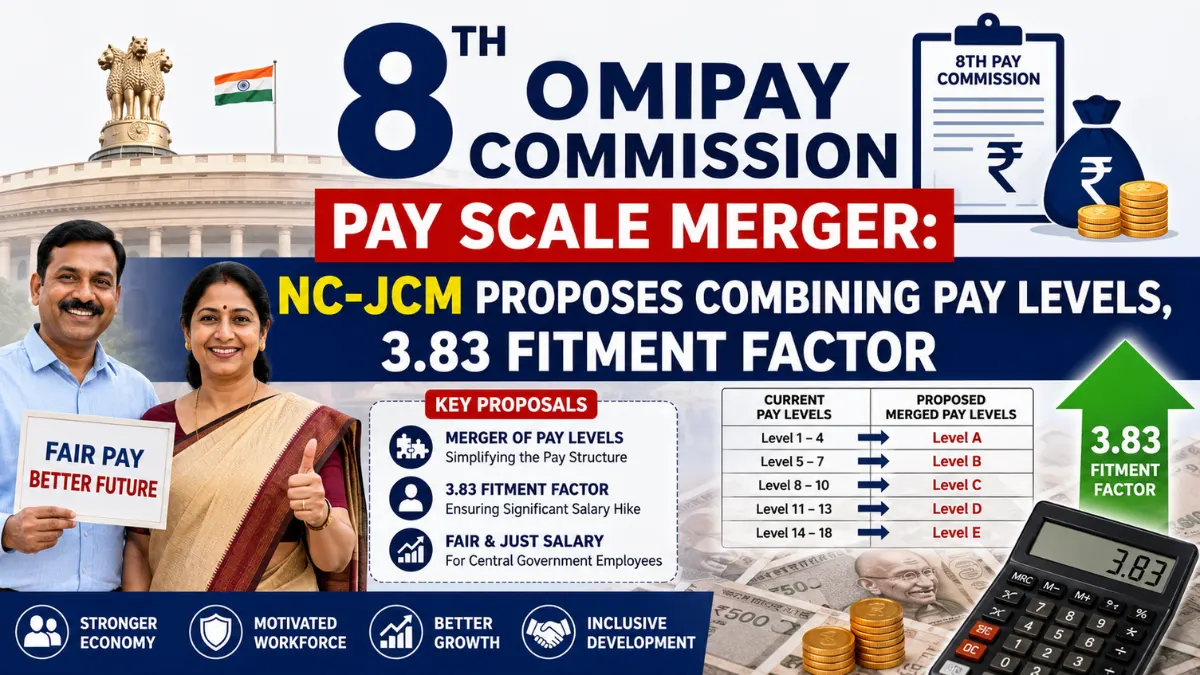
The 8th Pay Commission pay scale merger proposal has become the most talked-about demand of the current consultation cycle. The Staff Side of the National Council – Joint Consultative Machinery (NC-JCM), the apex body representing central government employees, has formally submitted a memorandum recommending that several existing pay levels be merged into single, wider bands — and that the resulting minimum salaries be calculated using a fitment factor of 3.833.
If accepted, the merger would collapse four separate pairs of pay levels and raise the minimum basic pay from ₹18,000 to roughly ₹69,000 at the entry level. That is not a small ask. It is, in fact, the boldest fitment-factor demand placed before any Pay Commission since salary structures were last overhauled in 2016 — and it lands at a moment when the 8th Central Pay Commission (8th CPC) is still deep in its consultation phase, with no interim decisions yet made.
📌Also Read: All A out 8th Pay Commission 2026 Expected Salary, Fitment Factor, Pay Matrix & Latest News
Table of Contents
8th CPC Pay Scale Merger — At a Glance
| Detail | Information |
|---|---|
| Proposing Body | NC-JCM Staff Side (apex central government employee union) |
| Submitted To | 8th Central Pay Commission |
| Levels Proposed for Merger | Level 2+3, Level 4+5, Level 7+8, Level 9+10 (plus Level 5 into Level 6 as a one-time measure) |
| Fitment Factor Demanded | 3.833 |
| Minimum Basic Pay Demanded | ₹69,000 (from current ₹18,000) |
| Status | Under consideration; no decision taken by the 8th CPC |
Why NC-JCM Wants Pay Levels Combined, Not Just Revalued
Every previous Pay Commission cycle has focused mainly on multiplying existing basic pay by a fitment factor — a straightforward revaluation. This time, NC-JCM has gone further, arguing that the current 18-level pay matrix itself is part of the problem.
The union’s reasoning is structural. With levels bunched close together, an employee who gets promoted from one level to an adjacent one often sees only a marginal jump in basic pay, since the two levels were never far apart to begin with. Merging levels widens that gap, so a promotion actually feels like a promotion. That is the logic behind combining Level 2 with Level 3, Level 4 with Level 5, Level 7 with Level 8, and Level 9 with Level 10 — plus folding Level 5 into Level 6 as a separate, one-time adjustment.
The Levels on the Table — What Actually Gets Merged
Under the proposal, an employee currently at Level 2 or Level 3 would sit on a single merged Level 3. Someone at Level 4 or Level 5 would move to a combined Level 5. Level 7 and Level 8 employees would be brought under Level 8, and Level 9 and Level 10 staff would fall under Level 10. Level 5, in a separate provision, would additionally be merged upward into Level 6 as a one-time correction.
In practical terms, this means an employee currently drawing the lower of any merged pair would be lifted to match the higher level’s pay band — not simply averaged between the two. That distinction matters, because it determines whether the merger is a genuine upgrade or a wash.
How Your Salary Changes If ₹69,000 and 3.83x Go Through
The headline figure is the minimum basic pay demanded for Level 1: ₹69,000, up from the current ₹18,000. That number comes directly from applying the 3.833 fitment factor NC-JCM has proposed.
Applying the same multiplier across the levels being merged gives an early sense of scale — though these figures remain entirely indicative until the 8th CPC issues its own recommendation.
| Pay Level (Current) | Current Minimum Basic Pay | Estimated Basic Pay at 3.833x |
|---|---|---|
| Level 1 | ₹18,000 | ₹69,000 (approx.) |
| Level 3 (post-merger with Level 2) | ₹21,700 | ₹83,176 (approx.) |
| Level 5 (post-merger with Level 4) | ₹29,200 | ₹1,11,924 (approx.) |
| Level 8 (post-merger with Level 7) | ₹47,600 | ₹1,82,451 (approx.) |
| Level 10 (post-merger with Level 9) | ₹56,100 | ₹2,15,033 (approx.) |
⚠️ These figures are calculated purely on the fitment factor NC-JCM has proposed. The 8th CPC has not confirmed any fitment factor, and the final number could land anywhere between the conservative estimates circulating (around 1.9x to 2.5x) and the union’s own ask. Treat this table as a scenario, not a forecast.
For a Level 6 employee drawing ₹35,400 basic pay today, even a more conservative fitment factor in the 2.5x range would push basic pay past ₹88,000 — before allowances. NC-JCM’s 3.833x demand would take the same employee closer to ₹1,35,700. That gap between the conservative estimate and the union’s ask is exactly what will be negotiated over the coming months.
The Other Ask Nobody’s Talking About — Doubling the Annual Increment
Buried inside the same memorandum is a second demand that could matter just as much over a career: raising the annual increment rate from the current 3% to 6%. Under the existing system, an employee’s basic pay grows by 3% every year regardless of pay level. NC-JCM wants that doubled, arguing that inflation has outpaced the current increment rate for years. You can read the union’s complete set of demands, including this one, in our detailed breakdown of NC-JCM’s full list of demands.
A doubled increment rate compounds. Over a 20-year career, the difference between annual 3% growth and annual 6% growth on basic pay is not marginal — it is the difference between a modest late-career salary and a substantially higher one. That is precisely why employee associations are pushing just as hard on this as they are on the fitment factor.
📌Also Read: 8th Pay Commission Chennai Puducherry Visit 2026
📌Also Read: 8th CPC Delhi Interaction Meeting 2026
A Proposal Is Not a Decision — Where the 8th CPC Actually Stands Right Now
It is worth being direct about where things stand: NC-JCM’s memorandum is a submission, not a settlement. The 8th Pay Commission, constituted on 3 November 2025 under the chairmanship of retired Supreme Court judge Justice Ranjana Prakash Desai, is still in an active consultation phase. As of late July 2026, the Commission had completed multiple rounds of regional meetings — including sessions in Kolkata, Bhubaneswar, Lucknow, Hyderabad, and Srinagar — gathering input from unions, pensioner bodies, and government departments across the country.
No interim recommendation on fitment factor, pay scale merger, or pension changes has been issued. The Commission’s 18-month mandate runs into 2027, and its final report is expected only after this full round of consultations concludes. Read alongside the government’s own MyGov feedback portal and the extended workforce-data submission deadline of 31 July 2026, the pattern is clear: this is still a data-gathering phase, not a decision-making one. Our 8th Pay Commission timeline tracks every milestone as the Commission moves through this process.
If You’re at Level 2, 4, 7, or 9 — What This Means for You
If your current pay level is one of those proposed for merger — Level 2, 4, 5, 7, or 9 — here is what matters in practice. You are not losing your level you are potentially being absorbed into the higher level of the pair, which would mean a bigger jump in basic pay than a straightforward fitment-factor revaluation alone would give you. You do not need to apply for anything or submit any request — this is a structural proposal that, if accepted, would apply automatically across the relevant cadres.
The catch is that nothing here is confirmed. Employees at these levels should treat the merger proposal as a strong possibility worth watching, not as an outcome to plan finances around just yet. You can estimate your own potential revised pay once the fitment factor is finalised using our 8th CPC salary calculator.
What Comes Next
The 8th CPC’s regional consultations are expected to continue through the second half of 2026, with more state visits planned. Once consultations conclude, the Commission will begin drafting its formal recommendations — a process that, going by the 7th CPC’s timeline, typically takes several more months before a report is submitted and the Cabinet takes it up for approval. Until then, expect more memoranda from other employee federations, each pushing their own version of the fitment-factor and pay-structure debate.
Frequently Asked Questions
What is the 8th Pay Commission pay scale merger proposal?
It is a recommendation submitted by NC-JCM Staff Side to merge several existing pay matrix levels into wider bands — combining Level 2 with 3, Level 4 with 5, Level 7 with 8, and Level 9 with 10 — alongside a demand for a 3.833 fitment factor.
Which pay levels will be merged under the NC-JCM proposal?
The proposal covers Level 2 and 3 (into Level 3), Level 4 and 5 (into Level 5), Level 7 and 8 (into Level 8), and Level 9 and 10 (into Level 10), with Level 5 also proposed to merge into Level 6 as a one-time measure.
What is the fitment factor demanded by NC-JCM?
NC-JCM has demanded a fitment factor of 3.833, which would raise the minimum basic pay for central government employees from ₹18,000 to approximately ₹69,000.
Has the government accepted the pay level merger proposal?
No. This is a memorandum submitted for the 8th CPC’s consideration. The Commission is still in its consultation phase and has not announced any interim decision on pay scale merger, fitment factor, or related matters.
When will the 8th Pay Commission implement the new pay matrix?
The 8th CPC was constituted on 3 November 2025 with an 18-month mandate, putting its final report timeline into 2027. Implementation would follow Cabinet approval after the report is submitted.
Will DA be merged with basic pay under the 8th CPC?
Some employee organisations have separately asked for accumulated Dearness Allowance (DA) to be merged with basic pay at implementation. The government has clarified there is currently no such proposal under active consideration.
Summing up…
The 8th Pay Commission pay scale merger proposal is the most structurally ambitious demand placed before the Commission so far — reshaping not just how much employees earn, but how the pay matrix itself is organised. Whether NC-JCM’s 3.833 fitment factor and merger structure survive the Commission’s deliberations is impossible to say this early. What is certain is that the debate over these numbers will only intensify as the 8th CPC moves closer to its final report. For a fuller picture of everything on the table, see our complete 8th Pay Commission guide.
Bookmark Govtserviceinfo.com and join our Social Media channel for instant alerts on DA hikes, pay revision orders, and 8th CPC updates.
Disclaimer: This article is based on media reports of the NC-JCM Staff Side memorandum submitted to the 8th Central Pay Commission, along with publicly available updates on the Commission’s consultation process as of late July 2026. All fitment factor and salary figures are indicative estimates based on the union’s proposal and are not official government figures. The 8th Pay Commission has not issued any final recommendation. Govtserviceinfo.com is not affiliated with the 8th Central Pay Commission or the Ministry of Finance. Readers should verify current information from official government sources before acting on any information published here.