
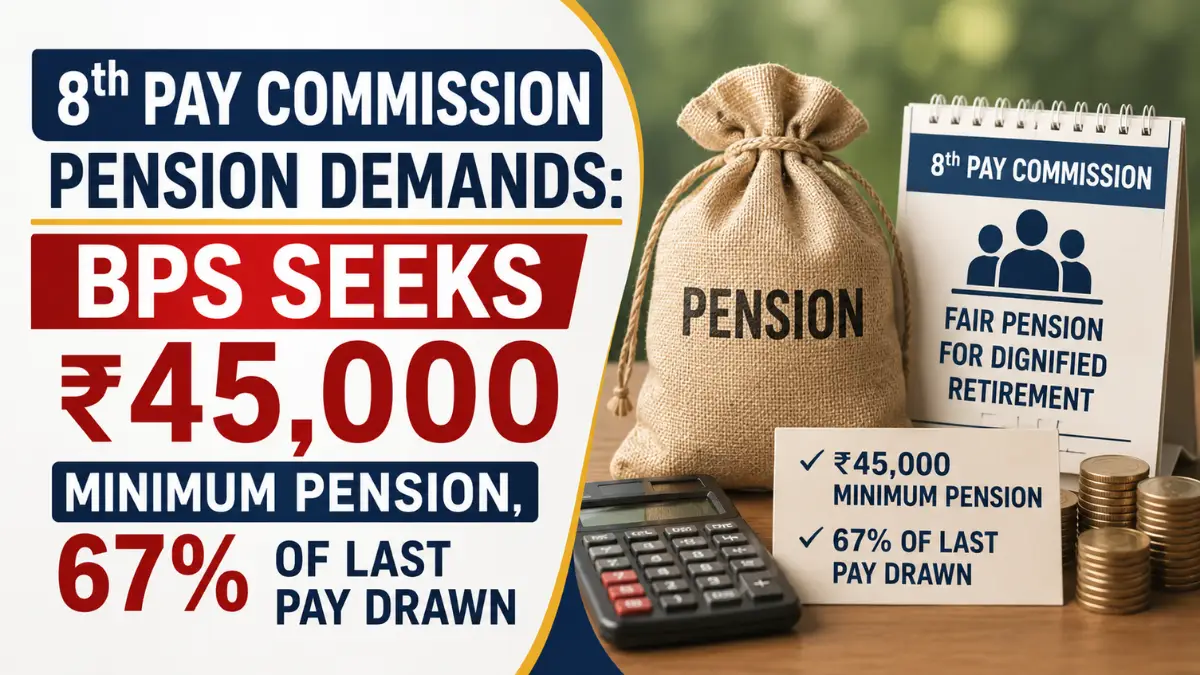
A pension is not pocket money for the retirement years — it is the only income many former government employees will have for the rest of their lives. That is the weight behind the 8th Pay Commission pension demands placed before the Commission on 7 August 2026 by Bharat Pensioners Samaj (BPS), the apex federation representing India’s central government pensioners. The headline numbers are stark: a minimum pension of ₹45,000 per month, pension at 67% of Last Pay Drawn (LPD), and a minimum basic pay of ₹69,000 with a fitment factor of 3.83. None of this is approved yet — but it tells pensioners exactly what is being argued for on their behalf, and by whom.
📌 Also Read: 8th Pay Commission 2026 Expected Salary, Fitment Factor, Pay Matrix & Latest News
Join WhatsApp
Join NowJoin Telegram
Join NowThe Meeting That Put Pensioners’ Numbers on the Record
On 7 August 2026, a BPS delegation led by President R.K. Chauhan and Secretary General Avinash Rajput met the 8th Central Pay Commission at Chandralok Building, Janpath, New Delhi. The delegation walked the Commission through a PowerPoint presentation and a detailed memorandum, and the Commission’s members reportedly engaged directly with the submissions rather than simply receiving them.
BPS is not a fringe voice in this process. Established in 1955, the federation is recognised by the Department of Pension and Pensioners’ Welfare (DoP&PW) and NITI Aayog, and it represents pensioners’ interests on the Standing Committee of Voluntary Agencies (SCOVA) — the government’s formal consultation body for pensioner grievances. With 245 affiliated associations, BPS says it speaks for nearly one crore pensioners across the country. That scale is why its 13-point charter carries weight even before the Commission issues a single recommendation.
The meeting matters because it comes at a specific moment in the 8th CPC timeline. The Commission, chaired by Justice Ranjana Prakash Desai, is currently in its consultation phase, gathering submissions from employee unions and pensioner bodies before it drafts recommendations. Nothing BPS asked for is confirmed — but the numbers it put on record are now part of the evidence the Commission will weigh.
What BPS Actually Wants — Minimum Pension, Fitment Factor and the 5.2-Unit Formula
The core of Bharat Pensioners Samaj’s case is a rethink of how minimum pay and pension are calculated in the first place. The 7th Pay Commission used what is called a three-unit family formula — one unit for the employee, 0.8 for a spouse, and 0.6 each for two children — to work out a subsistence-level minimum wage. BPS argues that formula no longer reflects how Indian families actually function.
In its place, BPS has proposed a 5.2 weighted-unit formula: 1.0 for the employee, 1.0 for the spouse — with no gender-based discount — 0.8 each for two children, and 0.8 each for two dependent parents. That last addition is the significant one. It formally counts the financial responsibility many employees carry toward ageing parents, something the earlier formula ignored entirely.
Run through BPS’s calculations, that revised formula produces a minimum basic pay of ₹69,000 and a fitment factor — the multiplier applied to existing basic pay to arrive at the revised figure — of 3.83. On the pension side, the federation wants a minimum pension of ₹45,000 per month, pension calculated at 67% of Last Pay Drawn, and family pension at 50% of Last Pay Drawn. It has also asked for HRA and Leave Travel Concession (LTC) benefits to be extended to pensioners, and for pay and pension to be revised every five years instead of the current ten-year cycle.
That last point deserves its own attention. A pensioner who retires just after a Pay Commission’s revision currently waits roughly a decade for the next one — a long stretch to absorb inflation on a fixed income. Cutting that to five years would materially change how much purchasing power a pension retains over a pensioner’s lifetime.
What This Looks Like in Rupees
Numbers on a memorandum are easy to skim past. Put them next to a real pensioner’s monthly income and the scale becomes clear.
A retired Group C employee currently drawing a minimum pension of around ₹9,000 per month under the 7th CPC structure would, if BPS’s ₹45,000 minimum pension demand were accepted in full, see that figure rise five-fold. For a mid-level pensioner whose last basic pay was, say, ₹56,900 (Pay Level 8), a fitment factor of 3.83 applied to that figure — the mechanism BPS is proposing — would push the revised reference pay well past ₹2.1 lakh, before the 67%-of-LPD pension formula is applied on top.
💡 It’s worth using an 8th CPC salary calculator to run your own basic pay through these proposed figures — the calculator applies the fitment factor to your actual pay level rather than an average example.
These are demand-stage numbers, not sanctioned ones. Independent analysts tracking the 8th CPC have generally clustered their fitment factor estimates in a lower band — often between 2.28 and 2.86 — which makes BPS’s 3.83 figure one of the more ambitious asks on the table. That gap between what pensioner associations are demanding and what analysts expect the Commission to actually recommend is likely to be one of the defining tensions of this Pay Commission cycle.
Pension Parity, Quarterly DA/DR and the Commuted Pension Fight — The Other Six Demands
Beyond the headline pay figures, BPS’s memorandum addresses a set of long-standing pensioner grievances that rarely make headlines but affect income directly.
The first is parity. BPS wants no distinction between pensioners who retired before 1 January 2026 and those who retire after, arguing that identical service should not produce unequal pensions based purely on retirement date. Tied to that is a demand to revise Dearness Relief (DR) — the pension equivalent of Dearness Allowance (DA) — every three months instead of twice a year, based on a rolling three-month average, along with a review of merging DR into basic pension once it crosses 25%.
Then there is restoration of commuted pension. Pensioners who opt to commute — take a lump sum against part of their future pension — currently wait 15 years before that portion is restored to their monthly payout. BPS argues this period was set in 1986 using interest rate and life-expectancy assumptions that no longer hold, and that pensioners typically recover the commuted amount well before 15 years are up. Its proposal: restore the commuted portion after 11 years, or at age 71, whichever comes first.
BPS has also revived a demand many pensioner groups have pushed for years — restoration of the Old Pension Scheme (OPS), the defined-benefit system that guarantees a fixed pension regardless of market performance, in place of the market-linked National Pension System (NPS) for employees who joined after 2004. Its argument is that post-retirement income should carry certainty, not investment risk.
Rounding out the list: a phased increase in additional age-related pension starting at 65 rather than the current threshold of 80 — BPS wants 70% of LPD at 65, rising in steps to 100% at 90 — and a substantial hike to the Central Government Employees Group Insurance Scheme (CGEGIS), with a minimum cover of ₹15 lakh for the lowest cadre.
That is not a small number. Across the roughly 65-68 lakh central government pensioners BPS says it represents, even modest movement on any one of these seven points would ripple through millions of household budgets.
Does This Apply to You? Autonomous Bodies, BSNL and CGHS Pensioners
Not every pensioner sits in the same bucket, and BPS’s memorandum is specific about who it is trying to bring into the fold.
If you are a pensioner of a Central Autonomous Body or a Statutory Body, BPS is asking the Commission to extend 8th CPC benefits to you at the same time as regular central government pensioners — not after a separate, often delayed, notification process that has historically left autonomous-body pensioners waiting years behind their counterparts.
If you are a BSNL pensioner, the memorandum specifically flags your pension parity and healthcare concerns, and asks for a simpler direct-payment mechanism for those who have opted into the Central Government Health Scheme (CGHS) rather than the current, often cumbersome, reimbursement route.
On healthcare more broadly, BPS wants CGHS itself strengthened — more doctors, specialists, medicines and wider cashless treatment — along with an increase in the Fixed Medical Allowance (FMA) to ₹5,000 per month for pensioners who live in rural or non-CGHS areas and cannot access cashless treatment at all. It has also asked for CGHS-equivalent cashless arrangements for eligible Employees’ State Insurance Corporation (ESIC) beneficiaries, and for barriers affecting hospital empanelment to be reviewed.
If none of the specific categories above apply to you — you are a standard central government pensioner outside these groups — the core demands on minimum pension, fitment factor, parity and commuted pension restoration are still the ones most directly relevant to your monthly income.
Your Practical Options From Here
There is nothing to file, apply for, or opt into right now. The 8th Pay Commission has not accepted, rejected, or ruled on any of BPS’s 13 demands — this was a consultation meeting, not a decision. What you can usefully do is track the Commission’s progress and understand which of these asks would change your own pension calculation if accepted, so you are not caught off guard when actual recommendations are published.
BPS has requested that whatever the Commission does recommend on pay, pension and allowances take effect from 1 January 2026, with arrears paid retroactively — the same pattern followed by the 7th CPC in 2016. If that timeline holds, pensioners would eventually receive a lump-sum arrears payment covering the gap between January 2026 and whenever implementation actually happens, which recent tracking suggests is more likely in 2027.
📌 Also Read: For the wider salary-side picture — fitment factor estimates, pay matrix projections and implementation timelines — see our 8th Pay Commission 2026 explainer, and compare pension structures in our NPS vs UPS comparison if OPS restoration doesn’t apply to you.
mportant Links
| What | Link |
|---|---|
| BPS Presentation to 8th CPC (Key Demands at a Glance) | Download PDF |
| 8th Pay Commission — Official Overview | 8th Pay Commission 2026 |
| 8th CPC Salary Calculator | Calculate Your Revised Pay |
| DA/DR Rate Tracker | DA/DR Hikes 2026 |
| NPS vs UPS Comparison | Read Here |
| Bharat Pensioners Samaj — Official Website | bps1955.in |
Frequently Asked Questions
Has the 8th Pay Commission approved ₹45,000 minimum pension?
No. ₹45,000 is a demand placed by Bharat Pensioners Samaj (BPS) in its memorandum, not a figure approved or recommended by the 8th Central Pay Commission. The Commission is still in its consultation stage and has not finalised any pension figures.
What is the 5.2 weighted family unit formula?
It is BPS’s proposed replacement for the three-unit formula used to calculate minimum wage and pension. It assigns 1.0 unit each to the employee and spouse, and 0.8 units each to two children and two dependent parents, totalling 5.2 units — intended to better reflect the real financial responsibilities employees carry.
When will 8th CPC pension revision be effective from?
BPS has requested that revised pay, pension and allowances take effect from 1 January 2026, following the precedent of previous Pay Commissions. This is a request, not a confirmed effective date — the Commission’s final report and government notification will determine the actual date.
What is BPS’s demand on commuted pension restoration?
BPS wants the commuted portion of pension restored after 11 years of commutation, or on the pensioner reaching age 71, whichever comes first — down from the current 15-year restoration period, which BPS argues is based on outdated 1986 interest-rate and life-expectancy assumptions.
Will DA merge with pension under the 8th CPC?
The government has clarified in Parliament that no Dearness Allowance (DA) merger with basic pay is currently under consideration. BPS has instead asked the Commission to examine merging Dearness Relief (DR) with basic pension specifically once DR crosses 25% — a narrower, pension-focused version of the demand.
What is the current fitment factor expected under 8th CPC?
No fitment factor has been finalised. Independent estimates generally range between 1.92 and 2.86, with many analysts clustering around 2.28 to 2.46. BPS’s demand of 3.83 is significantly higher than most independent projections, reflecting its push for a more generous minimum pay and pension baseline.
Summing Up…
Bharat Pensioners Samaj’s 13-point charter gives pensioners something they rarely get this early in a Pay Commission cycle: specific, rupee-denominated numbers to hold the process against. Whether the 8th Pay Commission accepts a ₹45,000 minimum pension, a 3.83 fitment factor, or any of BPS’s other demands remains entirely open — the Commission is still consulting, and its final recommendations could land well below what any single association has asked for. What is certain is that these numbers are now formally on record, and every pensioner tracking the 8th CPC has a clearer benchmark to measure the eventual outcome against.
Bookmark Govtserviceinfo.com and join our Telegram channel for instant alerts on DA hikes, pay revision orders, and 8th CPC updates.
Disclaimer: This article is based on the Bharat Pensioners Samaj presentation to the 8th Central Pay Commission dated 7 August 2026, and subsequent media coverage of the meeting. All figures represent demands made by Bharat Pensioners Samaj and have not been approved or recommended by the 8th Central Pay Commission. Govtserviceinfo.com is not affiliated with Bharat Pensioners Samaj or the 8th Central Pay Commission. Readers should verify current information from official government sources before acting on any information published here.







1 thought on “8th Pay Commission Pension Demands: BPS Seeks ₹45,000 Minimum Pension, 67% of Last Pay Drawn”