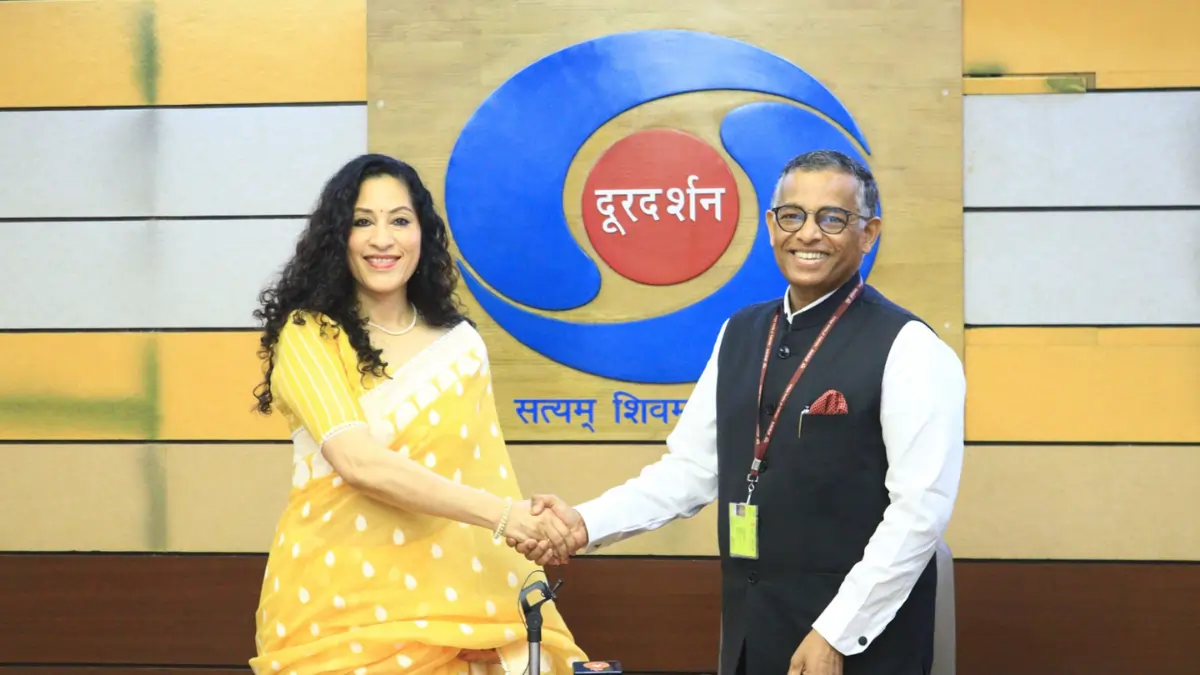
Doordarshan and the Indian Council for Cultural Relations (ICCR) have signed a Memorandum of Understanding (MoU) that moves India’s cultural diplomacy off the walls of embassy reception halls and onto television screens, OTT platforms, and social media feeds worldwide. The agreement, formalised on 07 April 2026 at Doordarshan Bhawan in New Delhi, is one of the most significant structural steps Prasar Bharati has taken to connect its broadcast muscle with the government’s soft-power ambitions.
The deal is not just a content-sharing arrangement. It creates a joint framework for production, rights ownership, digital archiving, and monetisation — a three-year partnership that could reshape how hundreds of millions of viewers at home and abroad encounter Indian classical music, dance, theatre, and visual arts.
Why This MoU Matters — and Why It Didn’t Happen Sooner
India has two of the world’s most powerful cultural institutions working largely in parallel. The ICCR, under the Ministry of External Affairs, runs an extensive network of Indian Cultural Centres abroad and organises thousands of performances and exhibitions through Indian missions each year. Prasar Bharati, under the Ministry of Information and Broadcasting (MIB), operates one of the largest public broadcasting networks on the planet — spanning Doordarshan’s television channels, All India Radio (AIR), and the growing WAVES OTT platform.
For decades, the content produced at ICCR events — a Bharatanatyam performance in Moscow, a Carnatic concert in Tokyo, a Kathak recital in Washington — was largely experienced by the audience present in the hall, then archived in formats that rarely reached mass viewership. Doordarshan had the distribution infrastructure. ICCR had the content and the cultural relationships. The two just weren’t formally connected.
This MoU changes that equation. The timing is not coincidental it follows Prasar Bharati’s aggressive push toward digital platforms, including the rollout of the WAVES OTT platform, which has positioned the public broadcaster not merely as a television network but as a multi-platform content ecosystem.
What the Agreement Actually Says — The Operational Framework
The MoU was signed by Shri K. Satish Nambudiripad, Director General of Doordarshan, and Smt. K. Nandini Singla, Director General of ICCR, in the presence of senior officials from both organisations. The framework it establishes is clear in its division of responsibilities.
ICCR will curate and supply cultural content — performances, recordings, and live events — drawn from its activities at Indian Missions abroad (embassies, consulates, and cultural centres) as well as its regional offices across India. Doordarshan and Prasar Bharati will handle production, coverage, and dissemination across their full platform stack: Doordarshan television channels, All India Radio networks, the WAVES OTT platform, and official social media channels.
Crucially, recorded content from Indian Missions abroad will be integrated into programming, which means a cultural performance organised by the Indian Embassy in Cairo or the Indian Cultural Centre in Berlin can now reach a domestic audience in Manipur or a diaspora viewer in Canada through the same broadcast.
📌 Also Read: Prasar Bharati Launches Creators’ Corner on DD News — another step in the broadcaster’s digital-first pivot.
The Content Rights Clause — Building a Permanent Digital Archive
One of the most forward-looking elements of the agreement is the provision for joint ownership of content rights in perpetuity, including digital rights. This deserves closer attention because it fundamentally changes the shelf life of cultural content.
Under a standard broadcast arrangement, a performance is covered, aired, and effectively retired. Under this MoU, every piece of content produced jointly by Doordarshan and ICCR becomes part of a permanent digital repository — one that both organisations can access, reuse, and redistribute across platforms indefinitely.
That matters for several reasons. India’s classical arts are living traditions, but video documentation of great performers — particularly those no longer performing — is scattered, poorly archived, and often inaccessible to the public. A structured digital archive with proper rights clarity creates the conditions for a genuine cultural heritage library, not just a content library.
Read alongside Prasar Bharati’s broader digital infrastructure push, this signals a longer-term ambition: positioning India’s public broadcaster as a custodian of the country’s performing arts heritage in the digital age.
Promotion, Monetisation, and the Question of Sustainability
The MoU goes beyond content sharing. Doordarshan will also handle pre-event publicity and cross-platform promotion for ICCR events — promotional campaigns across television and digital channels, social media amplification, and integration with OTT streaming. This is a meaningful commitment, because visibility for cultural programming has historically been one of its weakest points.
The agreement also opens up monetisation avenues for content generated under the collaboration. This could take the form of sponsored cultural programming, digital content licensing, and advertising partnerships. While the exact revenue model will evolve, the intent is clear: to create a self-sustaining content ecosystem rather than relying entirely on government budget allocations.
💡 For context, Prasar Bharati’s OTT platform WAVES already carries a growing catalogue of cultural content. The ICCR partnership gives that catalogue a systematic, institutionalised supply chain for the first time.
What This Means If You Work in Public Broadcasting or the Cultural Sector
If you are employed by Prasar Bharati — whether in production, digital operations, or content management — this MoU has practical implications for your work. Doordarshan’s production and dissemination responsibilities under the agreement mean increased output requirements, particularly for multi-platform content: a cultural event may now need to be covered, edited, subtitled, and distributed not just to a television audience but to OTT subscribers and social media viewers simultaneously.
For those working in India’s cultural sector — classical musicians, dancers, theatre practitioners, and their institutions — the partnership represents a significant new distribution channel. ICCR-affiliated events and performances that previously reached a few hundred people in a foreign city can now, in principle, reach millions of viewers through Doordarshan’s network. That scale of visibility has implications for patronage, audiences, and the economic viability of classical arts.
✅ The MoU runs for three years from the date of signing (07 April 2026) and can be extended by mutual consent of both organisations.
What Comes Next — The Timeline to Watch
The MoU establishes a framework; the work of building the content pipeline, the production protocols, and the digital archive infrastructure lies ahead. Here is what to watch for in the coming months.
The immediate next step will be the operationalisation of the content supply arrangement — establishing which ICCR events and recordings will be prioritised for broadcast and how the production workflow between the two organisations will function. Given the global footprint of Indian missions (over 200 missions and cultural centres worldwide), the volume of potential content is substantial.
The WAVES OTT platform’s role as a distribution vehicle will be central to how international audiences access this content. Watch for dedicated cultural programming sections on WAVES and for Doordarshan to begin integrating ICCR events into its programming schedules, likely with a promotional push ahead of major cultural occasions and national events.
The monetisation model will take longer to materialise, but the licensing and sponsorship framework it creates could eventually become a template for other public-private cultural broadcasting partnerships.
Frequently Asked Questions
What is the Doordarshan–ICCR MoU 2026 about?
The Memorandum of Understanding signed on 07 April 2026 formalises a three-year partnership between Doordarshan (Prasar Bharati) and the Indian Council for Cultural Relations (ICCR). Under the agreement, ICCR will supply curated cultural content from events held through Indian missions abroad and across India, while Doordarshan will produce, broadcast, and promote this content across its television, radio, OTT, and digital platforms.
Who signed the Doordarshan–ICCR MoU?
The agreement was signed by Shri K. Satish Nambudiripad, Director General of Doordarshan, and Smt. K. Nandini Singla, Director General of ICCR, at Doordarshan Bhawan in New Delhi on 07 April 2026.
Will cultural content from Indian embassies abroad be broadcast on Doordarshan?
Yes. One of the key provisions of the MoU is that recorded cultural content from Indian Missions abroad — including embassies, consulates, and cultural centres — will be integrated into Doordarshan’s programming and disseminated across its platform network.
What does joint ownership of content rights in perpetuity mean?
It means both Doordarshan (Prasar Bharati) and ICCR will co-own the rights to all content produced under this partnership, including digital rights, with no expiry date. This allows both organisations to archive, reuse, and redistribute the content indefinitely across platforms, effectively building a permanent digital cultural archive.
How long is the Doordarshan–ICCR MoU valid?
The agreement is initially valid for three years from 07 April 2026. It can be extended beyond that period by mutual consent of both Doordarshan and ICCR.
Will the cultural content be available on OTT platforms?
Yes. The MoU specifically includes OTT platforms as part of Doordarshan’s dissemination mandate. Prasar Bharati’s WAVES OTT platform is expected to be a primary vehicle for making this content available to domestic and international audiences on demand.
Can Doordarshan earn revenue from this cultural content partnership?
The MoU allows Doordarshan to explore monetisation opportunities arising from the jointly produced content. This could include sponsored programming, digital content licensing, and advertising partnerships, with the aim of making cultural broadcasting more financially self-sustaining.
Conclusion
The Doordarshan–ICCR MoU 2026 is not a routine administrative agreement. It is a structural realignment that connects India’s cultural diplomacy machinery with its public broadcasting infrastructure for the first time in a systematic, rights-defined, and digitally oriented way. For Indian classical arts, for Prasar Bharati’s growing digital portfolio, and for the millions of viewers globally who have never had easy access to high-quality Indian cultural programming, the partnership represents a genuine opening.
The real test will be in execution — in whether the content pipeline is built with quality and consistency, whether the digital archive becomes a resource that researchers and viewers can actually use, and whether the monetisation model proves sustainable over the three-year term and beyond.
Bookmark Govtserviceinfo.com and join our Telegram channel for instant alerts on Prasar Bharati employee news, MIB policy updates, and WAVES OTT developments.
Important Links
| Resource | Link |
|---|---|
| ICCR Official Website | iccr.gov.in |
| Prasar Bharati Official Website | prasarbharati.gov.in |
| Ministry of Information and Broadcasting | mib.gov.in |
| WAVES OTT Platform | mywaves.in |
Disclaimer: This article is based on information published by official government sources and news reports as of 07 April 2026. Readers are advised to refer to official notifications from Prasar Bharati and ICCR for the most current and authoritative information.