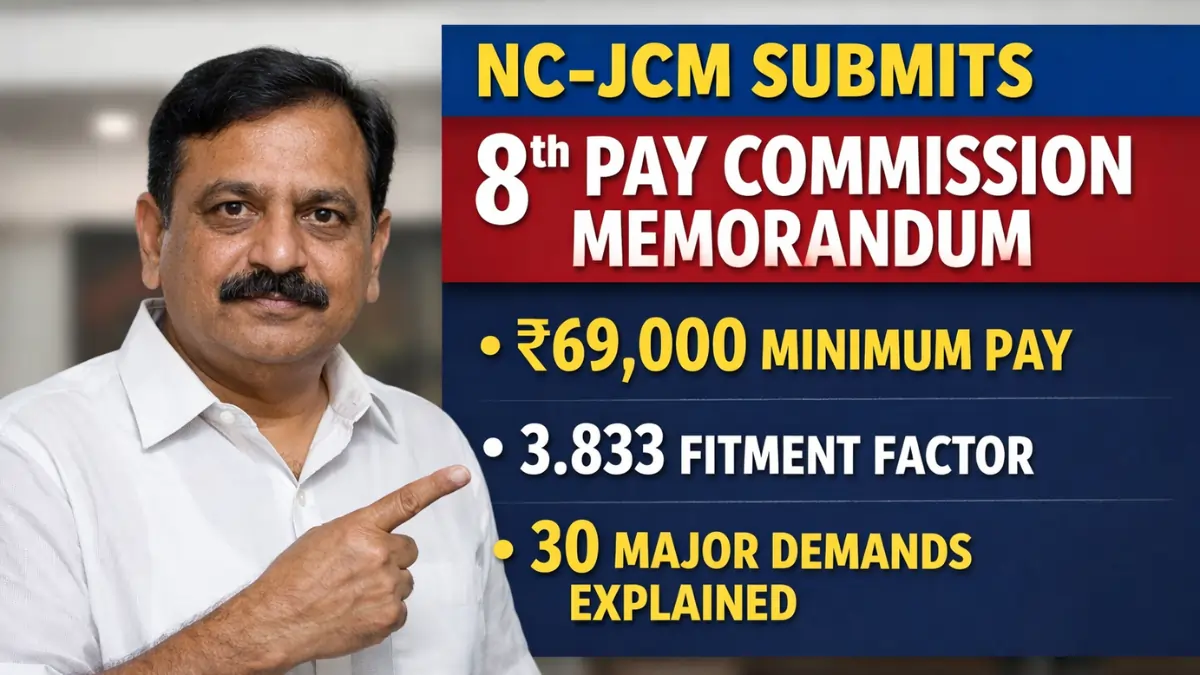
The 8th Pay Commission NC-JCM memorandum, formally submitted on 14 April 2026, places a bold set of demands on the table — chief among them a minimum basic salary of ₹69,000, a fitment factor of 3.833, and the complete withdrawal of the National Pension System (NPS) and Unified Pension Scheme (UPS) in favour of the Old Pension Scheme (OPS). For approximately 50 lakh central government employees and millions of pensioners, this document is the most comprehensive articulation yet of what the next pay revision could look like.
The Staff Side of the National Council – Joint Consultative Machinery (NC-JCM) finalised the 51-page memorandum at its Drafting Committee meeting on 13 April 2026 at J.P. Choubey Memorial Library, New Delhi. Secretary Shiva Gopal Mishra confirmed the document was uploaded to the 8th CPC portal within the prescribed deadline and circulated to all constituent organisations for onward submission.
The Fitment Factor That Changes Everything — 3.833 vs the 7th CPC’s 2.57
The single most consequential number in the entire memorandum is the proposed fitment factor of 3.833. Under the 7th Pay Commission, the fitment factor was 2.57 — itself considered generous at the time. The NC-JCM is now demanding a factor nearly 50% higher.
What does this mean in practice? An employee at the entry-level Pay Level 1 currently draws a basic pay of ₹18,000. Applying a fitment factor of 3.833 would raise that to approximately ₹69,000 — nearly four times the current figure. At the top of the proposed revised scale (Pay Scale 6, merging existing Levels 9 and 10), the minimum basic pay would reach ₹2,15,100.
The NC-JCM has not pulled this number out of thin air. The memorandum bases the ₹69,000 minimum on a detailed minimum wage calculation for a five-unit family — covering food, clothing, housing at 7.5%, fuel and electricity at 20%, skill development at 25%, recreational and festival expenses at 25%, and technology charges at 5%. The calculation uses retail market prices collected from cities across India as of early 2026.
This fitment factor, if accepted, would also be applied uniformly to existing pensioners — a demand the staff side frames as a constitutional obligation following recent Supreme Court rulings that pension cannot be discriminated against on the basis of retirement date.
Why ₹69,000 — The Science Behind the Minimum Wage Demand
One of the most detailed sections of the memorandum concerns the minimum wage methodology. The NC-JCM has long argued that the current system of treating a family as three units is outdated. The memorandum proposes recognising a family as five units: the employee (1 unit), spouse (1 unit, with no gender discrimination), two children (1 unit each), and 0.8 units each for both parents — totalling 5.2 units, rounded to 5.
This is consistent with India’s Maintenance and Welfare of Parents and Senior Citizens Act, which legally obligates children to support dependent parents. The Social Security Code 2020 also permits female employees to include parents-in-law in their family definition.
The food basket used to compute the minimum wage is calibrated to the ICMR recommendation of approximately 3,490 Kcal per day for physically demanding work — a significant upgrade from the earlier 2,700 Kcal norm that the memorandum calls “inadequate.” This covers protein sources, dairy, fruits, vegetables, and processed foods. The overall calculation, detailed in Annexure-I of the memorandum, arrives at a minimum monthly requirement of ₹68,947 — rounded to ₹69,000 — for a five-unit family.
For employees currently drawing ₹35,400 at Pay Level 6, the revised minimum at that level would be approximately ₹1,35,700, nearly doubling the current figure. That is not a marginal adjustment — it represents a substantive revaluation of what government service should pay.
💡 The NC-JCM also proposes that the annual increment be doubled from the current 3% to 6% of basic pay, applied uniformly across all proposed pay scales.
Pay Scale Mergers — A Simpler Matrix With Fewer Anomalies
Beyond the fitment factor, the memorandum proposes a structural overhaul of the pay matrix through mergers of adjacent pay levels. The current 18-level pay matrix would be compressed into 13 revised pay scales:
| Proposed Pay Scale | Merging Existing Levels | Minimum Basic Pay |
|---|---|---|
| Pay Scale 1 | Level 1 (unchanged) | ₹69,000 |
| Pay Scale 2 | Levels 2 & 3 merged | ₹83,200 |
| Pay Scale 3 | Levels 4 & 5 merged | ₹1,12,000 |
| Pay Scale 4 | Level 6 (unchanged) | ₹1,35,700 |
| Pay Scale 5 | Levels 7 & 8 merged | ₹1,82,500 |
| Pay Scale 6 | Levels 9 & 10 merged | ₹2,15,100 |
| Pay Scales 7–13 | Existing Levels 11–17 retained | Calculated via 3.833 factor |
The memorandum also proposes a one-time measure: all existing employees at Level 5 should be upgraded and merged into Level 6. The staff side argues this will eliminate long-standing pay anomalies and reduce the enormous disparity between adjacent scales that causes grievances during pay fixation.
A key equity demand accompanies the matrix reform: the ratio between minimum and maximum pay across the entire service should not exceed 1:12. This, the memorandum argues, would reduce income inequality within government service and reinforce the government’s identity as a model employer committed to social justice.
Allowances, Leave and Advances — What Changes for You
The memorandum covers allowances with equal thoroughness. Here is what each proposal means for serving employees:
Dearness Allowance (DA): The current 12-month averaging method for computing DA is proposed to be replaced with a 6-month average, since DA is already paid twice a year. The memorandum also demands a separate Consumer Price Index for government employees — distinct from the industrial worker index currently used — with appropriate weightages for food, housing, education, healthcare, and transportation.
House Rent Allowance (HRA): The revised HRA structure proposes 40% of basic pay for cities with population above 50 lakh (Class X), 35% for cities between 5-50 lakh (Class Y), and 30% for all other cities (Class Z). HRA should be indexed to DA so it automatically adjusts with inflation — a demand that has been raised since the 6th Pay Commission but never accepted. The memorandum also calls for HRA to be extended to pensioners, noting that a significant portion of pension is consumed by house rent after retirement.
Children’s Education Allowance (CEA): Proposed to be enhanced to ₹10,000 per child per month, with hostel subsidy rising to ₹35,000 per month per child. Both should be linked to DA-based automatic revision.
Transport Allowance: Proposed at three times the existing rates, with the restoration of the abolished City Compensatory Allowance.
Risk and Hardship Allowance: For employees in Railways, Defence manufacturing, ordnance handling, laboratories, and health care — the allowance is proposed at a minimum of ₹10,000 per month, linked to DA.
On advances, the memorandum demands interest-free loans across the board — House Building Advance (HBA) up to ₹2 crore, Personal Computer Advance up to ₹2 lakh, Four-Wheeler Advance up to ₹10 lakh, and the restoration of the withdrawn Festival Advance and Natural Calamity Advance.
✅ You can use our 8th Pay Commission Salary Calculator to estimate your revised pay once the fitment factor is confirmed.
Pension Demands — OPS Restoration and OROP for Civil Servants
For pensioners and NPS subscribers, the memorandum is unambiguous: the NPS and UPS must go. The staff side calls the replacement of the defined-benefit pension with the NPS — effective from 01 January 2004 — “not only going backwards but an illegal step” in light of the Supreme Court ruling that pension is a right and not a bounty.
Of more than 26 lakh NPS employees, only about 1.22 lakh (around 4.5%) opted for the UPS introduced from 01 April 2025. The memorandum treats this low migration rate as a rejection of both schemes and demands restoration of the non-contributory CCS (Pension) Rules under OPS.
Key pension reforms demanded include:
- Full pension fixed at 67% of the Last Pay Drawn (LPD) for a 30-year qualifying service, compared to the current 50%
- Family Pension enhanced to 50% of LPD from the present 30%
- An age-based pension enhancement structure: 70% of LPD at age 65, rising in steps to 100% of LPD at age 90
- Commutation restoration after 11 years instead of the current 15 years — the memorandum demonstrates through actuarial calculation that the commuted value is typically recovered within 10 years
- OROP (One Rank One Pension) principle extended to all civil pensioners, eliminating the disparity between pensioners of the same rank who retired at different dates
- Gratuity ceiling raised from ₹25 lakh to ₹75 lakh, calculated on the basis of 25 effective working days per month
⚠️ If you are currently under NPS, check our comparison of NPS vs UPS for central government employees to understand what the OPS restoration demand could mean for your retirement corpus.
Career Progression — 5 Promotions in 30 Years, Time-Scale for All
The most significant structural reform in the memorandum’s career progression section is the demand for a minimum of 5 promotions in a 30-year service career for every category of central government employee. Currently, many Group C employees — including MTS staff, drivers, fire fighting staff, clerical employees, canteen workers, and artisan categories — retire with fewer than 3 promotions, often depending entirely on the Modified Assured Career Progression (MACP) scheme.
The memorandum proposes financial upgradations at 6, 12, 18, 24, and 30 years of service in the promotional hierarchy — not just grade pay hierarchy as MACP currently operates. Each promotion or financial upgradation should carry 2 additional increments with a minimum benefit of ₹10,000.
The memorandum also proposes time-scale promotion for all Group B and Group C employees, arguing that the distinction between Group A (which already has time-scale promotion) and lower groups amounts to discrimination. You can check your MACP eligibility using our MACP Eligibility Checker.
What Comes Next — Timelines and the Constituent Submission Window
The NC-JCM memorandum covers only common service matters. Departmental issues — including department-specific allowances, cadre restructuring, and promotion rules unique to Railways, Defence, Postal, Income Tax, and Audit — are to be submitted separately by constituent organisations.
The 8th CPC’s current deadline for memorandum submissions is 30 April 2026. The NC-JCM has formally requested an extension to 31 May 2026 for departmental submissions, citing the time needed for nationwide consultations across constituent organisations.
The Commission has also been requested to increase the character limit for online submissions from 10,000 to 20,000 characters for Questions 7 and 8 (Cadre Management and Career Progression), given the complexity of these topics.
The 8th Pay Commission is expected to submit its recommendations before 1 January 2026 — the proposed date of effect for the revised pay structure. The timeline for implementation follows earlier precedents where pay commissions typically take 18–24 months from constitution to final report. You can track key milestones on our 8th Pay Commission Timeline page.
Frequently Asked Questions
What is the fitment factor proposed by NC-JCM for the 8th Pay Commission?
The NC-JCM has proposed a fitment factor of 3.833, compared to 2.57 under the 7th Pay Commission. This multiplier, if accepted, would raise an entry-level basic pay of ₹18,000 to approximately ₹69,000.
What is the minimum salary demand in the 8th Pay Commission memorandum?
The NC-JCM has demanded a minimum basic salary of ₹69,000 per month, calculated on the basis of a five-unit family using retail market prices for food, housing, fuel, education, technology, and other essential expenses as of early 2026.
Will the 8th Pay Commission recommendations apply to existing pensioners?
The NC-JCM has strongly demanded that all recommendations — including the revised fitment factor and pension enhancements — apply equally to pensioners who retired before 01 January 2026. This is framed as a constitutional obligation under Article 14 and recent Supreme Court rulings.
What is the NC-JCM’s stand on NPS and UPS?
The NC-JCM has demanded complete withdrawal of both NPS and UPS and restoration of the Old Pension Scheme (OPS) under CCS (Pension) Rules. The memorandum notes that only 4.5% of NPS employees migrated to UPS, calling this a clear rejection.
What HRA revision has been demanded in the 8th Pay Commission memorandum?
The proposed HRA rates are 40% of basic pay for Class X cities (population above 50 lakh), 35% for Class Y cities (5–50 lakh population), and 30% for Class Z cities. HRA should also be linked to DA for automatic inflation adjustment.
When will the 8th Pay Commission salary revision come into effect?
The proposed effective date is 1 January 2026. However, the final implementation date depends on when the Commission submits its report and the government acts on its recommendations, which typically takes additional time.
What is the career progression demand in the NC-JCM memorandum?
The NC-JCM demands a minimum of 5 financial upgradations in a 30-year career for all employees — at 6, 12, 18, 24, and 30 years of service. Each upgradation should carry 2 additional increments with a minimum benefit of ₹10,000.
Summing Up…
The NC-JCM’s memorandum to the 8th Pay Commission represents the most detailed and data-backed demand document the staff side has ever submitted. From a ₹69,000 minimum wage grounded in a scientific five-unit family calculation, to a 3.833 fitment factor, 6% annual increments, OPS restoration, and five assured promotions across a career — the demands are ambitious but structured on evidence.
Whether the 8th CPC accepts these in full, in part, or recommends something different entirely remains to be seen. What is certain is that these proposals will shape the negotiations ahead. For central government employees and pensioners, now is the time to stay informed, track developments, and ensure constituent organisations submit comprehensive departmental memoranda before the extended deadline of 31 May 2026.
📌 Stay updated: Bookmark our 8th Pay Commission 2026 hub for the latest developments, salary calculators, and official order updates.
Important Links
| Resource | Link |
|---|---|
| 8th CPC Official Portal | 8thcpc.gov.in |
| NC-JCM Official Contact | nc.jcm.np@gmail.com |
| Download the letter | Download PDF |
| 8th Pay Commission Overview | govtserviceinfo.com/8th-pay-commission-2026/ |
| 8th CPC Salary Calculator | govtserviceinfo.com/8th-cpc-salary-calculator/ |
| NPS vs UPS Comparison | govtserviceinfo.com/nps-vs-ups-comparison-2026/ |
| MACP Eligibility Checker | govtserviceinfo.com/macp-eligibility-checker/ |
Disclaimer: This article is based on the memorandum submitted by the Staff Side of NC-JCM to the 8th Central Pay Commission on 14 April 2026. The demands represent the staff side’s proposals and are not official government decisions or confirmed pay revision figures. Actual salary revisions will depend on the Commission’s final recommendations and government notification. Always refer to official government orders before taking action.