
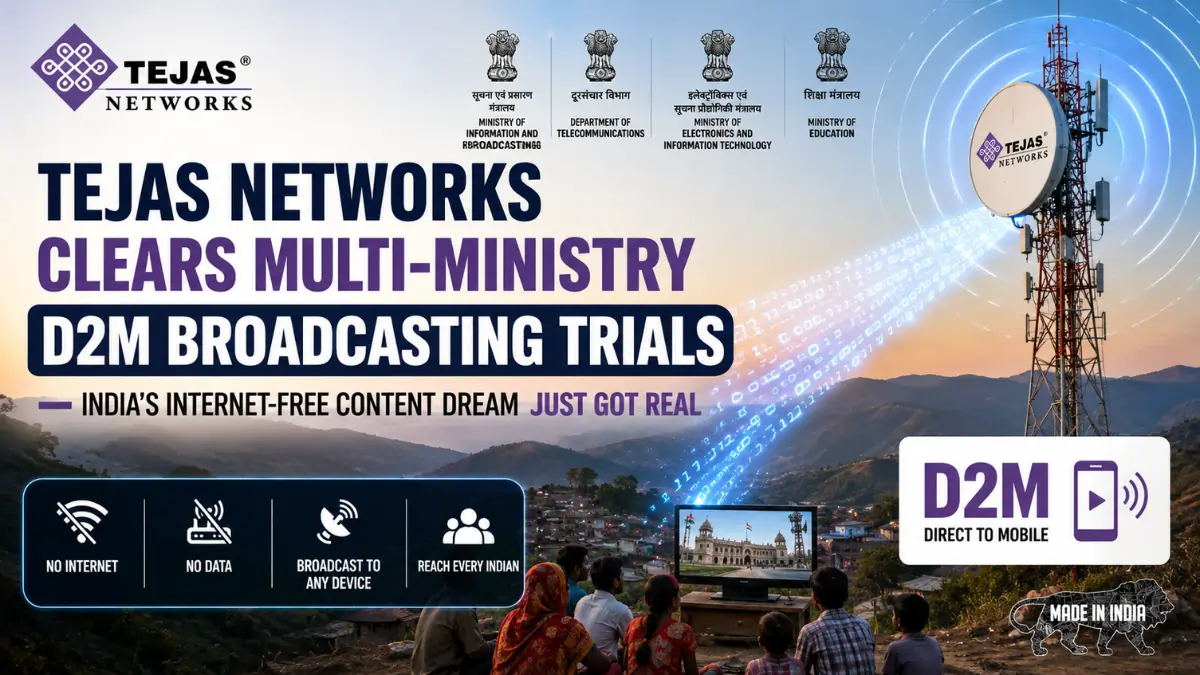
India’s Direct-to-Mobile (D2M) broadcasting ambition has crossed its most consequential hurdle yet. Equipment built by Tejas Networks — the Tata-controlled telecom gear maker — has successfully cleared a comprehensive round of laboratory and field trials for D2M broadcasting in Delhi, conducted under the watch of at least six central government ministries and agencies. The trials validated that D2M can deliver live video and audio directly to mobile phones without internet or a SIM card, without disrupting existing 2G, 3G, 4G, or 5G networks — and that conclusive, multi-ministry-backed verdict has fundamentally changed the terms of a debate that has been running for years.
For the first time since D2M trials began in earnest, the technology has been tested in public, with representatives from the Ministry of Information and Broadcasting (MIB), the Ministry of Electronics and Information Technology (MeitY), the Department of Telecommunications (DoT), the Wireless Planning and Coordination (WPC) Wing, the Telecom Engineering Centre (TEC), the Department of Science and Technology (DST), and Prasar Bharati all present at the evaluations. That is not a procedural footnote — it is the direct answer to the central objection that India’s biggest private telecom operators had raised. The runway for stalling D2M just got dramatically shorter.
Track every open notification & never miss a deadline
What D2M Actually Is — and Why It Matters More Than You Think
Direct-to-Mobile broadcasting is, at its core, a technology that treats your phone like a radio. Instead of streaming video over a cellular data connection — consuming spectrum, burning mobile data, and depending on internet infrastructure — D2M uses the Ultra High Frequency (UHF) broadcast spectrum in the 470–582 MHz band to beam IP-based content directly to compatible devices. Live TV, audio, video clips, emergency alerts, and public advisories can all be pushed to smartphones, feature phones, tablets, dongles, laptops, and home gateways simultaneously, at essentially zero per-viewer marginal cost.
Think of it as FM radio for the digital age — but carrying high-definition video. Just as a radio in a village with no mobile tower can still catch AIR’s signal, a D2M-enabled phone in a Tier-III town with patchy internet can receive a live cricket broadcast without touching the data network. That is the promise. And the Tejas Networks trials have now demonstrated it works technically in real-world conditions.
The technology has been developed over nearly eight years as a fully indigenous effort — hardware, software, and chipset all built in India. At its heart is the SL-3000 Software Defined Radio (SDR) chipset, designed by Saankhya Labs, which was acquired by Tejas Networks and is now part of the Tata group’s telecom equipment portfolio. Parag Balwant Naik, Executive Vice President for Silicon, Broadcast System and Satcom at Tejas Networks, described it plainly: “D2M is the first deep-tech technology stack coming entirely out of India.” That description is accurate — and commercially significant, because it means the government does not need to depend on foreign vendors for the infrastructure backbone.
What the Delhi Trials Actually Tested — and What They Proved
The laboratory and field trials that Tejas Networks’ equipment has now cleared were not routine checkboxes. They were specifically designed to address the objections that the Cellular Operators Association of India (COAI) had raised against earlier, more limited evaluations.
The laboratory tests used Tejas’ MarkOne D2M handset — a fully ATSC 3.0-compliant device — operating within the 470–582 MHz spectrum band. ATSC 3.0 is the international next-generation broadcasting standard, and its use means India’s D2M infrastructure is aligned with global interoperability frameworks. The laboratory phase assessed two critical parameters: transmitter spectral compliance (whether the D2M transmitter stays within its allocated band without leaking into adjacent spectrum) and coexistence with existing mobile networks. The result was unambiguous — D2M signals caused no harmful interference to any of the major cellular standards, from legacy 2G to modern 5G.
💡 Key finding: Independent studies commissioned by Prasar Bharati and conducted by IIT Kanpur had already concluded that D2M in the 470–582 MHz band causes neither harmful interference to 4G/5G networks nor abnormal heating of smartphones. The multi-ministry trials have now reaffirmed and extended those findings under wider scrutiny.
The field trials in Delhi went further, testing real-world performance and user experience. The most important finding for everyday users: voice calls and SMS messages retained absolute priority over D2M broadcast streams. When a call comes in, D2M content automatically pauses — ensuring the broadcast layer never competes with or degrades core communication services. That was the operators’ most pointed consumer-experience concern, and it has been directly answered.
The trials also validated the performance of a broader receiver ecosystem — not just the MarkOne handset, but also dongles, compatible smartphones, and home gateways. On the transmission side, Single Frequency Network (SFN) architecture was demonstrated to deliver stronger indoor signal coverage than the older Multi Frequency Network (MFN) approach, a result that significantly improves the economics of urban deployment, where building penetration has historically been D2M’s weakest point.
The Regulatory Battle Behind the Milestone — Why COAI Fought This So Hard
To understand why this trial result matters as much as it does, you have to understand the politics of what came before it.
COAI — the industry body representing Reliance Jio, Bharti Airtel, and Vodafone Idea — spent the better part of a year objecting to the D2M evaluation process. In January 2026, COAI argued publicly that the IIT Kanpur-led tests commissioned by Prasar Bharati were incomplete: conducted without the participation of telecom operators or device ecosystem companies, insufficiently transparent, and skipping critical assessment areas such as device certification, Electromagnetic Field (EMF) compliance, and real-world usage scenarios beyond interference and device heating. The association called for fresh trials conducted under a consultative, technology-neutral framework.
On paper, those were procedural concerns. In practice, the commercial motivation was transparent. Video consumption is the fastest-growing driver of mobile data revenue in India, and it underpins much of the monetisation case for 5G. If D2M can deliver live television without touching the data network, it removes a significant chunk of premium content from the operators’ revenue equation. As one telecom industry executive noted in trade reporting: “Video consumption is central to 5G monetisation strategies. If D2M bypasses data networks, it alters the revenue equation.”
⚠️ The spectrum stakes are also high. COAI has consistently opposed the allocation of the 470–582 MHz band to D2M broadcasting, arguing it should remain available for IMT (International Mobile Telecommunications) services — i.e., mobile broadband. The Committee of Secretaries (CoS) resolved that argument in February 2026, formally clearing the 470–582 MHz band for D2M use and directing Prasar Bharati to begin Phase I rollout within six months. The multi-ministry trial results released this week reinforce that policy decision with technical evidence that operators can no longer easily contest.
The political significance of conducting these fresh trials in the presence of MIB, MeitY, DoT, WPC, TEC, DST, and Prasar Bharati simultaneously is that COAI’s procedural transparency argument no longer holds. Every relevant ministry was at the table. The process was exactly what the operators had asked for. And the results went against their preferred outcome.
What This Means for Prasar Bharati — and the Indian Viewer
Prasar Bharati, India’s public broadcaster, is the central beneficiary of this development, and the implications for what it can deliver to Indian audiences are substantial.
The public broadcaster currently reaches audiences through Doordarshan’s satellite and cable infrastructure — a distribution model that depends entirely on intermediaries such as cable operators and DTH (Direct-to-Home) service providers. D2M would give Prasar Bharati a direct-to-device distribution channel that bypasses all of those intermediaries entirely. Emergency alerts, public health messaging, educational programming for students in low-connectivity regions, live government addresses, and disaster warnings could all be pushed to every D2M-enabled device in the country simultaneously, without requiring a data connection or a functioning cellular tower.
That is a capability with genuine strategic value. A cyclone-hit coastal district with damaged cellular towers can still receive emergency broadcast instructions on a D2M device. A village in a Tier-III district with limited mobile internet penetration can still receive live educational content on a ₹2,000 feature phone. That is not a hypothetical framing — it is the explicit use case the Ministry of Information and Broadcasting has been building toward.
📌 Trials across 19 cities including Mumbai, Delhi, and Bengaluru are currently underway using both high-power and low-power transmitters. The Low Power Low Tower (LPLT) transmitter model is particularly important for cost-effective indoor coverage in dense urban areas and for reaching smaller towns where building a full broadcast tower is economically impractical.
The Ministry has appointed Ernst & Young (EY) as the project management consultant to design the national D2M roadmap, including a sustainable revenue and Public-Private Partnership (PPP) structure. That consultancy appointment signals the government is now in serious commercial planning mode, not just pilot experimentation.
Tejas Networks’ Strategic Position — India’s Deep-Tech Moment
For Tejas Networks, these trial results are a strategic inflection point that extends well beyond broadcasting.
The company — a Tata group entity that acquired Saankhya Labs, the original developer of D2M technology in India — now owns the reference architecture for D2M infrastructure that Prasar Bharati and the DoT can specify in commercial deployment tenders. That is a position of considerable commercial advantage in a market that is moving, by government policy, toward indigenous technology procurement.
The SL-3000 chipset that powers the MarkOne handset has already been integrated into Intel-powered laptops, demonstrating that D2M reception can be embedded into computing devices — not just dedicated handsets. Lava International and HMD have both announced plans to launch D2M-enabled smartphones. KhushTech has launched what it describes as India’s first D2M feature phone using the ATSC 3.0 standard and the Tejas chipset. A growing device ecosystem around a validated, indigenously built chipset is precisely the kind of commercial moat that Tejas Networks could not have purchased — it has to be earned through exactly this kind of multi-year, government-backed trial process.
Parag Naik, EVP at Tejas Networks, summed up the trajectory at the India Mobile Congress in October 2025: “Subject to regulatory clearances, we expect rollout by mid-year. By late next year, we should see commercial D2M services.” With the CoS spectrum decision in February 2026 and the multi-ministry trial clearance now confirmed, those regulatory clearances are largely in place.
For an industry that has long depended on imported telecom hardware, a fully indigenous technology stack — chipset, handset, transmitter, software — clearing multi-ministry scrutiny and heading toward commercial deployment represents something more than a corporate milestone. It is a proof of concept for India’s deep-tech manufacturing ambitions.
What Comes Next — The Road to Commercial D2M
The trial clearance is significant, but several milestones remain before a D2M-enabled phone in your pocket becomes a reality for most Indian consumers.
Device certification norms are the immediate next priority. Mass-market deployment requires a standardised certification framework so that device manufacturers — from premium smartphone makers to budget feature phone producers — know exactly what technical specifications their hardware must meet. Without that framework, the ecosystem risks fragmentation, where early D2M devices are not interoperable or consistent in performance.
Scaling the transmitter network is the infrastructure challenge. The LPLT model helps economics, but a nationwide network of D2M transmitters is still a substantial capital investment requiring coordination between Prasar Bharati, state governments, and private PPP partners.
Content ecosystem development will determine whether viewers actually adopt the technology. D2M is an infrastructure play — it delivers the pipe. What fills that pipe, who pays for it, and how the revenue is shared between Prasar Bharati, private broadcasters, and advertisers will shape whether D2M becomes a mass-market platform or a niche public service broadcaster tool.
A national D2M rollout is targeted for mid-2026, with commercial services expected toward the end of 2026, according to statements from Tejas Networks and government sources. The six-month deadline set by the CoS for Prasar Bharati to complete Phase I puts that timeline under formal government accountability.
Frequently Asked Questions
What is Direct-to-Mobile (D2M) broadcasting and how does it work?
D2M is a broadcast technology that uses terrestrial UHF spectrum — specifically the 470–582 MHz band — to transmit live video, audio, and data directly to compatible mobile devices without requiring an internet connection or mobile data. It works similarly to FM radio reception but carries digital IP-based content, including live TV, emergency alerts, and educational programming.
Does D2M interfere with 4G and 5G mobile networks?
No. Independent technical tests conducted by IIT Kanpur, and now reaffirmed by multi-ministry field trials in Delhi, have confirmed that D2M signals operating in the 470–582 MHz band do not cause harmful interference to 2G, 3G, 4G, or 5G cellular networks. Voice calls and SMS messages retain priority over D2M streams at all times.
Which devices can receive D2M broadcasts?
The validated receiver ecosystem includes the Tejas Networks MarkOne handset (ATSC 3.0 compliant), D2M-enabled dongles, compatible smartphones from brands including Lava and HMD, home gateways, and Intel-powered laptops with the SL-3000 chipset embedded. KhushTech has also launched a D2M-enabled feature phone.
What is ATSC 3.0 and why does India use it for D2M?
ATSC 3.0 is a next-generation international broadcasting standard that supports high-definition IP-based content delivery. India has adopted it for D2M because it enables rich multimedia — including HD video, interactive data, and emergency messaging — and aligns India’s infrastructure with global interoperability standards.
When will D2M services be available commercially in India?
The government is targeting a phased rollout beginning mid-2026, following the Committee of Secretaries’ approval of the 470–582 MHz spectrum allocation. Commercial services are expected by late 2026, subject to device certification norms being finalised and transmitter infrastructure being scaled across cities.
Why did COAI object to the D2M trials, and has that issue been resolved?
COAI — representing Reliance Jio, Bharti Airtel, and Vodafone Idea — argued that earlier D2M trials lacked transparency and stakeholder inclusion, and that the 470–582 MHz spectrum should remain available for mobile broadband rather than broadcasting. The latest round of trials, conducted in the presence of MIB, MeitY, DoT, WPC, TEC, DST, and Prasar Bharati simultaneously, directly addresses the transparency objection. The spectrum question was separately resolved by the Committee of Secretaries in February 2026.
What is Tejas Networks’ role in D2M?
Tejas Networks (a Tata group company) developed the SL-3000 SDR chipset through its subsidiary Saankhya Labs, which is the core receiving component in D2M-enabled devices. The company also developed the MarkOne handset, the transmitter hardware, and the broader infrastructure software stack for D2M deployment. Its equipment is the reference architecture that cleared the multi-ministry trials
Summing Up…
The multi-ministry clearance of Tejas Networks’ D2M equipment in Delhi is not a minor technical update. It is the moment that collapses the last credible procedural argument against India’s most consequential broadcasting policy shift in a generation. The technology works. It does not disrupt existing networks. It has been tested in public, by every relevant government agency simultaneously. And it has been built entirely in India.
What follows is no longer a question of whether D2M happens — it is a question of how fast. Device certification, transmitter rollout, content licensing, and revenue architecture are the remaining challenges. They are real and will take time. But the foundation is now validated, and the clock on commercial deployment is running.
For Prasar Bharati, this is the beginning of a direct-to-device distribution future. For Tejas Networks, it is a strategic positioning that could define the company’s next decade. And for the 600-million-plus Indians who consume video on mobile devices — many in areas where data connectivity is unreliable or expensive — D2M’s success could mean access to live content, emergency alerts, and public information that was simply out of reach before.
If you are interested in how Prasar Bharati’s digital transformation is reshaping public broadcasting in India, explore our coverage of the WAVES OTT platform launch and Prasar Bharati’s growing digital footprint.
Important Links
| Resource | Link |
|---|---|
| Prasar Bharati Official Website | prasarbharati.gov.in |
| Ministry of Information & Broadcasting | mib.gov.in |
| Tejas Networks Official Website | tejasnetworks.com |
| D2M Solutions — Tejas Networks | tejasnetworks.com/resource/direct-to-mobile-solutions |
Disclaimer: This article is based on publicly available information from trade and industry sources. It is intended for informational purposes only. Readers are advised to refer to official government notifications and company announcements for authoritative guidance on regulatory and commercial matters related to D2M broadcasting in India.






1 thought on “Tejas Networks Clears Multi-Ministry D2M Broadcasting Trials — India’s Internet-Free Content Dream Just Got Real”