
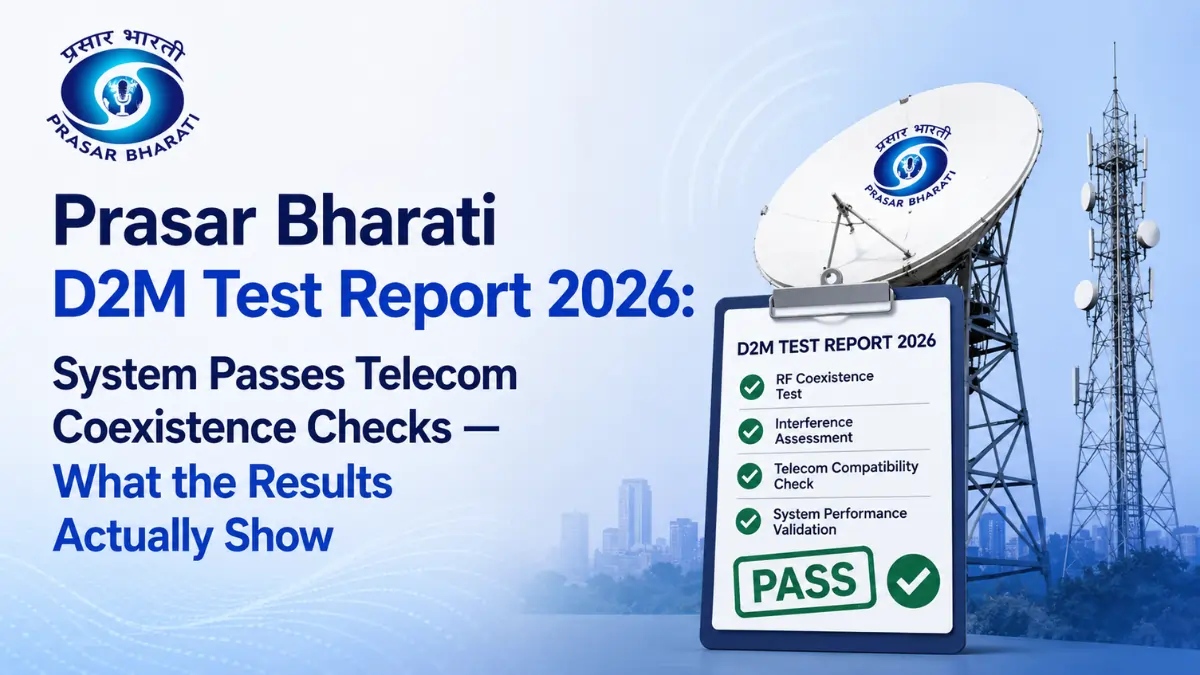
Prasar Bharati’s D2M test report for 2026 is out — and the public broadcaster says Direct-to-Mobile (D2M) broadcasting in the 470–582 MHz band has cleared every telecom coexistence parameter tested so far. Lab evaluations conducted in Bengaluru and field tests conducted in Delhi recorded zero call failures, 100 percent SMS success, and strong signal improvement through Single Frequency Network (SFN) operation. For a technology that has been disputed for months, this round of testing represents a significant step forward — though it does not settle every outstanding question.
The results were published on 18 May 2026 and cover three distinct exercises: a laboratory evaluation of the D2M Broadcast Radio Head, a field verification of mobile voice call and SMS behaviour during active D2M playback, and an SFN performance demonstration in central Delhi. The exercise involved IIT Kanpur, Telecommunication Engineering Centre (TEC), the Wireless Planning and Coordination (WPC) wing of the Department of Telecommunications (DoT), the Ministry of Electronics and Information Technology (MeitY), the Department of Science and Technology (DST), and the Ministry of Information and Broadcasting (MIB).
📌 Also Read: How to Fill Your Census 2027 Self Enumeration Form Online – Step-by-Step Method
From Lab to Delhi Streets: How the Tests Were Actually Conducted
The laboratory tests took place on 13 March 2026 at Aracion Technology Private Limited in Bengaluru — a TEC-recognised facility. The evaluation focused on three technical parameters for the 40W D2M Broadcast Radio Head operating in the 470–582 MHz band: base station transmit power, spurious emissions, and adjacent-channel leakage ratio (ACLR).
Across three frequency points — 474 MHz (lower band), 522 MHz (mid band), and 578 MHz (upper band) — the measured transmit power ranged from 45.75 dBm to 47.24 dBm. All readings were marked as pass. The test confirmed the D2M Broadcast Radio Head met the 3GPP Category B spurious emission limits across a sweep from 9 kHz to 2.910 GHz, covering harmonic regions that are often a hidden source of interference. Adjacent-channel leakage performance also cleared the defined acceptance limits across all three band positions.
The field tests followed on 25 March 2026, this time on the streets of Delhi, using a MarkOne D2M handset and Samsung smartphones fitted with a D2M dongle. Researchers ran 10 call attempts each under four different test conditions — Jio 4G, Jio 5G, Airtel 4G, and Airtel 2G — while D2M content was actively streaming.
The result: zero call blocks, a 100 percent call setup success rate, and a 100 percent SMS delivery rate across all four network configurations. In other words, D2M streaming did not disrupt voice calls or text messages in any tested scenario.
💡 That matters because the biggest concern raised by telecom operators since the November 2025 tests has been whether D2M could crowd out voice and data services on live networks — especially during high-traffic events like cricket matches or breaking news broadcasts.
📌 Also Read: DD Free Dish 97th MPEG-4 e-Auction 2026 Result
What the SFN Test in Delhi Revealed
Alongside the lab and field exercises, Prasar Bharati also demonstrated Single Frequency Network (SFN) operation in Delhi, using a combination of High Power High Tower (HPHT) transmitters and Low Power Low Tower (LPLT) units on 538 MHz in the Kartavya Path area.
SFN is the architecture that makes urban D2M rollout commercially viable. Instead of a single powerful transmitter trying to cover a city — which produces signal shadows and dead zones — SFN uses multiple synchronised transmitters that reinforce each other in overlap areas.
The test results bear this out quantitatively. At Central Vista Parking 2 on Kartavya Path, a single HPHT transmitter produced a weak baseline of approximately -78 dBm received signal strength indicator (RSSI) and 4 dB signal-to-noise ratio (SNR) — marginal conditions for a stable stream. Adding one LPLT unit alongside HPHT pushed RSSI to approximately -63 dBm and SNR to 22 dB. With additional synchronised LPLT sites active, the test recorded -49 dBm to -58 dBm RSSI and 23–30 dB SNR across measurement points. Audio and video reception was described as notably more stable in overlap areas.
📌 The takeaway for any future D2M city deployment is practical: LPLT infrastructure in urban environments does not just improve signal strength — it meaningfully improves the quality and consistency of what reaches the viewer’s screen.
Why This Round of Tests Is Different from November 2025
This is not the first time Prasar Bharati has published D2M test results. The public broadcaster released its initial round of findings on 21 November 2025, covering interference and device heating concerns raised by telecom stakeholders. At the time, those results were disputed almost immediately by the Cellular Operators Association of India (COAI), which represents Reliance Jio, Bharti Airtel, and Vodafone Idea.
COAI’s criticism had two edges. First, on process: the November 2025 tests were conducted without the active participation of telecom operators, device manufacturers, or chipset vendors. COAI said this made the conclusions procedurally questionable, arguing that any credible evaluation required these parties at the table. Second, on scope: the association contended the tests only examined one technology standard — ATSC 3.0-based D2M — without assessing cellular broadcast alternatives that could accomplish similar goals without the spectrum conflict.
The February 2026 Committee of Secretaries (CoS) decision to clear the 470–582 MHz band for D2M and set a six-month Phase I rollout deadline for Prasar Bharati added policy momentum behind the technology. But COAI’s concerns about the evaluation framework were acknowledged: the CoS also directed a separate committee to be constituted to address stakeholder objections.
The updated Terms of Reference (ToR) for this round of testing were prepared following a 6 March 2026 meeting of nodal officers from DoT, MeitY, DST, the Department of Economic Affairs (DEA), and IIT Kanpur — chaired by the CEO of Prasar Bharati. The revised framework widened the institutional footprint of the exercise, bringing more regulatory bodies into the process. That widened participation is what distinguishes the May 2026 report from its November 2025 predecessor.
The timing is not coincidental. Publishing these results now, with IIT Kanpur, TEC, WPC, MeitY, DST, and MIB all named as participants, is a direct response to COAI’s transparency objection. Whether it is sufficient to satisfy telecom operators is another question.
📌 Also Read: Tejas Networks Clears Multi-Ministry D2M Broadcasting Trials — India’s Internet-Free Content Dream Just Got Real
What the Tests Did Not Cover — And Why That Still Matters
The May 2026 report is careful to define its own limits. The ToR for this phase explicitly excluded several parameters: Quality of Service (QoS) key performance indicators (KPIs) for data services, electromagnetic field (EMF) exposure measurements, device certification requirements, and regulatory and licensing implications.
Read alongside COAI’s January 2026 submissions, this exclusion list maps almost exactly to what the industry said was missing from the November 2025 round. The scope has expanded — but not all the way to where COAI wanted it.
For Prasar Bharati and the government, the logic is probably sequential: establish the baseline interference and coexistence results first, then move to broader QoS and EMF assessments in later phases. For COAI, the counterargument is that a phased approach still defers the evaluation of the most commercially sensitive parameters — the ones that bear most directly on 5G spectrum planning.
What the D2M Test Results Mean if You Follow Broadcasting or Telecom Policy
The D2M technology being tested is ATSC 3.0-based, which means content — live TV, Doordarshan (DD) channels, public interest broadcasts, emergency alerts — can be received on a compatible handset using broadcast spectrum, without consuming cellular data or even requiring a network connection. That is the fundamental use case: reach audiences in areas with poor connectivity, reduce data load on telecom networks during mass viewership events, and deliver emergency communications directly to devices.
India’s public broadcaster began its IIT Kanpur partnership on D2M as far back as 2019. A proof of concept was conducted in Bengaluru; a hybrid HPHT-LPLT pilot followed in Delhi, using the Pitampura television transmitter as HPHT and LPLT units around Kartavya Path — the same location now used for SFN testing. The continuity of the testing site is deliberate: Kartavya Path has been the demonstration window for D2M in Delhi, and the signal improvement data from that location has now appeared in two successive test cycles.
You can follow Prasar Bharati’s parallel digital expansion through the WAVES OTT platform and smart TV preinstall initiative and the WAVES OTT growth targets to understand how D2M fits into a broader broadcast convergence strategy. D2M is not a replacement for internet streaming — it is designed to run alongside it, handling mass reach while broadband handles interactivity and on-demand content.
For those tracking DD Free Dish and DD’s broader reach, the Delhi Film City–Prasar Bharati MoU for 2026 and the DD News Creators’ Corner initiative are useful context for where DD is heading as a content organisation even as D2M works through its regulatory clearances. There is also a BSNL dimension worth watching: BSNL’s network infrastructure has been discussed in the context of LPLT deployment, and the BSNL VRS 2026 developments give a sense of where that organisation’s workforce and capacity currently stands.
What Comes Next for D2M — The Six-Month Phase I Clock Is Ticking
The Committee of Secretaries’ February 2026 directive gave Prasar Bharati six months from that point to execute Phase I of D2M rollout. That window closes around August 2026. The May 2026 test results are, in effect, the technical documentation needed to sustain that timeline and demonstrate regulatory compliance at each stage.
What the next phase likely needs to produce:
- QoS KPI testing under real-world data service load conditions
- EMF exposure measurements across device types and usage scenarios
- A device certification framework that clarifies which handsets and dongles meet the standard
- Broader telecom operator involvement in the evaluation process — the standing COAI demand
Whether a broader stakeholder evaluation can be completed within the Phase I window is uncertain. But the trajectory is clear: the government has made a policy call on spectrum allocation, the CoS has set a deadline, and Prasar Bharati is publishing test results in cadence with that political commitment.
The outstanding question is whether COAI and the telecom industry will participate formally in the next evaluation round — or whether they will continue to contest the process from outside it.
Frequently Asked Questions
What is D2M technology and how does it work in India?
Direct-to-Mobile (D2M) is a broadcast technology that sends live TV content — including Doordarshan channels and public interest programming — directly to compatible mobile handsets using broadcast spectrum, without requiring cellular data or an internet connection. India is testing ATSC 3.0-based D2M in the 470–582 MHz frequency band.
Did the Prasar Bharati D2M tests show any interference with Jio or Airtel signals?
The May 2026 field test recorded zero call blocks and 100 percent call and SMS success across Jio 4G, Jio 5G, Airtel 4G, and Airtel 2G networks, while D2M content was actively streaming. The tests did not find evidence of D2M interfering with voice calls or SMS delivery under tested conditions.
Why did COAI object to the D2M tests done in November 2025?
COAI argued the November 2025 tests lacked transparency because they were conducted without the participation of telecom operators, device manufacturers, or chipset vendors. The industry body also said the evaluation focused only on ATSC 3.0-based D2M without assessing cellular broadcast alternatives, and that several critical parameters — including QoS KPIs, EMF exposure, and device certification — were not covered.
Has the government approved D2M for commercial rollout in India?
The Committee of Secretaries (CoS) approved allocation of the 470–582 MHz spectrum band for D2M in February 2026 and directed Prasar Bharati to execute Phase I within six months. A separate committee was also directed to address telecom industry concerns. Final commercial launch is subject to further testing, regulatory clearances, and device ecosystem readiness.
What is Single Frequency Network (SFN) and why does it matter for D2M?
SFN is an architecture where multiple transmitters broadcast the same content on the same frequency in a synchronised manner. In urban D2M deployment, combining High Power High Tower (HPHT) and Low Power Low Tower (LPLT) transmitters in SFN configuration significantly improves signal strength and reception consistency — especially in signal shadow areas. The Delhi SFN test showed SNR improving from 4 dB with a single HPHT to 23–30 dB with HPHT plus multiple LPLT units.
Which organisations were involved in the May 2026 D2M tests?
The tests were carried out with the involvement of IIT Kanpur, TEC (Telecommunication Engineering Centre), WPC (Wireless Planning and Coordination), MeitY, DST, MIB, and Aracion Technology Private Limited as the authorised technology partner. The laboratory tests were conducted at Aracion’s TEC-recognised facility in Bengaluru; the field tests were conducted in Delhi.
What D2M tests are still pending?
The May 2026 report explicitly excludes QoS KPI testing for data services and EMF exposure measurements from its scope. Device certification requirements and regulatory/licensing implications also remain outside the current Terms of Reference and are expected to be addressed in subsequent evaluation phases.
Summing up…
Prasar Bharati’s May 2026 D2M test report provides the clearest technical documentation yet that ATSC 3.0-based D2M transmission in the 470–582 MHz band does not disrupt mobile voice calls or SMS on live 4G, 5G, and 2G networks — at least under the conditions tested. The SFN results from Kartavya Path add concrete signal strength data to what has largely been a theoretical debate about urban deployment viability.
What the report does not do is close the argument. The exclusion of QoS KPIs and EMF measurements means the full technical picture remains incomplete, and COAI’s demand for broader stakeholder participation in the evaluation process has not yet been formally met. With the Phase I clock ticking toward August 2026, the next few months will determine whether D2M moves from a promising pilot to a functioning public broadcast service — and whether the telecom industry is at the table when it does.
Important Links
| Resource | Link |
|---|---|
| Prasar Bharati Official Website | prasarbharati.gov.in |
| TEC (Telecom Engineering Centre) | tec.gov.in |
| MIB (Ministry of Information & Broadcasting) | mib.gov.in |
| Source Article | Read here |
Disclaimer: This article is based on publicly available test reports and news sources. It is intended for informational purposes only. Readers are advised to refer to official notifications from Prasar Bharati, DoT, and MIB for authoritative guidance on D2M policy and rollout timelines.








1 thought on “Prasar Bharati D2M Test Report 2026: System Passes Telecom Coexistence Checks — What the Results Actually Show”