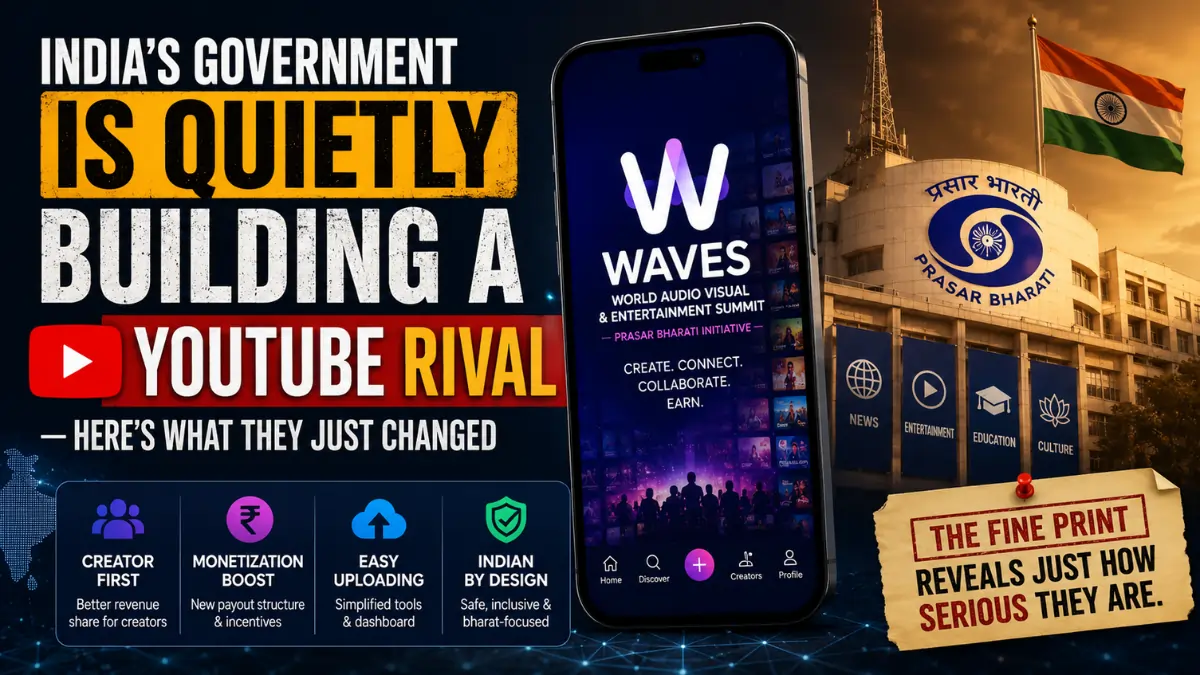
Prasar Bharati is quietly rebuilding its state OTT platform WAVES into a full-blown creator economy — and the fine print reveals just how serious they are.
For decades, “Prasar Bharati” and “creator economy” belonged in two completely different sentences. One was the stodgy home of Doordarshan reruns. The other was YouTube, Instagram Reels, and influencers pulling in crores from brand deals. But a quietly updated policy document is now blurring that line in a way the media industry didn’t expect.
According to a report by exchange4media, Prasar Bharati has overhauled the content sourcing framework for its OTT platform WAVES — and the changes go far beyond a routine policy update. The public broadcaster’s recently updated content sourcing framework for WAVES introduces a streaming-minutes-based monetisation model and tightening of verification and compliance requirements.
Translation: India’s state broadcaster wants a piece of the creator economy pie. And it’s building the machinery to actually compete for it.
From Government Broadcaster to Platform Operator
The shift here isn’t cosmetic. Industry insiders describe it as an attempt by Prasar Bharati to transform its public broadcasting model by developing its OTT service, WAVES, into a platform that fosters a creator economy, moving beyond traditional content acquisition to a more hybrid model similar to YouTube and other digital marketplaces.
One senior media executive, speaking anonymously, framed it bluntly: this looks less like a policy tweak and more like an attempt to build a structured digital content marketplace under the Prasar Bharati banner — with the open question being whether WAVES can actually pull creators away from YouTube, Meta, and commercial OTT platforms where they already make their living.
That’s a massive ask. But the details of the new framework suggest Prasar Bharati isn’t approaching this casually.
Creators Get Paid for Watch Time, Not Just Views
Here’s where it gets interesting for anyone who’s ever tried to make money online: WAVES is ditching the old-school licensing-fee model in favor of something that sounds a lot more like YouTube’s playbook.
Instead of a flat fee for content, payouts will now be tied to actual streaming consumption — how long people watch, not just whether they click. Industry analysts point out that this mirrors a broader shift across streaming platforms globally, where watch time has become the metric that actually matters because, unlike view counts, it’s much harder to game.
The platform is also throwing its doors open to formats it previously would have ignored entirely: creator-led programming, microdramas, short-form video, educational entertainment, music content, documentaries, and digital-first productions. Microdramas and creator-driven formats in particular are being read as a signal — these are the formats that have exploded worldwide over the past couple of years, and their inclusion means WAVES wants to be more than a public broadcaster’s streaming app.
The Paperwork That Should Worry Every Aggregator
Before anyone gets too excited about a new revenue stream, there’s a catch — and it’s a big one.
The revised onboarding process now demands a mountain of documentation: declarations, affidavits, indemnities, ownership certifications, and proof covering everything from rights history to exclusivity status to third-party clearances. Multiple executives compared the rigor to the kind of institutional rights-verification processes usually reserved for major broadcasters and global streaming giants — not the loose, informal deal-making that’s typical of India’s fragmented digital content world.
A media and entertainment lawyer put it plainly: the paperwork might look excessive on the surface, but as platforms scale, rights disputes become inevitable — and if WAVES is preparing for a much bigger content catalogue, tighter rights verification isn’t optional, it’s essential.
In other words: this isn’t a platform looking for a quick content dump. It’s building infrastructure meant to survive scale and legal scrutiny.
Creators Now Have to Bring Their Own Audience
Perhaps the most telling shift is what WAVES is now demanding from creators, not just offering them.
Content providers are being asked to submit detailed marketing and audience-engagement plans — covering promotional strategy, social media activity, influencer collaborations, and outreach initiatives — before they even get onboarded. It’s a clear signal that having good content isn’t enough anymore; platforms want creators who show up with an audience already in hand, not ones who expect the platform to build it for them.
That’s a real departure from how public broadcasting has traditionally worked, where the institution curated and pushed content to a captive audience. Now, creators are expected to be co-marketers of their own work.
Can a Government Platform Actually Compete With YouTube?
That’s the billion-rupee question hanging over all of this. As one media investor tracking India’s digital entertainment sector noted, this might be one of the first serious attempts by a public broadcaster anywhere to build a structured creator marketplace around a national OTT platform — but creator economies only work when audiences, creators, and monetisation all grow together, and that’s the hard part.
Whether WAVES can go from a policy overhaul to a genuine destination where creators choose to build careers remains to be seen. Audience scale, real earnings for creators, and engagement numbers will be the real test — not the ambition of the framework itself.
But one thing is clear: the era of Prasar Bharati as a passive broadcaster is ending. Whether WAVES becomes India’s answer to YouTube or a well-intentioned experiment that never scales, the government just signaled it wants a real seat at the creator economy table.
Important Links
| What | Link |
|---|---|
| Prasar Bharati Official Website | prasarbharati.gov.in |
| Prasar bharati Pay-Per-View (PPV) Content sourcing Policy 2026 (Updated) | Click Here |
| Earlier D2M Validation Report | Read Here |
| MyWAVES Platform Coverage | Read Here |
| WAVES OTT Coverage | Read Here |
| All Prasar Bharati Updates | Browse Category |
Disclaimer: This article is a commentary piece based on Prasar bharati Pay-Per-View (PPV) Content sourcing Policy 2026 (Updated) and is not an official statement from Prasar Bharati, WAVES, or any government body. Quotes attributed to industry executives, analysts, and consultants are drawn from the publicly available article, in which they were granted anonymity by the original publication. Headline framing (e.g., “YouTube rival”) reflects editorial interpretation for engagement purposes and should not be read as an official characterization by Prasar Bharati or WAVES of their own platform strategy. Details of the content sourcing framework are current as of the original report’s publication date and may be revised by Prasar Bharati without notice. Readers seeking authoritative or legal detail on WAVES’ policies should consult official Prasar Bharati/WAVES communications directly.