
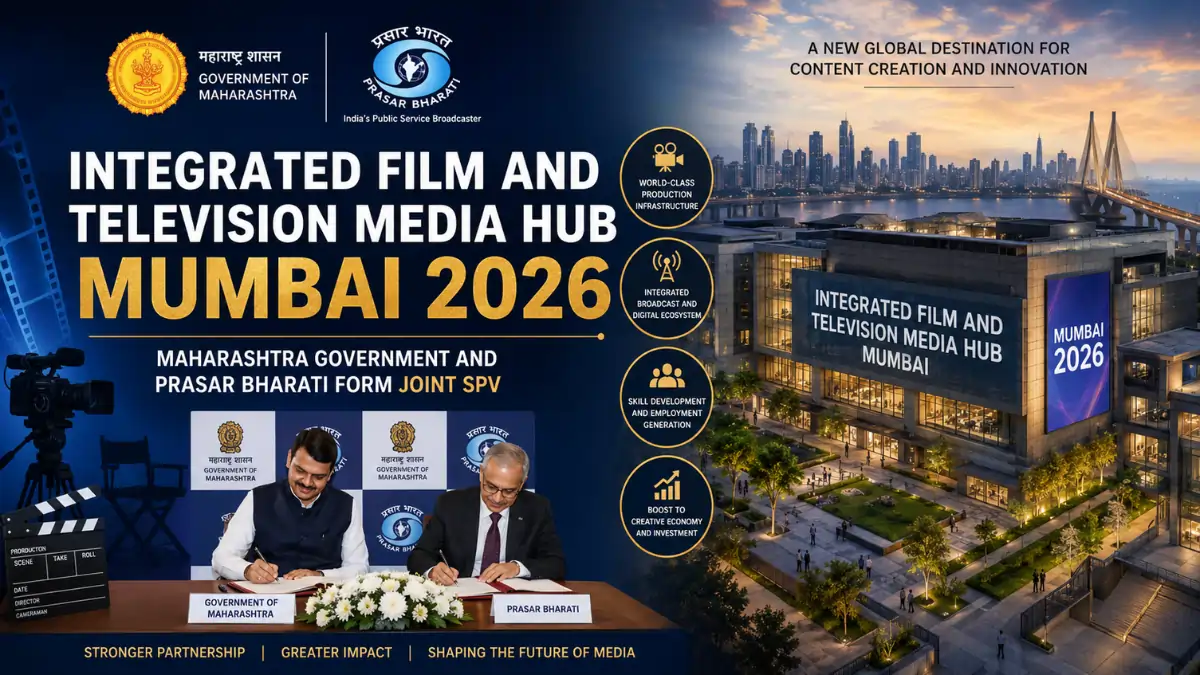
Maharashtra is making its biggest bet yet on the entertainment economy. The state government and India’s public broadcaster Prasar Bharati have joined hands to develop a world-class Integrated Film and Television Media Hub on Prasar Bharati’s sprawling land parcel in Malad, Mumbai — and the project has moved from MoU to formal Special Purpose Vehicle (SPV) formation in a matter of months.
Chief Minister Devendra Fadnavis approved the SPV on 03 June 2026, following a review meeting on the Memorandum of Understanding (MoU) already signed between Prasar Bharati, the Maharashtra Industrial Development Corporation (MIDC), and the Maharashtra Film, Theatre and Cultural Development Corporation (MFTCDC). With approximately 150 acres earmarked for joint development, this project could fundamentally reshape Mumbai’s position as Asia’s premier media production destination.
📌 Also Read: Prasar Bharati Latest News — DD News & Akashvani Updates for Govt Employees
Table of Contents
Prasar Bharati – Maharashtra Media Hub 2026 — Quick Overview
| Detail | Information |
|---|---|
| Project Name | Integrated Film and Television Media Hub |
| Location | Malad, Mumbai, Maharashtra |
| Land Area for Development | ~150 acres (out of 278 acres total) |
| Land Owner | Prasar Bharati / All India Radio (AIR) |
| Joint Venture Structure | Special Purpose Vehicle (SPV) |
| Partners | Government of Maharashtra + Prasar Bharati |
| MoU Signatories | Prasar Bharati, MIDC, MFTCDC |
| SPV Approved On | 03 June 2026 |
| Approved By | CM Devendra Fadnavis |
| Development Plan Deadline | End of June 2026 |
| Nearby Infrastructure | Goregaon Film City (Dadasaheb Phalke Chitranagari) |
What Exactly Is Being Built?
The proposed hub is not a single studio — it is a full-stack media and entertainment ecosystem. Think of it as a self-contained destination that covers every stage of the content creation pipeline, from pre-production training to post-production finishing, hospitality, and tourism.
The proposed media hub will feature state-of-the-art film studios, sound stages, hospitality services, IT and ITES infrastructure, and tourism development projects. It will also house international-standard film and music training institutes established in collaboration with renowned global institutions.
Here is a breakdown of what is planned:
| Facility Type | Details |
|---|---|
| Film Studios | World-class production studios with modern equipment |
| Sound Stages | Dedicated sound stages for film and television shoots |
| IT & ITES Infrastructure | Tech support for digital production, post-production, VFX |
| Hospitality | Hotels and allied services for film crews and visitors |
| Tourism Development | Film tourism experiences linked to Bollywood heritage |
| Training Institutes | International-standard film and music education centres |
| Media Production Services | Allied support for content creation at scale |
💡 The hub is designed to function as a complete media and entertainment destination — not just a studio complex — with production, training, and commercial facilities all under one umbrella.
The Land: 150 Acres of Repurposed Akashvani Property in Malad
The site at the heart of this project belongs to All India Radio (AIR), which operates under Prasar Bharati. Out of Prasar Bharati’s total 278-acre land parcel in Malad, approximately 150 acres are proposed for joint development alongside Film City. As most of All India Radio’s broadcasting shifts to FM systems, the unutilised land will be effectively repurposed to expand the media and entertainment sector.
This repurposing is smart policy. As AIR’s MW and SW transmitter operations wind down with the shift to digital and FM broadcasting, vast tracts of prime Mumbai land — previously occupied by transmission infrastructure — are becoming available. Converting this into a media hub keeps the land within the public broadcasting ecosystem while unlocking its economic potential.
Prasar Bharati CEO Gaurav Dwivedi pointed out the geographical proximity between Mumbai’s Film City and Prasar Bharati’s Akashvani land in Malad, which despite being close, have evolved separately. “Due to various reasons, these areas have developed independently. But with the Government of India and the Maharashtra government now aligned in their vision for focused development of the media sector, the need for collaboration became essential,” he said.
📌 Also Read: NPS vs UPS Calculator — Choose the Right Pension Scheme for Prasar Bharati Employees
The SPV Structure — How Will It Work?
A Special Purpose Vehicle (SPV) is a dedicated legal entity created specifically for a single project. In this case, the SPV is a joint venture between the Government of Maharashtra and Prasar Bharati, structured to pool land, institutional support, and financial resources from both sides.
CM Fadnavis approved the formation of the Special Purpose Vehicle (SPV), a joint venture between the Government of Maharashtra and Prasar Bharati, to develop a world-class Integrated Film and Television Media Hub at the All India Radio (Prasar Bharati) land in Malad. The decision followed a review meeting chaired by the Chief Minister regarding the Memorandum of Understanding (MoU) signed with Prasar Bharati.
The three-way MoU between Prasar Bharati, MIDC, and MFTCDC lays the legal and institutional groundwork. The SPV will now operate as the executing entity, responsible for all planning, development, and commercial decisions going forward.
Regulatory Hurdles — NDZ and CRZ Clearances Required
The Malad land is not without complications. CM Fadnavis noted that since the land is currently governed by No Development Zone (NDZ) and Coastal Regulation Zone (CRZ) regulations, development is restricted to a limited area. To facilitate comprehensive development, necessary statutory clearances, regulatory amendments, and modifications to the Development Control Regulations (DCR) will be undertaken, with the state government extending full cooperation.
This is a significant commitment. Getting CRZ modifications and DCR amendments approved typically requires coordination between the state urban development department, the Maharashtra Coastal Zone Management Authority, and the Ministry of Environment, Forest and Climate Change at the central level. The state government’s explicit commitment to “extend full cooperation” signals that these clearances will be fast-tracked.
⚠️ Until these regulatory clearances are obtained, only a portion of the 150-acre plot can be developed. The eventual scope of the project depends significantly on how much of the CRZ and NDZ restrictions can be relaxed.
What Happens Next — Timeline and Action Points
The Chief Minister directed the appointment of a consultancy firm for a pre-feasibility study and action plan. A joint working committee is to be formed for the Detailed Project Report and technical work, and the development plan is to be finalised by the end of June 2026.
Here is the near-term roadmap:
| Action | Timeline |
|---|---|
| Appointment of consultancy firm for pre-feasibility study | Immediately / June 2026 |
| Formation of joint working committee (DPR and technical work) | June 2026 |
| Finalisation of development plan | By end of June 2026 |
| Preparation of Detailed Project Report (DPR) | Following committee formation |
| Regulatory amendments (NDZ/CRZ/DCR) | Parallel track — ongoing |
| Construction and development phase | Post-DPR approval |
The government’s decision to set a hard deadline of June 2026 for the development plan is unusual and reflects the political priority being given to this project.
Where Does This Fit in India’s Broader Creative Economy Push?
This project does not exist in isolation. It is part of a much larger national strategy to position India as a global content production superpower.
The Union Minister and the Chief Minister presided over the MoU exchange between Prasar Bharati and the Maharashtra Film, Stage and Cultural Development Corporation Limited to establish a film and TV media hub promoting innovation and global competitiveness. CM Fadnavis and Union Minister Ashwini Vaishnaw also inaugurated the WAVES Bharat Pavilion at Gulshan Mahal, launched the IICT logo and 17 industry-aligned courses, and released the Outcome Reports of WAVES 2025’s first edition.
The World Audio Visual and Entertainment Summit (WAVES) — launched by the Ministry of Information and Broadcasting — has become the annual flagship event driving India’s media economy agenda. The Malad hub is directly linked to this WAVES ecosystem, aligning with the government’s push for the Indian Institute of Creative Technology (IICT) and the broader AVGC (Animation, Visual Effects, Gaming and Comics) policy.
Maharashtra is also not the only state moving in this direction. The Delhi Government signed a Memorandum of Understanding with Prasar Bharati to develop the national capital into a global media hub, with the initiative aimed at creating a state-of-the-art integrated ecosystem bringing together film, television, animation, visual effects, gaming and comics on a single platform. The competition between state governments to capture India’s booming content economy is intensifying — and Mumbai’s Malad hub gives Maharashtra a significant head start.
📌 Also Read: 8th CPC Salary Calculator — Estimate Your Pay Revision
What This Means for Prasar Bharati Employees
For employees of Prasar Bharati — particularly those at the Akashvani Mumbai centre in Malad — this project brings both opportunity and uncertainty. The repurposing of transmitter land suggests that AIR’s operational footprint at the Malad facility will continue to shrink as FM and digital broadcasting takes over. However, the creation of the media hub also opens the possibility of new roles and collaborations for Prasar Bharati staff in content production, training, and commercial management.
The SPV structure means the new entity will function somewhat independently from Prasar Bharati’s regular organisational structure, though Prasar Bharati will be a stakeholder and contributor. Employees in technical broadcast roles should watch for any official communication from the Prasar Bharati head office on how the transition of land and facilities will be managed.
⚠️ No Prasar Bharati employee relocation or retrenchment has been announced. If you are a Prasar Bharati employee affected by or interested in this project, keep track of official circulars from Prasar Bharati House, New Delhi.
📌 Also Read: MACP Eligibility Checker — Check Your Upgradation Status
Frequently Asked Questions
What is the Integrated Film and Television Media Hub in Mumbai?
It is a world-class media production and entertainment complex being developed jointly by the Maharashtra Government and Prasar Bharati on approximately 150 acres of All India Radio land in Malad, Mumbai. The hub will include film studios, sound stages, IT and ITES infrastructure, hospitality facilities, film tourism projects, and international-standard training institutes for film and music. A Special Purpose Vehicle (SPV) — a joint venture between Maharashtra and Prasar Bharati — was formally approved on 03 June 2026 to develop and manage the project.
Where exactly is the media hub being built?
The project is located at Prasar Bharati’s All India Radio (Akashvani) land in Malad, Mumbai. The total land parcel is 278 acres, of which around 150 acres will be used for the media hub development. The site is located near Goregaon Film City (officially called Dadasaheb Phalke Chitranagari), which makes it a natural extension of Mumbai’s existing film production infrastructure.
Who signed the MoU for this project?
A tripartite MoU was signed among Prasar Bharati, the Maharashtra Industrial Development Corporation (MIDC), and the Maharashtra Film, Theatre and Cultural Development Corporation (MFTCDC). The MoU was originally signed during the Indian Institute of Creative Technology (IICT-NFDC) campus inauguration event in Mumbai, and was followed by the formal approval of the SPV by CM Devendra Fadnavis on 03 June 2026.
What are the regulatory challenges for this project?
The Malad land is governed by No Development Zone (NDZ) and Coastal Regulation Zone (CRZ) regulations, which restrict the type and scale of development permitted. To enable full development across 150 acres, the Maharashtra government has committed to pursuing necessary statutory clearances, amendments to Development Control Regulations (DCR), and other regulatory changes. These clearances involve multiple state and central bodies and will take time to obtain.
What is a Special Purpose Vehicle (SPV) and why is it used here?
An SPV is a separate legal entity created for a specific project. Using an SPV allows the Maharashtra government and Prasar Bharati to pool their resources — land, funding, and institutional capacity — without merging their main organisations. The SPV will be responsible for planning, developing, and managing the Integrated Film and Television Media Hub independently. This structure is commonly used for large public-private infrastructure projects in India.
How does this project relate to WAVES?
The World Audio Visual and Entertainment Summit (WAVES) is an annual event led by the Ministry of Information and Broadcasting to drive India’s creative economy. The Malad media hub is a direct output of the WAVES ecosystem — the original MoU between Prasar Bharati and MFTCDC was signed at a WAVES-related event. The project aligns with WAVES’ broader goals of creating a global content production ecosystem in India, supported by IICT and the AVGC sector policy.
When will the Malad media hub be ready?
No final completion timeline has been announced. The immediate priorities are: appointing a consultancy firm for a pre-feasibility study, forming a joint working committee, and finalising the development plan by end of June 2026. The Detailed Project Report (DPR) will follow. Actual construction is expected to begin only after regulatory clearances (NDZ/CRZ/DCR) are obtained, which could take one to two years.
Summing Up…
The Maharashtra–Prasar Bharati Integrated Film and Television Media Hub in Malad is one of the most significant media infrastructure projects announced in India in recent years. With 150 acres of prime Mumbai land, the backing of the state government, and alignment with the central government’s WAVES and AVGC strategy, it has the potential to create thousands of jobs across the media production value chain — from directors and cinematographers to IT professionals, hospitality workers, and trainers.
The immediate test is whether the regulatory hurdles — NDZ and CRZ clearances — can be resolved quickly enough to keep the project on schedule. If they can, Mumbai will have a powerful new media quarter sitting alongside the existing Film City, cementing the city’s position as India’s undisputed entertainment capital for decades to come.
Bookmark GovtServiceInfo.com and join our Telegram channel for the latest updates on this project, Prasar Bharati employee news, and all central government developments.
Disclaimer: This article is based on officially reported information from government press releases and credible news sources as of 03–04 June 2026. Details of the DPR, final land use, and project scope are yet to be finalised by the joint working committee. For Prasar Bharati employee-specific queries, refer to official communications from Prasar Bharati House, New Delhi.



The idea for a media hub sounds interesting. I wonder how it will impact local filmmakers.