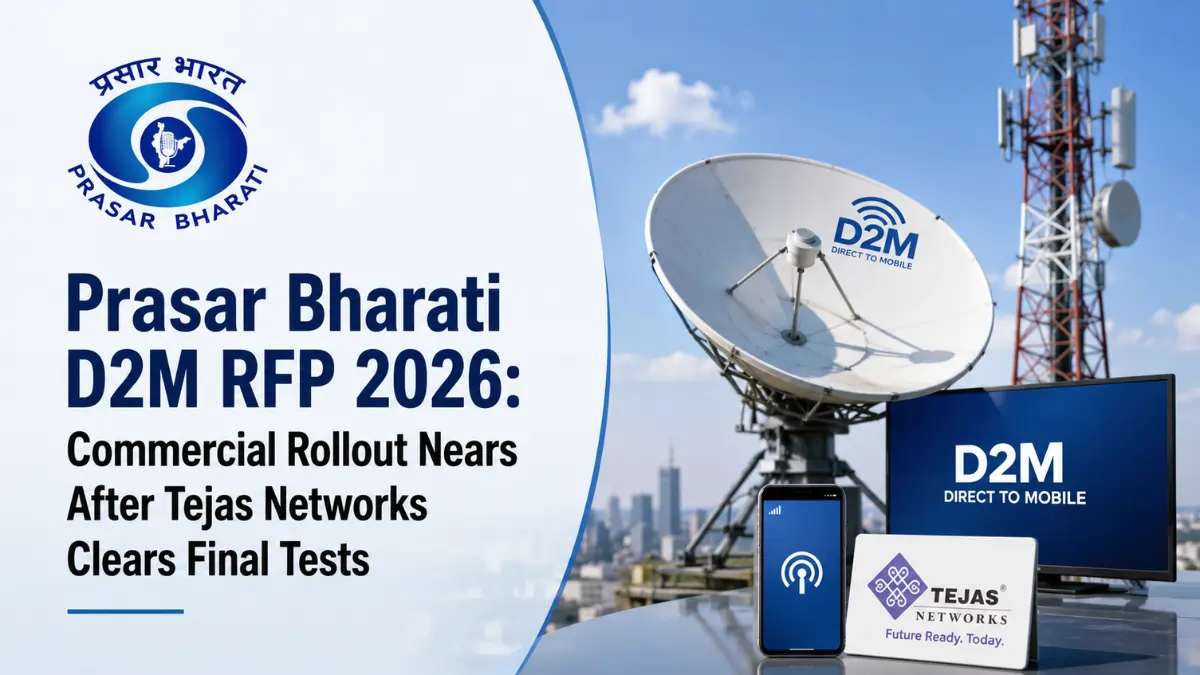
The Prasar Bharati D2M RFP 2026 is expected to be floated by July, after equipment from Tejas Networks Ltd cleared a fresh round of validation tests for Direct-to-Mobile (D2M) broadcasting, according to people familiar with the matter. The Request for Proposal (RFP) is meant to identify implementation partners and lay out a roadmap for wider deployment — and it marks the moment D2M stops being a multi-year pilot project and starts becoming a procurement exercise with real commercial stakes.
The tests were conducted in the presence of representatives from the Ministry of Information and Broadcasting (MIB), the Ministry of Electronics and Information Technology (MeitY), the Department of Telecommunications (DoT), and Prasar Bharati itself — a level of multi-agency oversight that reflects how contested this technology has been. D2M broadcasting transmits video, audio, educational content, news updates and emergency alerts directly to compatible mobile devices using broadcast spectrum, bypassing both broadband and cellular data networks entirely.
People aware of the process say the validation has been completed and the RFP will likely be floated next month, with the immediate goal of identifying partners who can take the technology from trial to scale. That single step — moving from “tested” to “tendered” — is what separates this update from the string of policy announcements that have preceded it over the past year.
D2M RFP 2026 — Key Facts
| Detail | Information |
|---|---|
| Initiative | Commercial RFP for Direct-to-Mobile (D2M) broadcasting |
| Issuing Authority | Prasar Bharati, under Ministry of Information and Broadcasting (MIB) oversight |
| RFP Expected | July 2026 |
| Spectrum Band | 470–582 MHz |
| Equipment Validated | Tejas Networks Ltd (via Saankhya Labs) |
| Trial Footprint | 19+ Indian cities |
| Deployment Model Proposed | Public-Private Partnership (PPP), per EY’s roadmap |
| Target Reach | ~90 million TV-less households; 800 million+ smartphone users |
| Official Website | prasarbharati.gov.in |
Why D2M Has Taken This Long to Reach a Procurement Stage
D2M is not a new idea — proof-of-concept demonstrations in Delhi and Bengaluru established its basic feasibility years ago. What has changed recently is the policy machinery around it. In February 2026, the Committee of Secretaries (CoS) cleared the 470–582 MHz spectrum band for D2M use and gave Prasar Bharati a six-month deadline to execute Phase I of the rollout — a window that closes around August 2026, which puts real pressure behind a July RFP.
Around the same time, the Ministry appointed consultancy firm Ernst & Young (EY) as project management consultant to design a national D2M roadmap, including a commercial framework and revenue model. EY’s Detailed Project Report (DPR) was accepted by Prasar Bharati after multiple revisions and forwarded to the MIB in June 2026, recommending a Public-Private Partnership (PPP) structure in which private players bring capital and execution capacity while Prasar Bharati anchors the project on spectrum usage and public service delivery. A Parliamentary Standing Committee on Information and Communications Technology had also pushed the government to speed up these decisions, citing encouraging pilot results.
That sequence — spectrum clearance, a consultant-built roadmap, a parliamentary nudge — is what has built up to this month’s news. The RFP isn’t a standalone announcement; it’s the next mechanical step in a timeline the government set for itself five months ago.
What the Latest Validation Round Actually Proved
The validation tests that triggered this RFP timeline were run on equipment built by Tejas Networks Ltd, through its Saankhya Labs unit, and reviewed in documents seen by industry press. They followed an earlier, more detailed round of testing published in May 2026, which covered three separate exercises: a laboratory evaluation of the D2M broadcast radio head in Bengaluru, a field verification of mobile voice-call and SMS behaviour during live D2M playback in Delhi, and a Single Frequency Network (SFN) signal-strength demonstration in central Delhi. ✅ That round recorded zero call failures and 100 percent SMS success during active D2M transmission — the specific telecom-coexistence metrics operators had said were missing from earlier trials. You can read the fuller breakdown of that May 2026 validation report for the underlying numbers.
Separately, earlier studies commissioned by Prasar Bharati and conducted by the Indian Institute of Technology (IIT) Kanpur concluded that D2M broadcasting in the 470–582 MHz band does not cause harmful interference to cellular networks and does not result in abnormal heating in smartphones. All of this sits on top of an active pilot programme: Prasar Bharati, working with IIT Kanpur and Saankhya Labs, is currently running D2M trials across more than 19 cities, testing both high-power and low-power transmission architectures to determine which model scales best nationally.
In other words, the “validation” referenced in this latest update isn’t a one-off lab result — it’s the most recent layer in a stack of tests built specifically to answer the telecom industry’s objections one at a time.
The Telecom Industry’s Pushback — and Why It Hasn’t Stalled the Process
That last point matters because the testing process has been genuinely contested. The Cellular Operators Association of India (COAI), which represents Reliance Jio, Bharti Airtel and Vodafone Idea, disputed Prasar Bharati’s first round of findings almost as soon as they were released in November 2025. COAI’s objection had two parts: on process, it argued the tests were run without telecom operators, device manufacturers or chipset vendors at the table, making the conclusions procedurally weak; on scope, it said the evaluation looked only at one technology standard and skipped comparable cellular-broadcast alternatives, while leaving out parameters like electromagnetic field (EMF) exposure and device certification.
In January 2026, COAI formally asked the government to redo the technical evaluation altogether. The pushback didn’t stop the CoS from clearing the spectrum band the following month — but it did shape the process. The CoS decision came with a parallel directive to set up a separate committee specifically to examine telecom-sector concerns, and the updated terms of reference for this latest round of testing were drafted after a March 2026 meeting of nodal officers from DoT, MeitY, the Department of Science and Technology, and the Department of Economic Affairs, chaired by Prasar Bharati’s CEO.
That matters because it means the RFP is arriving with telecom objections acknowledged, not ignored — even if COAI itself remains unconvinced that revenue and spectrum-planning concerns have been fully addressed.
The Numbers Behind the Push: 90 Million Households With No TV
The government’s confidence in D2M rests on a fairly stark access gap. Data from Chrome OTT (COTT) cited in industry coverage estimates that India has 1.206 billion digital users, including 1.169 billion smartphone users and 404 million connected-TV users, with roughly 417 million people using more than one device. Put together, India has close to 1.28 billion video viewers across linear television, smartphones and connected TVs — about 89 percent of the population — and 84 percent of them currently consume video through internet-based platforms.
The gap D2M is built to close sits in the remaining numbers. Of India’s roughly 280 million households, only about 190 million have access to television services, leaving close to 90 million households outside the TV ecosystem entirely. Against that, India has an estimated 800 million smartphone users and another 250 million feature-phone users — far more devices than there are TV connections. For a household with a smartphone but no television and unreliable or expensive mobile data, D2M is pitched as a way to receive video, education content and emergency alerts without needing either a TV subscription or a data plan.
What This Means for Prasar Bharati and Doordarshan Employees
If you work at Prasar Bharati or Doordarshan, this RFP is the point where D2M stops being a technical pilot you’ve heard about and starts becoming a procurement process that will shape how content actually reaches viewers. The PPP model recommended in EY’s roadmap means private partners will likely handle a significant share of execution and capital — which changes the kind of coordination, technical liaison and operational roles Prasar Bharati staff may be asked to take on as the project scales beyond pilot cities.
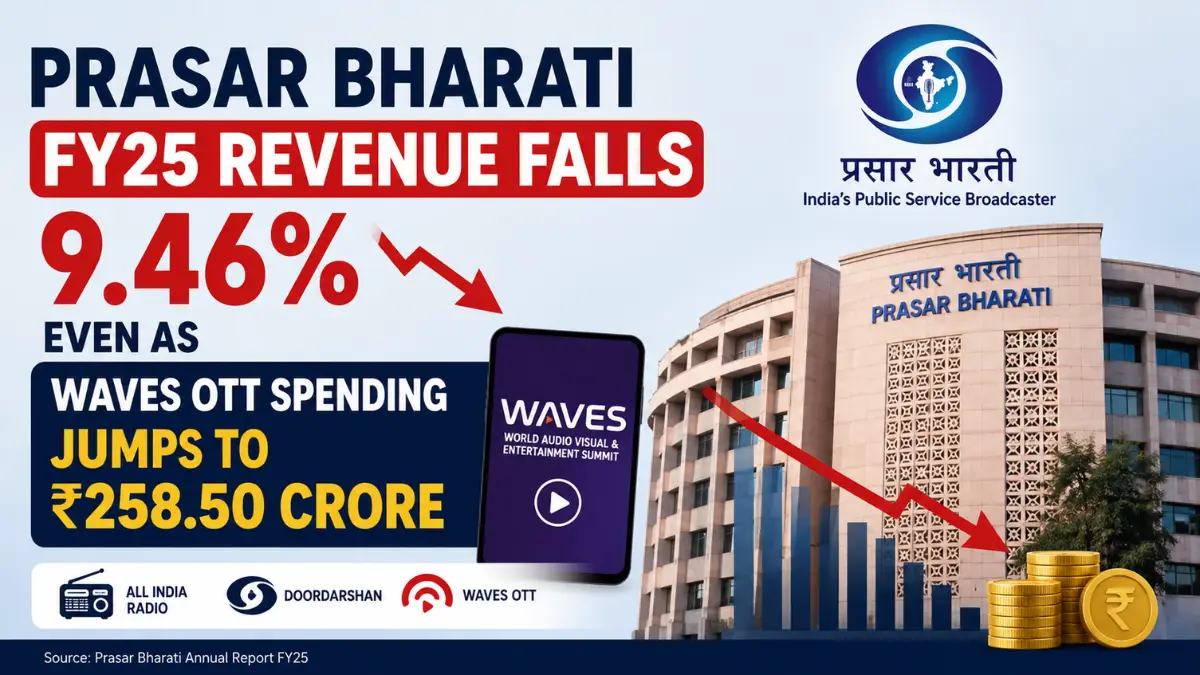
You don’t need to do anything immediately. No staffing changes, transfers or role redesigns connected to D2M have been officially announced, and specifics on how distribution, technical and content teams will be organised around a commercial rollout are [to be announced] once the RFP results are in. What is worth tracking is the pattern: D2M sits alongside WAVES OTT and other recent moves as part of a broader shift in how Prasar Bharati positions itself — not solely as a content broadcaster, but increasingly as the infrastructure layer for how that content reaches people, whether over the internet through platforms like WAVES OTT or over the air through D2M.
The Bigger Picture — A Sovereign Distribution Network, Not Just a Tech Trial
Officials involved in the project have described D2M’s appeal in terms of sovereignty as much as access: the ability to deliver emergency alerts, educational programming and public advisories without depending on network congestion or mobile data availability is being framed as a national capability, not just a broadcast feature. Read alongside Prasar Bharati’s other recent digital pushes — including the MyWAVES creator platform and the broader WAVES OTT streaming push — D2M completes a two-sided strategy: own the internet-delivered distribution layer through WAVES, and own the internet-independent layer through D2M.
That dual approach is also why the PPP framework matters so much to how this plays out. Broadcasters have largely welcomed D2M because it offers a distribution path independent of telecom infrastructure, but industry executives have cautioned that without a clear monetisation model — advertising, subscription or public funding — long-term scalability remains uncertain. The RFP, when it lands, should start answering exactly that question: who pays for D2M, and how.
What Comes Next — The RFP, the August Deadline, and the Road to Commercial Launch
The immediate marker to watch is the RFP itself, expected in July 2026. Behind it sits the CoS’s six-month Phase I deadline from February 2026, which closes around August 2026 — meaning the RFP timeline isn’t arbitrary; it’s built to meet a government-imposed clock. Earlier reporting from February 2026 placed commercial D2M launches roughly a year and a half out from that point, which would put a realistic nationwide commercial rollout sometime in late 2027, though that timeline depends entirely on how quickly the RFP process identifies and onboards partners.
⚠️ None of this is locked in yet. The RFP could still narrow or expand scope based on bids received, and COAI’s objections haven’t disappeared simply because testing has continued. 📌 For Prasar Bharati’s other ongoing digital initiatives — from WAVES OTT to DD Free Dish auctions — track the Prasar Bharati category page for connected updates as they land.
Important Links
| What | Link |
|---|---|
| Prasar Bharati Official Website | prasarbharati.gov.in |
| Earlier D2M Validation Report | Read Here |
| MyWAVES Platform Coverage | Read Here |
| WAVES OTT Coverage | Read Here |
| All Prasar Bharati Updates | Browse Category |
Frequently Asked Questions
What is D2M (Direct-to-Mobile) broadcasting technology?
D2M is a broadcast technology that delivers video, audio, educational content, news and emergency alerts directly to compatible mobile devices using broadcast spectrum — without needing an internet connection or mobile data. It works similarly to how a TV or radio signal reaches a receiver, except the receiver here is a smartphone.
When will Prasar Bharati issue the D2M RFP?
The Request for Proposal (RFP) is expected to be floated in July 2026, following the completion of the latest round of technology validation tests on Tejas Networks’ equipment.
Which spectrum band has been cleared for D2M broadcasting in India?
The Committee of Secretaries (CoS) cleared the 470–582 MHz band for D2M use in February 2026, after IIT Kanpur’s studies found it does not interfere with cellular networks or cause abnormal device heating.
Does D2M broadcasting need internet or mobile data to work?
No. D2M is designed specifically to bypass broadband and cellular data networks, transmitting content over broadcast spectrum directly to compatible devices — which is its main appeal for areas with unreliable or costly internet access.
Why are telecom operators opposing D2M broadcasting?
The Cellular Operators Association of India (COAI) has argued that earlier validation tests excluded telecom operators and device makers, covered too narrow a scope, and that dedicating spectrum to D2M could affect mobile video revenue, which is central to 5G monetisation strategies.
Will D2M replace DD Free Dish or WAVES OTT?
No. D2M is being positioned as a third, complementary distribution layer — alongside DD Free Dish’s satellite delivery and WAVES OTT’s internet streaming — aimed specifically at users with smartphones but no TV connection or reliable data access.
Summing Up…
The Prasar Bharati D2M RFP 2026 doesn’t settle every question around this technology — COAI’s objections remain live, and the commercial framework is still being worked out through the PPP model EY has recommended. But it does mark a genuine shift: after more than a year of tests, committee reviews and stakeholder pushback, D2M is finally moving toward a stage where real companies bid for real implementation contracts. For the roughly 90 million Indian households without television access, that procurement process — however bureaucratic it sounds — is the step that actually decides whether D2M becomes a usable service or stays a long-running pilot.
Bookmark Govtserviceinfo.com and join our Telegram channel for instant alerts on Prasar Bharati employee news, MIB policy updates, and WAVES OTT developments.
Disclaimer: This article is based on reporting by Exchange4media (published 19 June 2026) and prior coverage of Prasar Bharati’s D2M validation tests, EY’s Detailed Project Report, and the Committee of Secretaries’ February 2026 spectrum decision. The RFP timeline, deployment model and commercial launch dates referenced here are based on statements from people familiar with the matter and have not been confirmed through an official Prasar Bharati or MIB notification at the time of publishing. Readers should verify current information from official government sources, including prasarbharati.gov.in, before acting on any information published here.