The 8th Pay Commission cadre management changes proposed by the National Council – Joint Consultative Machinery (NC-JCM) Staff Side could reshape the service structure for lakhs of central government employees. As the 8th Central Pay Commission (8th CPC) gathers data and inputs from various stakeholders to frame its recommendations, the Staff Side has submitted a detailed memorandum laying out five significant cadre reforms it wants implemented. These proposals touch everything from ending outsourcing of government jobs to fixing long-standing pay discrimination between secretariat staff and field office employees.
If you are a central government employee in Group B or Group C, or if you work in a field unit that has always been treated as a step below the Central Secretariat, these proposals are directly relevant to you. Read on to understand what the NC-JCM has demanded — and what it could mean for your service career.
📌 Also Read: 8th Pay Commission 2026 – Full Timeline, Updates and What to Expect
Join WhatsApp
Join NowJoin Telegram
Join NowTable of Contents
8th Pay Commission Cadre Management Proposals – At a Glance
| Detail | Information |
|---|---|
| Submitted By | NC-JCM Staff Side |
| Submitted To | 8th Central Pay Commission (8th CPC) |
| Document Type | Memorandum / Representation |
| Key Subject | Cadre Management Reforms for Central Govt Employees |
| Number of Proposals | 5 Major Changes |
| Applicable To | Group B and Group C Central Government Employees |
| Status | Under Consideration by 8th CPC |
| Official Website | 8thcpc.gov.in |
Background: Why Is NC-JCM Raising Cadre Management Issues Now?
The 8th Central Pay Commission was constituted by the Government of India to review the pay structure, service conditions, and allowances of central government employees. The Commission has been collecting memoranda from employee unions, service associations, and the Staff Side of the National Council – Joint Consultative Machinery (NC-JCM).
The NC-JCM Staff Side represents the interests of central government employees in joint consultations with the government. Their memorandum to the 8th CPC is one of the most closely watched submissions because it reflects the collective demands of central government employees across departments — from Railways and Defence to Postal and Income Tax.
Among the multiple concerns they have raised, cadre management stands out as a critical area. Employees in Group B and Group C categories have long suffered from irregular cadre reviews, pay disparities between departments, and the growing use of outsourcing that eliminates permanent government positions.
📌 Also Read: 8th Pay Commission: NC-JCM Lists 9 Key Demands
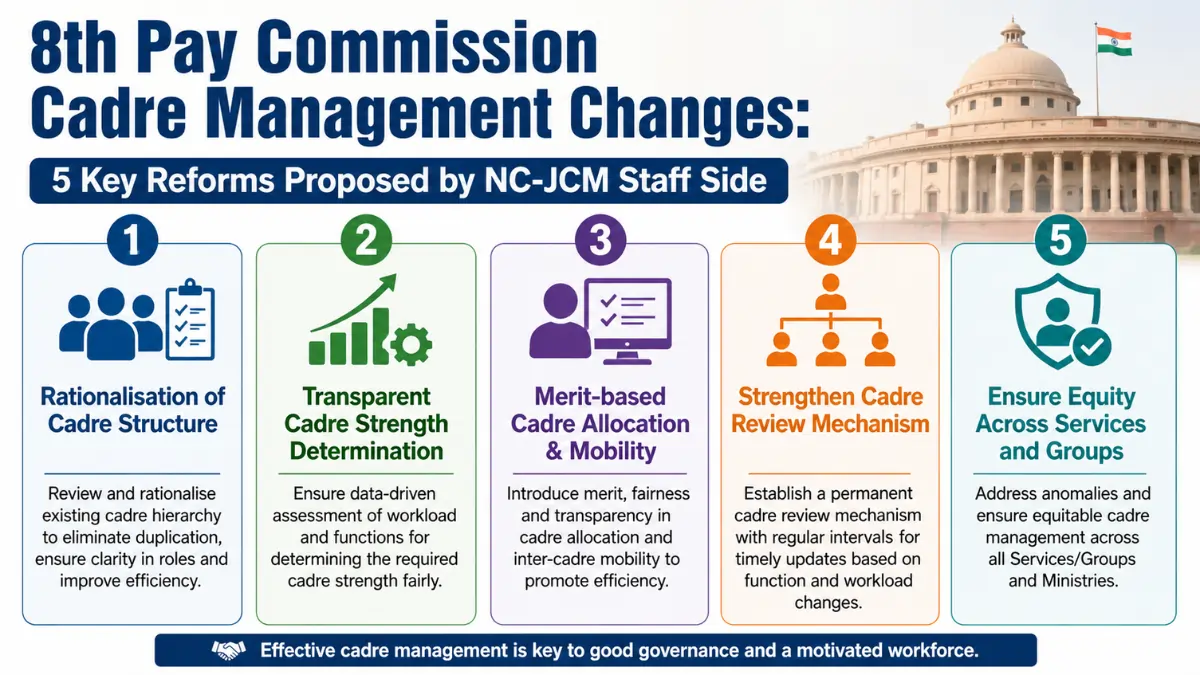
5 Cadre Management Changes Proposed by the NC-JCM Staff Side
1. Equal Pay for Equal Work — End Salary Discrimination Across Ministries
The single biggest demand in the cadre management section of the NC-JCM memorandum is the implementation of the constitutional principle of equal pay for equal work.
The Staff Side has pointed out that employees performing identical roles — with the same qualifications, skill requirements, and job responsibilities — are placed in different pay scales simply because they happen to belong to different ministries or departments. This creates an unequal and demoralising pay structure that the Staff Side argues is fundamentally unjust.
Their memorandum specifically states that disparity in pay scales and promotional prospects between one ministry and another — for identical categories of posts — must be done away with. The Hon’ble Supreme Court has upheld the constitutional principle of equal pay for equal work on multiple occasions, and the NC-JCM has cited these judicial precedents to strengthen its case.
In practical terms, this means if an employee working in the Ministry of Finance and an employee working in the Ministry of Railways are both performing the functions of a Junior Accounts Officer — with the same educational qualification and job profile — they must receive the same pay. Currently, inter-departmental pay gaps make this far from the reality.
What it means for you: If your pay scale is lower than a counterpart in another ministry doing the same work, this proposal — if accepted by the 8th CPC — could result in upward revision of your pay scale to match the higher-paying ministry.
2. Stop Outsourcing of Central Government Jobs
The NC-JCM Staff Side has made a firm demand: the 8th CPC should recommend ending the practice of outsourcing permanent central government jobs.
The memorandum has urged the Commission to recommend that all posts currently lying vacant in departments such as Railways, Defence, Postal, Income Tax, and Audit & Accounts be filled through direct recruitment and promotion instead of being handed over to private contractors or outsourcing agencies.
The Staff Side has outlined several compelling reasons for this demand:
- Outsourcing of permanent posts in central government departments is increasing every year, which harms both service quality and national interest.
- There are approximately 15 lakh posts lying vacant across central government ministries and departments. These vacancies are not because the posts are redundant — they exist because the government has delayed or avoided filling them. This puts enormous additional workload and stress on existing employees.
- Outsourced and contract workers are routinely exploited. The government, as a model employer, should not permit such exploitation within its own departments.
- During the COVID-19 pandemic, it was regular government employees — not outsourced workers — who kept essential government services running, often at great personal risk. Many lost their lives to COVID-19 infection in the line of duty. Yet even compassionate appointment was not granted to their dependents in several cases.
What it means for you: If this recommendation is accepted, it would mean more permanent government jobs being created and filled — reversing a trend that has seen thousands of government functions handed over to private contractors over the past decade.
3. Recruitment of Non-Gazetted Posts at Regional Level
Currently, recruitment for many non-gazetted central government posts is conducted at an all-India level. The NC-JCM Staff Side has proposed shifting this to regional-level recruitment to address a persistent problem: high attrition.
When employees are recruited from one part of the country and posted to another region far from their home, many of them look for opportunities to move closer to home — often through re-application, inter-cadre transfers, or simply leaving the job. This creates a revolving door that wastes training resources and keeps departments perpetually understaffed.
By recruiting non-gazetted staff at the regional level, the government can ensure that employees are posted within their home region — reducing the desire to leave and improving retention rates. This is a relatively simple structural change that could have a significant impact on departmental efficiency and employee morale.
What it means for you: If you are a non-gazetted employee who has struggled with postings far from home, this reform could eventually lead to a more humane and locally-anchored recruitment system.
📌 Also Read: 8th Pay Commission: NC-JCM Questionnaire Draft Answers
4. End Pay Discrimination Between Central Secretariat and Field Units
One of the most longstanding structural inequalities in central government service is the pay gap between employees working in the Central Secretariat and those working in subordinate or field offices of the same department.
This discrimination, as the Staff Side rightly points out, is a colonial-era legacy — introduced by the British to place a premium on desk work in Delhi over frontline work in the field. Secretariat employees have historically been given a higher pay structure compared to their counterparts in field offices performing similar or even more demanding roles.
The NC-JCM memorandum has urged the 8th CPC to ensure pay parity between secretariat and field office employees, and to extend this parity across all pay scales — not just at the entry level of Assistants, but right up to the level of Under Secretary.
This is a demand that has been raised by employee unions for decades. Several court judgments have supported the principle of pay parity for equivalent roles. The 8th CPC now has an opportunity to formally end this discrimination.
What it means for you: If you work in a field or subordinate office and have always been paid less than your counterpart doing equivalent work in the Central Secretariat, this reform could result in your pay scale being revised upward to match the secretariat pay structure.
⚠️ Note: Pay parity between secretariat and field offices has been partially addressed in past pay commissions but never fully resolved. The extent to which the 8th CPC accepts this recommendation will determine how much benefit employees actually receive.
5. Mandatory Cadre Review for Group B and Group C Employees Every 5 Years
The fifth and final cadre management proposal relates to Cadre Review — a structured process through which the government reviews the staffing, promotion channels, and pay grades of a particular service or cadre.
At present, cadre reviews are periodically mandated for Group A services — typically every five years. However, no such mandatory review exists for Group B and Group C employees. The result? Many categories of Group B and Group C employees have gone more than a decade without any cadre review.
The NC-JCM has cited a telling example: the Artisan Staff in the Ministry of Defence last had a Cadre Review / Inter Grade Revision in 2010 — over 15 years ago. The result is that employees are stagnating in lower grades, promotional opportunities are blocked, and the number of higher-grade posts has not kept pace with the growth in workforce size.
The Department of Personnel and Training (DoPT) has itself issued instructions dated 30 September 2022, clearly stipulating that every cadre should be reviewed once in five years in consultation with the representatives of the relevant service or cadre. Yet according to the Staff Side, this consultation has not been taking place in practice. Instead, in the name of cadre review, entry-level and promotional posts are being abolished as part of “matching savings” — a deeply damaging outcome for employee career prospects.
The Staff Side has also proposed that where promotions are delayed because of administrative failures, employees should be given retrospective promotion from the date the vacancy arose — in line with various court judgments on the matter.
What it means for you: If you are in a Group B or Group C post and have been waiting years for a cadre review that would open up promotional avenues, this proposal — if accepted — could mandate a structured review and ensure you are not kept waiting indefinitely for career progression.
What Is NC-JCM and Why Does Its Memorandum Matter?
The National Council – Joint Consultative Machinery (NC-JCM) is the highest joint forum for consultation between the Government of India and its employees on matters affecting service conditions. The Staff Side of the NC-JCM represents all major central government employee unions and federations.
When the NC-JCM Staff Side submits a memorandum to a Pay Commission, it carries significant weight. Past Pay Commissions — including the 6th and 7th CPC — have accepted several Staff Side recommendations, sometimes in full and sometimes in modified form. The 8th CPC is expected to give due consideration to these proposals before finalising its report.
📌 Also Read: 8th Pay Commission Salary Hikes – Fitment Factor and Pay Matrix Analysis
Summary of the 5 NC-JCM Cadre Management Proposals
| # | Proposal | Benefit to Employees |
|---|---|---|
| 1 | Equal Pay for Equal Work across ministries | Removes inter-departmental pay discrimination |
| 2 | Stop outsourcing; fill 15 lakh vacant posts | More permanent government jobs created |
| 3 | Regional-level recruitment for non-gazetted posts | Reduces transfers far from home, cuts attrition |
| 4 | Pay parity between Central Secretariat and Field Offices | Field office employees get equivalent pay |
| 5 | Mandatory Cadre Review every 5 years for Group B & C | Better promotions, career progression restored |
Important Links
| What | Link |
|---|---|
| 8th CPC Official Website | Visit Here |
| NC-JCM Staff Side Memorandum | Check Official Source |
| DoPT Cadre Review Instructions (30.09.2022) | Download Here |
| 8th Pay Commission Latest Updates | Read Here |
| 8th Pay Commission Salary Calculator | Use Calculator |
| Our free Tools | Links |
| Income Tax CalculatorFY 2025-26 | Click here to Calculate |
| MACP Eligibility Checker | Click here to Calculate |
| LTC Calculator 2026 | Click here to Calculate |
| 8th CPC Salary Calculator | Click here to Calculate |
| NPS vs UPS Calculator | Click here to Calculate |
| DA Calculator 2026 | Click here to Calculate |
| NPS Corpus Estimator For Govt Employees | Click here to Calculate |
| KMA & ALK Arrear Calculator | Click here to Calculate |
Frequently Asked Questions
What is the NC-JCM Staff Side and why should I care about its memorandum?
The NC-JCM (National Council – Joint Consultative Machinery) Staff Side is the official body representing central government employees in consultations with the government. Its memorandum to the 8th CPC is one of the most comprehensive documents submitted to the Commission, covering pay, allowances, and service conditions. Past Pay Commissions have accepted several NC-JCM recommendations, making this a critical document for all central government employees.
What does “equal pay for equal work” mean in the context of the 8th CPC proposals?
It means that two employees performing the same job — with the same qualifications and responsibilities — should not be placed in different pay scales simply because they belong to different ministries or departments. The NC-JCM Staff Side has asked the 8th CPC to recommend eliminating this inter-departmental pay gap for identical categories of posts. The Supreme Court has upheld this principle multiple times.
Why has the NC-JCM demanded that outsourcing of government jobs be stopped?
The Staff Side argues that outsourcing permanent government jobs is harming service quality, exploiting contractual workers, and leaving approximately 15 lakh central government posts vacant — adding pressure on existing employees. They want all vacancies in departments like Railways, Defence, Postal, and Income Tax filled through direct recruitment and promotion instead.
What is a Cadre Review and why does it matter for Group B and Group C employees?
A Cadre Review is a formal process where the government reviews the structure of a service — including the ratio of posts at different grades, promotion channels, and pay scales. For Group A services, this happens every five years. For Group B and Group C, it has often been delayed for a decade or more. Without timely cadre reviews, promotional posts stagnate, employees get stuck in lower grades, and career progression slows significantly.
What is the difference in pay between Central Secretariat and Field Office employees, and why?
Central Secretariat employees have historically been given a higher pay structure compared to employees in subordinate or field offices doing equivalent work. This discrimination dates back to British-era administrative practices. The NC-JCM has demanded that the 8th CPC end this disparity and ensure pay parity between secretariat and field office employees up to the level of Under Secretary.
Will these proposals definitely be included in the 8th CPC recommendations?
Not necessarily. The 8th CPC will evaluate all memoranda and submissions before drafting its report. Some proposals may be accepted fully, others partially, and some may be set aside. Past Pay Commissions have, however, accepted several NC-JCM recommendations. The more stakeholders and employee unions push for these demands, the greater the chance of their inclusion.
When is the 8th Pay Commission expected to submit its final report?
The 8th CPC is expected to submit its report well before its recommendations are to take effect from 01 January 2026. The Commission is currently in the data-gathering phase. Keep visiting Govtserviceinfo.com for the latest updates on the 8th CPC timeline and findings.
Summing Up…
The five cadre management changes proposed by the NC-JCM Staff Side to the 8th Pay Commission represent some of the most structurally important reforms demanded by central government employees in years. From ending the colonial-era pay gap between secretariat and field offices, to mandating cadre reviews for Group B and Group C employees every five years, to stopping the rampant outsourcing of permanent government jobs — these proposals could meaningfully improve the service conditions and career prospects of millions of government employees across India.
Whether the 8th CPC will accept them fully, partially, or reject them remains to be seen. But the fact that they are now formally on record in an official memorandum ensures they cannot be ignored. Stay informed as the Commission continues its work.
Bookmark Govtserviceinfo.com and join our Telegram channel for instant alerts on 8th CPC updates, DA hikes, pay revision orders, and more.
Disclaimer: This article is based on the memorandum submitted by the NC-JCM Staff Side to the 8th Central Pay Commission and has been compiled for informational purposes only. The proposals mentioned here are demands from employee unions and have not yet been accepted or implemented by the Government of India. Govtserviceinfo.com does not guarantee that any of these recommendations will be included in the 8th CPC report. Readers are advised to refer to official government notifications and circulars for final decisions. Please verify all information from official sources before taking any action.