
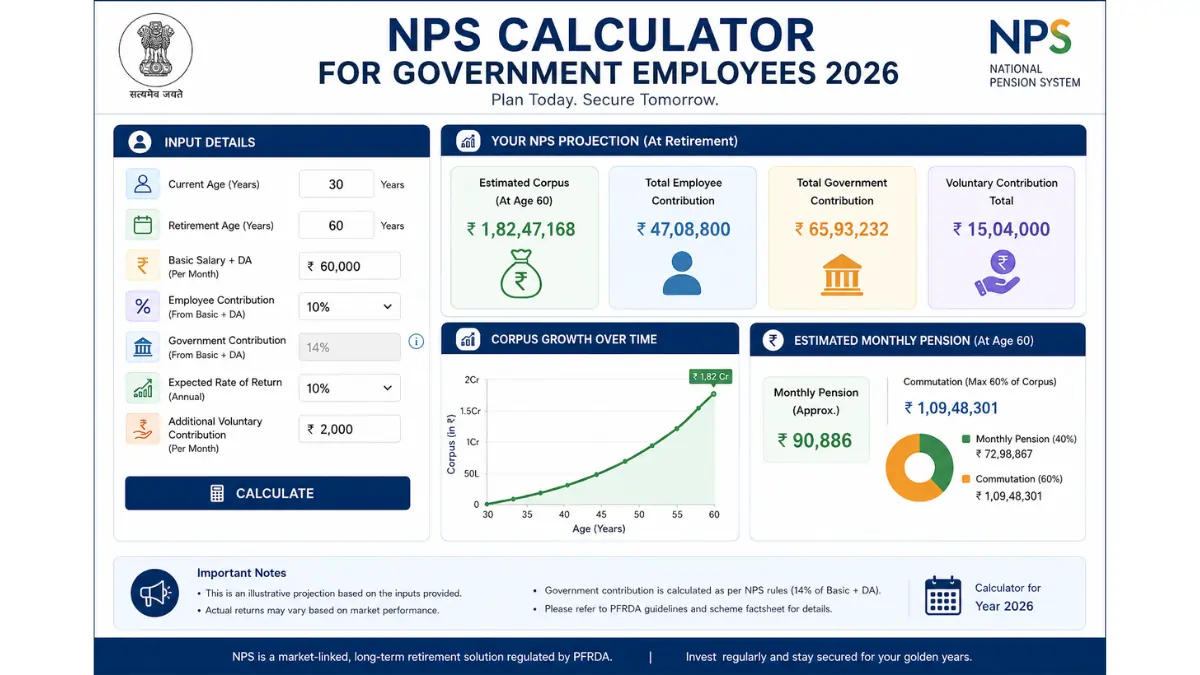
The National Pension System (NPS) is the primary retirement savings scheme for over 1.5 crore central and state government employees in India, regulated by the Pension Fund Regulatory and Development Authority (PFRDA). Unlike the old defined-benefit pension, NPS is a market-linked, defined-contribution scheme — meaning your retirement corpus depends directly on how much you contribute and how your chosen Pension Fund Manager grows it over time.
This free NPS Corpus Estimator helps you calculate two critical numbers before you retire: your total accumulated corpus and your estimated monthly pension. As per current PFRDA rules, 60% of your corpus can be withdrawn as a tax-free lump sum at retirement, while the remaining 40% must be used to purchase an annuity — which then pays your monthly pension for life. Simply enter your current age, monthly contribution, expected return, and annuity rate below to get an instant personalised projection.
Whether you are a Group A, B, or C central government employee, a state government servant, or a private sector NPS subscriber — this calculator works for all. It also lets you factor in your existing NPS corpus from your NSDL CRA statement, giving you a far more accurate retirement estimate than starting from zero. Use the results to plan additional voluntary contributions (AVC) or decide whether switching to the Unified Pension Scheme (UPS) makes sense for your remaining years of service.
✅ Based on PFRDA Rules 2025 ✅ 60% Lump Sum + 40% Annuity Split ✅ Works for Central & State Govt ✅ Free — No Login Required ✅ Instant Results
NPS Corpus Estimator
Estimate your retirement corpus & monthly pension under the National Pension System
What is NPS?
National Pension System is a voluntary, defined contribution retirement plan regulated by PFRDA for government and private sector employees.
60% Lump Sum
At retirement (age 60), 60% of the corpus can be withdrawn as a tax-free lump sum under current income tax rules.
40% Annuity
At least 40% of the corpus must be used to purchase an annuity from a PFRDA-empanelled Annuity Service Provider (ASP).
Expected Returns
NPS equity funds (Tier I) have historically delivered 10–12% p.a. long-term returns. Conservative estimates use 8–10%.
Others Free Tools
| Resource | Link |
|---|---|
| Income Tax CalculatorFY 2025-26 | Click here to Calculate |
| Gratuity Calculator | Click here to Calculate |
| LTC Calculator 2026 | Click here to Calculate |
| Pension Calculator for CG Employee | Click here to Calculate |
| 8th CPC Salary Calculator | Click here to Calculate |
| DA Hike Calculator | Click here to Calculate |
| NPS vs UPS Comparison | Click here to Calculate |
| MACP Eligibility Checker | Click here to Calculate |
| DA Calculator 2026 | Click here to Calculate |
| Age Calculator Online | Click here to Calculate |
| KMA & ALK Arrear Calculator | Click here to Calculate |
How much NPS corpus will I get at retirement as a central government employee?
Your NPS corpus at retirement depends on three factors: your monthly contribution (employee 10% + government 14% = 24% of Basic + DA), the number of years of service, and the annual return earned by your chosen Pension Fund Manager (PFM). Use the calculator above by entering your current age, retirement age, and expected return to get a personalised estimate.
As a rough benchmark: a central government employee at Pay Level 6 (Basic ₹35,400) contributing for 30 years at a 10% annual return can expect a corpus of approximately ₹1.2–1.5 crore — depending on DA revisions over the period. The calculator above accounts for your existing corpus too, which significantly boosts the final number.
💡 Tip: Enter your existing NPS corpus (check your NSDL CRA statement) into the calculator for a more accurate projection — most employees underestimate this figure.
How is the monthly pension calculated from NPS at retirement?
At retirement, at least 40% of your total NPS corpus must be used to purchase an annuity from a PFRDA-empanelled Annuity Service Provider (ASP) such as LIC, SBI Life, or HDFC Life. This annuity then pays you a fixed monthly pension for life.
Monthly Pension = (40% of Corpus × Annuity Rate) ÷ 12
For example: If your total corpus is ₹1 crore, ₹40 lakh goes to annuity. At a 6% annuity rate, your monthly pension = (₹40,00,000 × 6%) ÷ 12 = ₹20,000 per month. Annuity rates currently range from 5.5% to 7% depending on the provider and plan type chosen. You can adjust the annuity rate slider in the calculator above to see how different rates affect your pension.
How is the monthly pension calculated from NPS at retirement?
At retirement, at least 40% of your total NPS corpus must be used to purchase an annuity from a PFRDA-empanelled Annuity Service Provider (ASP) such as LIC, SBI Life, or HDFC Life. This annuity then pays you a fixed monthly pension for life.
Monthly Pension = (40% of Corpus × Annuity Rate) ÷ 12
For example: If your total corpus is ₹1 crore, ₹40 lakh goes to annuity. At a 6% annuity rate, your monthly pension = (₹40,00,000 × 6%) ÷ 12 = ₹20,000 per month. Annuity rates currently range from 5.5% to 7% depending on the provider and plan type chosen. You can adjust the annuity rate slider in the calculator above to see how different rates affect your pension.
Can I withdraw 60% of my NPS corpus tax-free at retirement?
Yes. Under current income tax rules, the lump sum withdrawal of up to 60% of the NPS corpus at retirement is fully tax-free. This has been the rule since the 2019 Union Budget, which brought NPS to EEE (Exempt-Exempt-Exempt) status on par with PPF and EPF.
The remaining 40% used to purchase an annuity is also not taxed at the time of purchase. However, the monthly pension income you receive from the annuity is taxable as per your applicable income tax slab. So if you receive ₹20,000/month as pension, that ₹2.4 lakh annual income is added to your total income and taxed accordingly.
⚠️ Note: If you withdraw before age 60 (premature exit), different rules apply — only 20% can be taken as lump sum and 80% must go to annuity.
What is a realistic expected return to use in the NPS calculator?
NPS Tier I equity funds (Scheme E) have historically delivered 10–12% CAGR over the long term, while the balanced Auto Choice lifecycle fund has given around 9–10%. Conservative estimates using government securities (Scheme G) average 7–8% p.a.
For planning purposes, financial advisors typically recommend using 10% for aggressive projection, 8% for moderate, and 6–7% for conservative. Since NPS returns are market-linked and not guaranteed, using 9–10% in the calculator gives a realistic middle-ground estimate. Avoid using 12%+ as it can lead to over-optimistic projections. The calculator above defaults to 10% — you can adjust it using the slider.
Should I switch from NPS to UPS as a central government employee in 2025?
The Unified Pension Scheme (UPS), available to central government employees from 01 April 2025, guarantees a pension of 50% of average basic pay of the last 12 months — provided you have 25+ years of service. This is a defined-benefit guarantee, unlike NPS which is market-linked. Employees with 10–24 years of service get a proportional pension, with a floor of ₹10,000/month.
Whether to switch depends on your years of service remaining and risk appetite. If you have fewer than 10 years left to retirement, UPS offers more certainty. If you have 20+ years and started early with NPS, your accumulated corpus under NPS could yield a higher pension than UPS guarantees. The switch is a one-time irrevocable decision — so model both scenarios carefully before choosing.
📌 Use this NPS calculator alongside our NPS vs UPS comparison tool to make a side-by-side decision for your specific pay level and years of service.
How much should I invest in NPS to get ₹50,000 pension per month?
To receive ₹50,000/month as pension, you need the 40% annuity portion of your corpus to be large enough. Working backwards at a 6% annuity rate: ₹50,000/month requires an annuity corpus of ₹1 crore, which means a total NPS corpus of ₹2.5 crore (since annuity = 40%).
Required Corpus = (Monthly Pension × 12) ÷ Annuity Rate ÷ 0.40
= (50,000 × 12) ÷ 0.06 ÷ 0.40 = ₹2.5 Crore
To reach ₹2.5 crore: starting at age 30 with a 10% expected return, you would need to contribute approximately ₹11,000–12,000 per month over 30 years. For government employees, your employer’s 14% contribution counts — so your personal outgo is less. Plug your own numbers into the calculator above to find your exact figure.
What happens to my NPS corpus if I die before retirement?
If an NPS subscriber dies before retirement, the entire accumulated corpus is paid to the nominated family member (spouse, children, or parents) as a lump sum — without any mandatory annuity purchase. The nominee does not need to use 40% for annuity; they receive the full corpus tax-free.
This is a significant advantage of NPS over traditional pension schemes. The nominee simply needs to submit a death certificate, the subscriber’s PRAN details, and KYC documents to the nearest PoP (Point of Presence) or CRA to claim the amount. It is strongly advisable to keep your NPS nomination updated — especially after marriage or the birth of a child — by logging into the NSDL CRA portal.







1 thought on “NPS Calculator for Government Employees 2026”