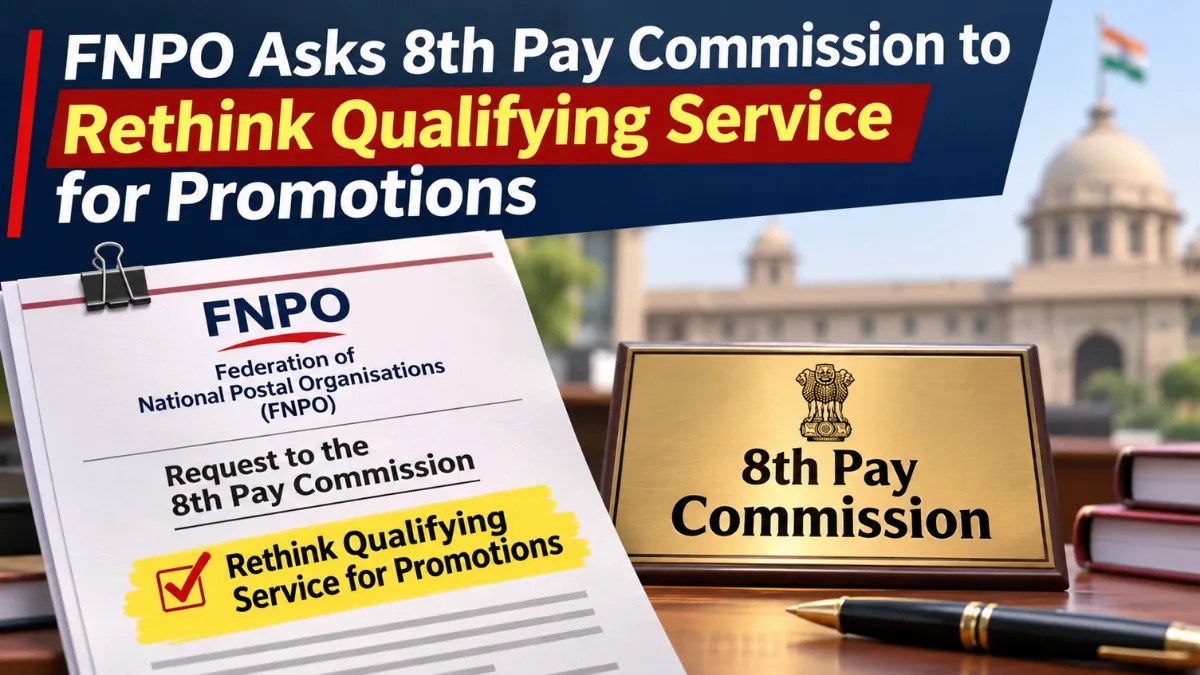
The 8th Pay Commission qualifying service 2026 debate has a sharp new voice. In a letter dated 20 November 2026, the Federation of National Postal Organisations (FNPO) asked the 8th Central Pay Commission (CPC) to review how many years an employee must serve before becoming eligible for promotion. The federation says some waiting periods run to 8, 10 and even 12 years, while other promotions need only one to three. It wants that gap closed.
The issue goes beyond postal staff. The waiting periods come from a Department of Personnel and Training (DoPT) Office Memorandum (OM) of 20 September 2022 that applies across Central Government cadres. For any employee stuck at the same level while vacancies sit empty, the number of years in that table decides when the next rung opens. FNPO argues the numbers were never set with cadre realities in mind.
📌 Also Read: FNPO’s earlier memorandum demanding ₹54,000 minimum pay
8th Pay Commission Qualifying Service – Key Facts
| Detail | Information |
|---|---|
| Submitted by | Federation of National Postal Organisations (FNPO), Secretary General Sivaji Vasireddy |
| Addressed to | Justice Ranjana Prakash Desai, Chairperson, 8th CPC |
| Letter dated | 20 November 2026 |
| Rule under challenge | DoPT OM No. AB-14017/4/2021-Estt.(RR), 20 September 2022, Annexure-I |
| Core complaint | Uneven and lengthy minimum qualifying service for promotion |
| Hardest-hit area | Department of Posts supervisory and managerial cadres |
The Rule Behind the Wait: What DoPT’s 2022 Memorandum Set
Qualifying service is the minimum time an employee must spend in a grade before they can be considered for promotion to a higher Pay Level. DoPT’s 2022 OM set these periods for the 7th CPC pay matrix. It replaced the older tables built around the 6th CPC pay structure. Recruitment rules for each cadre are then framed around them.
FNPO’s letter picks out the entries it considers heaviest. The contrast with the shortest entries in the same Annexure is what makes its case.
Join WhatsApp
Join NowJoin Telegram
Join Now| Promotion | Qualifying service (as listed by FNPO) |
|---|---|
| Level 2 to Level 4 | 8 years |
| Level 4 to Level 6 | 10 years |
| Level 6 to Level 9 | 8 years |
| Level 6 to Level 10 | 10 years |
| Level 6 to Level 11 | 12 years |
| Level 7 to Level 11 | 9 years |
| Level 9 to Level 11 | 7 years |
| Level 11 to Level 13 | 10 years |
Now set those beside the same Annexure’s shortest waits. Going from Level 7 to Level 8, or Level 8 to Level 9, takes just two years. An employee who qualifies for a Level 8 step after two years and an employee waiting for Level 11 after twelve are both “promoted”, yet their careers move at very different speeds. That is the inequality FNPO wants the Commission to examine.
The 10-year Level 4 to Level 6 wait is also worth noticing. It matches the first interval of the Modified Assured Career Progression (MACP) scheme, under which employees get financial upgradations at 10, 20 and 30 years. In effect, a regular promotion can take as long as MACP does. For employees in those cadres, the promotion rule offers little advantage over simply waiting.
Why FNPO Says the Department of Posts Is Paying the Price
The letter’s second argument is operational. The Department of Posts runs postal, banking, insurance and other citizen services, and it needs experienced supervisors to do so. FNPO says the long qualifying periods shrink the pool of eligible officials in feeder cadres. That leaves vacancies unfilled in Lower Selection Grade (LSG), Higher Selection Grade-II (HSG-II) and Higher Selection Grade-I (HSG-I) posts.
The federation also lists the HSG-I Non-Functional Grade, supervisory roles in Postal and Railway Mail Service (RMS) establishments, Senior Superintendent of Post Offices posts, other Group B administrative jobs, and Director-level positions. The problem is sharpest in promotions through Limited Departmental Competitive Examinations (LDCE) and seniority-cum-fitness. In both, the qualifying period directly limits who can apply.
The consequence, FNPO says, is that serving officers carry extra charge. Supervision weakens, decisions slow down, and technology-based initiatives suffer. That matters because it moves the argument beyond employee welfare. FNPO is telling the Commission that delayed promotions are also a service-delivery problem.
This is not a new complaint from the federation. FNPO’s website records an earlier request to the Department of Posts for a one-time relaxation, so that officials with at least one year in the feeder cadre could be considered for HSG-II and HSG-I. The same page notes earlier relaxations that cut the LSG to HSG-II requirement from six years to four, and HSG-II to HSG-I to three. The new letter takes the argument to the pay commission.
The Real Cost: Stagnation, Delayed Pay and Morale
For the individual employee, the cost of a long wait is concrete. FNPO says years of service and departmental experience go unrewarded while employees wait to become eligible. It lists lost promotional opportunities in their most productive years, delayed financial benefits and lower morale. It also cites inequality compared with cadres elsewhere in the Central Government that reach promotion faster.
The analytical point is the one in the letter’s closing lines. FNPO argues that qualifying service should reflect cadre structure, the nature of duties, feeder-grade availability and the promotional hierarchy. It should not be set merely by the gap between two Pay Levels. That is a real shift in logic. The 2022 table, read plainly, tracks distance on the pay matrix. FNPO wants it to track how a cadre actually works.
What the letter does not settle is how far the Commission can go. A pay commission recommends and the Government decides, and qualifying service is ultimately written into individual recruitment rules. Even if the 8th CPC agrees, changes would have to travel through DoPT and each cadre’s rules.
What FNPO Wants the 8th CPC to Do
The letter’s final section, “Recommendations Sought from the 8th CPC”, begins at the foot of the third page. [Editor: insert the exact recommendation from page 4 of the letter. FNPO’s call is reported as a uniform qualifying service of 1 to 4 years across departments. This is not visible on pages 2–3.]
What the visible pages confirm is the direction. FNPO points to transitions in the same Annexure that need only one, two or three years, and calls for fairness, consistency and reasonable progression across cadres. It also wants the Commission to protect the promotional avenues of Central Government employees, with particular attention to the Department of Posts.
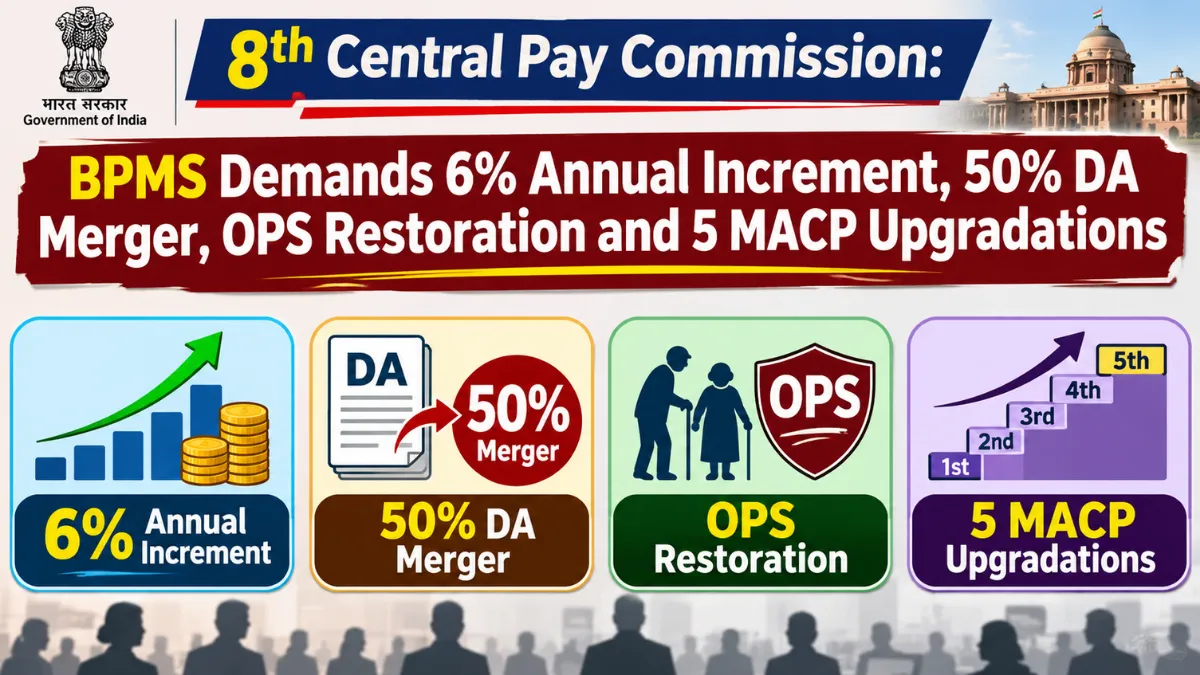
Other unions are asking for similar things. A draft by the Bharatiya Postal Mazdoor Sangh (BPMS) dated 17 April 2026 asks that the qualifying period should not exceed five years wherever it is currently longer. That shows the demand is spreading across employee bodies.
If You’re Waiting on a Promotion, Here’s What This Means for You
If you are a Postal Assistant, Postman, Multi-Tasking Staff member, or an employee in any cadre where you face an 8 to 12 year wait, this letter changes nothing in your service record today. It is a demand, not an order. Your eligibility is still governed by your cadre’s current recruitment rules and the 2022 OM.
You do not need to file anything because of this letter. What you can do is check your cadre’s recruitment rules for your exact qualifying period, and watch your employee association’s updates. The Commission has not yet said whether it accepts the argument.
💡 If you rely on MACP while waiting, remember it is a financial upgradation and not a promotion. Qualifying service for promotion and MACP intervals run on separate clocks, so check both. Our MACP eligibility checker can help.
The catch is time. Even a favourable recommendation would reach you only after the Government accepts it and cadre rules are amended.
What Comes Next: The 8th CPC Timeline
The letter lands during the Commission’s consultation phase. FNPO’s website records that the 8th CPC scheduled a meeting with the federation on 20 November 2026 at its Chanderlok Building office. The Commission was constituted on 3 November 2025, and its report is expected around May 2027, about 18 months after constitution.
Between now and the report, expect more unions to take positions on promotion norms. Our 8th Pay Commission 2026 hub and the 8th CPC timeline track each step. For the wider employee-side agenda, see NC-JCM’s key demands.
Important Links
| What | Link |
|---|---|
| FNPO’s Key Demands | Download PDF |
| FNPO official website | fnpo.org |
| Related post | 8th Pay Commission 2026 |
Frequently Asked Questions
What is the minimum qualifying service for promotion under DoPT OM 20.09.2022?
It depends on the Pay Levels involved. The OM’s Annexure-I ranges from one year for some senior transitions to 12 years for Level 6 to Level 11. Your cadre’s recruitment rules are the final authority for your own post.
Has the 8th CPC reduced the qualifying service for promotion?
No. FNPO’s letter of 20 November 2026 is a request. The Commission has not announced any recommendation, and its report is expected around May 2027.
Is qualifying service the same as MACP?
No. Qualifying service is the minimum time before you can be considered for regular promotion. MACP is a financial upgradation, normally at 10, 20 and 30 years, for those who have not been promoted.
Does the FNPO demand apply to all Central Govt employees?
FNPO speaks for Department of Posts employees, but the 2022 OM it challenges applies across Central Government cadres. Any change the Commission recommends could therefore reach other departments too.
How many years for Level 6 to Level 11 promotion?
The 2022 OM prescribes 12 years for Level 6 to Level 11, the longest period FNPO lists. FNPO wants this reviewed.
When will the 8th CPC submit its report?
The Commission was constituted on 3 November 2025, and its report is expected around May 2027. The Government must still accept any recommendation before it takes effect.
Conclusion
FNPO’s letter turns a technical table into a career question. It says the real obstacle to promotion is often the wait, not the vacancy. Whether the 8th Pay Commission agrees will shape how fast Group B and C employees move for years to come.
Bookmark Govtserviceinfo.com and join our Telegram channel for instant alerts on DA hikes, pay revision orders, and 8th CPC updates.
Disclaimer: This article is based on a letter from the Federation of National Postal Organisations dated 20 November 2026 and the DoPT OM dated 20 September 2022. All details are subject to official announcements from the relevant authorities. Govtserviceinfo.com is not affiliated with the 8th CPC, DoPT or FNPO. Readers should verify current information from official government sources before acting on it.