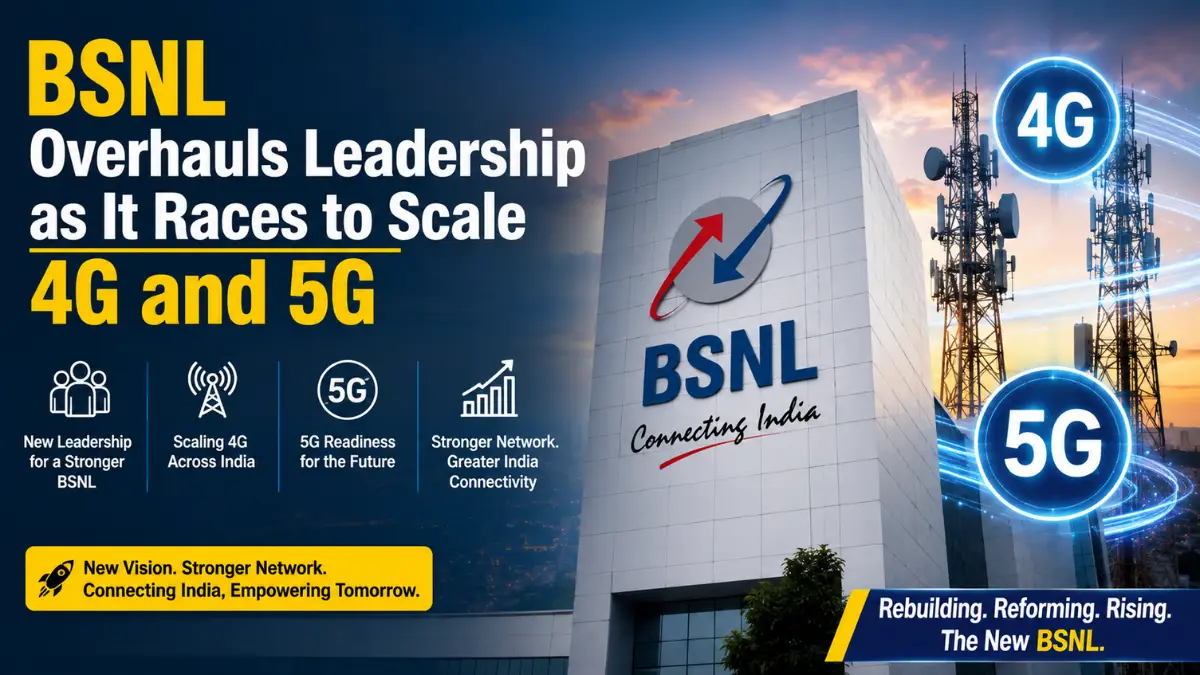
Bharat Sanchar Nigam Ltd is rebuilding its senior management from the ground up, moving to fill a leadership vacuum just as the state-run carrier’s indigenous 4G network crosses a major milestone and its 5G rollout begins in earnest.
Three threads are converging at once: a plan to hire 100 General Managers on contract, the phased exit of long-serving telecom-service officers who have run BSNL on deputation for up to 25 years, and a long-delayed search for a full-time Chairman and Managing Director — a post that has sat unfilled for more than two years.
Filling the Gap Left by Departing ITS Officers
For decades, BSNL’s senior ranks have been staffed largely by officers of the Indian Telecommunication Service (ITS), deputed from the Department of Telecommunications rather than recruited by the company itself. That arrangement is now unwinding: officers who have served at BSNL for close to 25 years are being repatriated to their parent cadre in phases, leaving gaps in exactly the roles the company needs most as it builds out network infrastructure.
To backfill them, BSNL plans to recruit 100 General Managers in the telecom stream on contract, open to both internal executives and outside professionals. Candidates must be engineers under 50, with at least 15 years of experience and a minimum of five years at senior executive or Deputy General Manager level. The roles carry a monthly salary of ₹2.25 lakh with a 5 percent annual increment — pay designed to be competitive enough to draw private-sector telecom talent into network operations, IT systems and large-scale deployment work.
That last point is the crux of the plan. BSNL had installed more than 105,000 indigenous 4G sites by the end of April 2026 and has since begun rolling out 5G services in Delhi — its first live 5G deployment. Managing a network at that scale, built substantially on domestic technology rather than established global vendors, is a different operational challenge than the one BSNL’s leadership was built to handle a decade ago.
📌 Also read: BSNL JTO Recruitment 2026
Not everyone is on board. Employee unions have objected to hiring outside professionals for senior positions, arguing that experienced BSNL executives should be promoted from within rather than passed over for external hires. It’s a familiar fault line inside the company: unions have previously pushed back hard on voluntary retirement schemes and on BSNL’s reliance on domestically-sourced 4G equipment even as they now object to bringing in outside talent to run that same network. BSNL is currently reviewing applications ahead of shortlisting, with deputed ITS officers expected to return to the DoT gradually as replacements are appointed.
A Two-Year Search for a Permanent Chief
The other vacancy is at the very top. BSNL has not had a full-time CMD since P.K. Purwar’s term ended in July 2024. Robert J. Ravi, a senior DoT official who also holds the CMD post at MTNL, has been running BSNL on additional charge since then, with his term extended repeatedly — most recently through an April 2026 extension that keeps him in place into October.
A first attempt to fill the post properly, in 2025, ended without a result: around ten candidates were interviewed, but the search committee did not recommend anyone. The government has since reopened the process, constituting a fresh Search-cum-Selection Committee under the Chairman of the Public Enterprises Selection Board, this time explicitly inviting applications from the private sector for a post that pays in the ₹80,000–1,25,000 scale on an immediate-absorption basis. Applications closed on 22 July, with 29 candidates in the running — seven of them from outside the public sector.
Getting this appointment right matters more than it might have a few years ago. A permanent CMD would be expected to steer BSNL’s 4G expansion, oversee the 5G scale-up, and address the company’s finances at a moment when the underlying numbers are improving but still deep in the red: a consolidated net loss of ₹1,280 crore for the April–June quarter of FY27, narrower than the ₹1,419 crore loss the previous quarter but wider year-on-year than the ₹1,007-crore loss recorded a year earlier. Revenue from operations, however, grew 4.2 percent year-on-year to ₹5,306 crore, and the company’s mobile subscriber base has held at roughly 93 million — with average revenue per user up sharply over the past year as network quality has improved.
📌 Also read: Is BSNL’s Second VRS Now Inevitable?
Why the Timing Isn’t a Coincidence
None of this is happening in isolation. BSNL’s revival case has always rested on the same argument: that indigenous 4G, followed by 5G, would let it compete on network quality rather than price alone. Reaching 105,000 4G sites and switching on 5G in Delhi are proof points for that argument — but only if the company has the leadership bench to keep executing at the pace those milestones demand. A management structure still leaning on officers approaching the end of long deputations was always a temporary fix. The GM recruitment drive and the CMD search are both, in effect, BSNL trying to convert a network buildout into a durable institution before the officers who built it move on.
Whether the company can do that while keeping its unions on side — and while a full-time CMD is still weeks or months from being named — will say a lot about how much of BSNL’s recent momentum is structural, and how much depends on individuals who may not be there much longer.
📌 Also read: BSNL Senior Executive Trainee Recruitment 2026