
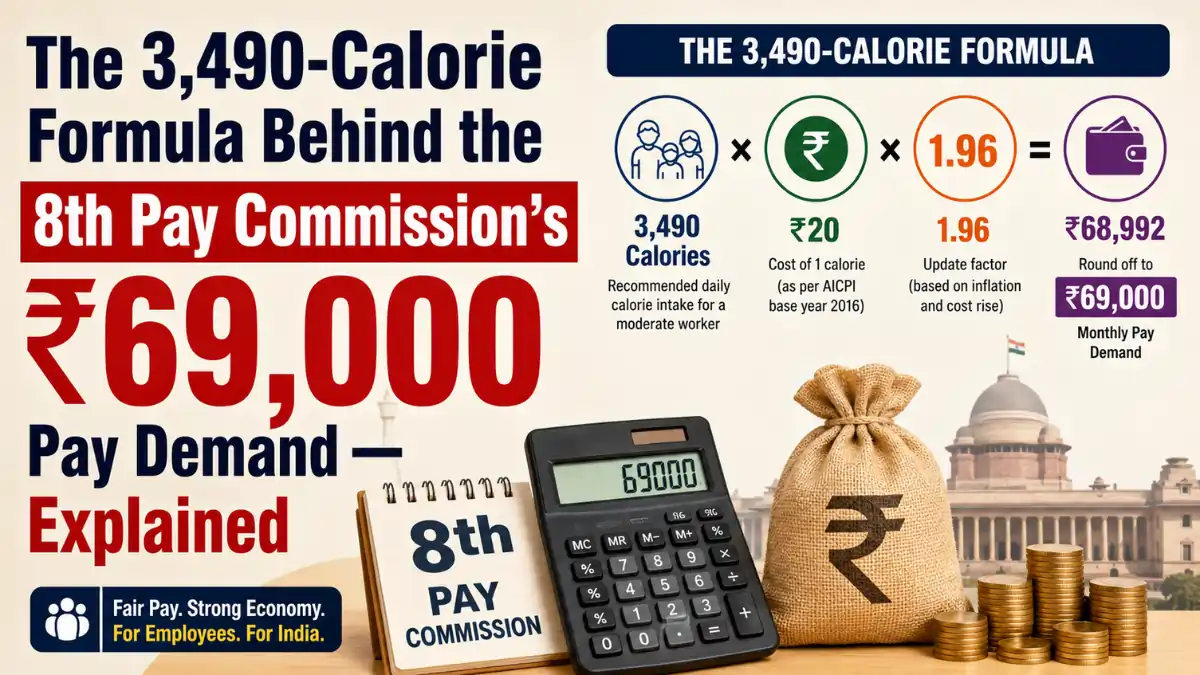
The 8th Pay Commission’s 3,490-calorie food cost formula is not a nutrition recommendation — it is the scientific foundation of a ₹69,000 minimum pay demand that, if accepted, would trigger the largest salary revision in the history of Indian pay commissions. On 14 April 2026, the Staff Side of the National Council – Joint Consultative Machinery (NC-JCM), the body that formally represents central government employees in pay discussions, submitted a 51-page memorandum to the 8th Central Pay Commission (CPC). At the heart of that document is a calculation — methodical, referenced, and deliberately provocative — that concludes a government employee needs at least ₹69,000 per month just to live with dignity.
For approximately 50 lakh central government employees and nearly 68 lakh pensioners, this memorandum is the most detailed articulation yet of what pay revision under the 8th Pay Commission could look like — and what employee unions believe the government owes them.
Table of Contents
From 2,700 to 3,490 Calories — Why the Old Formula Was Called a “Survival Wage”
Every pay commission since Independence has used some version of a need-based minimum wage formula. The method traces back to the 15th Indian Labour Conference of 1957, which said that minimum wages should cover the food, clothing, housing, and other basic needs of a worker and their family. The calorie benchmark embedded in that formula — 2,700 kilocalories per day — has been used, with minor modifications, by successive pay commissions ever since.
The NC-JCM memorandum calls that number obsolete. It argues that 2,700 kcal represented a bare subsistence standard in the 1950s and that retaining it seven decades later means the minimum pay calculated from it is, at best, a survival wage — not a living one. The memorandum instead invokes the Indian Council of Medical Research (ICMR) recommendation of 3,490 kilocalories per day, which accounts for the energy needs of employees engaged in physically demanding work. Industrial workers, paramilitary personnel, and certain support staff categories, the Staff Side argues, routinely do work that the 2,700-calorie model was never designed to reflect.
That shift — from 2,700 to 3,490 kcal — is not just a number change. It recalibrates the entire floor on which minimum pay is calculated, because food expenditure is the base from which housing, clothing, and other cost components are derived as percentages. A higher calorie baseline means a higher food cost, which flows into a higher minimum pay. This is the first methodological argument the NC-JCM makes before it gets to any salary figure.
The 5-Unit Family Formula — Who It Covers and Why It Changed
The second structural shift in the memorandum concerns who the “family” in the minimum wage calculation is assumed to be. Previous pay commissions used a three-unit family model — broadly, an employee, a spouse, and a dependent child. The NC-JCM has proposed replacing this with a five-unit family model.
The revised family structure, as submitted in the memorandum, includes the employee (counted as one unit), a spouse (0.8 units), two children (0.6 units each), and two dependent parents (0.6 units each) — totalling 5.2 units, rounded to five for calculation purposes. The inclusion of dependent parents is the critical addition. The memorandum cites the Maintenance and Welfare of Parents and Senior Citizens Act, under which adult children have a legal obligation to support ageing parents who cannot support themselves. In practice, the Staff Side argues, millions of government employees across the country already do this — they simply weren’t being compensated for it in the minimum wage formula.
The shift from three to five units is not a small statistical adjustment. It meaningfully increases the calculated cost of maintaining a government employee’s household, which directly raises the computed minimum pay. It also reflects a social reality — multigenerational households are common across India, and a pay formula that ignores this is one that systematically underestimates what employees actually spend.
📌 Also Read: NC-JCM’s 9 key demands to the 8th Pay Commission
How ₹69,000 Was Calculated — The Living Wage Breakdown
With the 3,490-calorie standard and the five-unit family model as its foundation, the NC-JCM’s memorandum then builds up to the ₹69,000 minimum pay figure using a structured cost-of-living model. The food cost forms the base. To that, the memorandum adds other essential expenditure categories as percentages: housing at 7.5% of the total, fuel and electricity at 20%, skill development at 25%, recreation and festival expenses at 25%, and technology charges — a new addition reflecting the digital age — at 5%.
The inclusion of technology charges as a separate line item is worth noting. It is the first time any NC-JCM memorandum has formally acknowledged that internet access, a smartphone, and basic digital tools are no longer luxuries but necessities for a functioning household in 2026. Previous pay commission formulas had no such category.
The memorandum also specifies a monthly dairy consumption benchmark of 30 to 35 litres for a five-unit family, factoring in market prices for milk and milk products in calculating food expenditure. The cumulative total of all these components — food, housing, fuel, clothing, skill-building, recreation, and technology — produces ₹69,000 as the monthly minimum pay.
The fitment factor then follows directly from the minimum pay demand. The 7th Pay Commission had set the minimum pay at ₹18,000. If ₹69,000 is the new minimum, the ratio between the two is 3.833. The NC-JCM has therefore proposed a fitment factor of 3.833 — meaning every existing employee’s basic pay, at every level, would be multiplied by 3.833 to arrive at their revised pay. Pensioners would see an equivalent revision applied to their pension.
💡 The same fitment factor of 3.833 would apply uniformly across all pay levels — from the lowest-paid Group C employee to a senior Grade A officer. The absolute rupee increase would be vastly different, but the multiplier is the same.
What a Fitment Factor of 3.833 Would Mean for Your Salary
The picture looks different depending on where you are in the pay matrix. Here is what the proposed fitment factor of 3.833 would mean for employees at three representative pay levels, compared to the 7th Pay Commission’s fitment factor of 2.57.
| Pay Level | Current Basic Pay (7th CPC) | At Fitment 2.57 (7th CPC applied) | At Fitment 3.833 (NC-JCM demand) |
|---|---|---|---|
| Level 1 | ₹18,000 | ₹46,260 | ₹69,000 |
| Level 6 | ₹35,400 | ₹90,978 | ₹1,35,658 |
| Level 10 | ₹56,100 | ₹1,44,177 | ₹2,15,031 |
⚠️ These figures are based on NC-JCM’s proposed fitment factor and are not confirmed government decisions. Actual revisions depend on the 8th Pay Commission’s final recommendations and subsequent government notification.
If you are currently drawing a basic pay of ₹35,400 at Pay Level 6, the NC-JCM’s demand would take your basic pay to approximately ₹1,35,658. Add Dearness Allowance (DA) — which will likely be merged with basic pay at implementation — and House Rent Allowance (HRA) on top, and total in-hand compensation could more than double for a mid-level employee. For a Level 1 employee, the ₹69,000 minimum pay itself is the outcome.
You do not need to apply for anything at this stage. The memorandum represents the Staff Side’s demand — the 8th Pay Commission will now examine it, along with submissions from other stakeholder groups, before making its own recommendations to the government. What you should do is stay informed on the 8th CPC hearing schedule and Delhi-Pune meeting updates as the Commission begins its deliberations in earnest.
Why the Government Is Unlikely to Accept 3.833 — and What It Might Actually Approve
The analytical question — and the one most government employees want answered — is whether any of this will actually happen. The honest answer is: not at 3.833.
The NC-JCM’s demand is a negotiating position, not a prediction. Unions submit ambitious memoranda; governments apply fiscal constraints; pay commissions navigate the space between the two. That is how the process has worked since the 1st Pay Commission. The 7th Pay Commission received a demand for a fitment factor of 3.68 and ultimately recommended 2.57. The gap between the union ask and the government acceptance was 30%.
Read alongside the current fiscal context — the government is managing a post-COVID consolidation, infrastructure spending commitments, and a defence modernisation budget — a fitment factor above 2.86 is considered optimistic by most independent analysts. The range that expert estimates most commonly land in is 1.92 to 2.86, with 2.57 (same as the 7th CPC) representing the conservative anchor and 2.86 the upper-bound scenario that many employee associations privately consider achievable.
That said, the 3,490-calorie and five-unit family methodology may have a longer-term impact beyond this pay commission. If the 8th CPC formally acknowledges these frameworks — even while recommending a lower fitment factor — it sets a precedent for future commissions to work from a more scientifically grounded baseline. That shift in methodology is, arguably, as significant as the number itself.
Also worth noting: the NC-JCM memorandum also calls for DA merger at the time of implementation, restoration of the Old Pension Scheme (OPS) by scrapping the National Pension System (NPS) and Unified Pension System (UPS), an increase in the annual increment from 3% to 6%, and a minimum of five MACP financial upgradations over a 30-year career span. Each of these is a separate demand — and each has its own probability of acceptance.
Frequently Asked Questions
What is the 5-unit family formula in the 8th Pay Commission?
The 5-unit family formula is a wage calculation model proposed by the NC-JCM Staff Side that expands the traditional three-unit family (employee, spouse, one child) to five units by adding dependent parents. The expanded model is grounded in the Maintenance and Welfare of Parents and Senior Citizens Act, which makes supporting elderly parents a legal obligation. This broader family definition raises the calculated cost of living, which in turn raises the computed minimum pay.
How did NC-JCM calculate the ₹69,000 minimum pay demand?
The ₹69,000 figure was derived by calculating the monthly cost of feeding, housing, and supporting a five-unit family using the ICMR’s 3,490-calorie daily standard as the food base, then adding housing (7.5%), fuel and electricity (20%), skill development (25%), recreation and festivals (25%), and technology charges (5%) as percentage additions. The detailed calculation sheet was enclosed with the memorandum submitted to the 8th CPC on 14 April 2026.
What is the ICMR 3,490-calorie norm used in 8th Pay Commission calculations?
The Indian Council of Medical Research (ICMR) recommends 3,490 kilocalories per day as the nutritional requirement for individuals engaged in physically demanding work. The NC-JCM has proposed using this as the food cost baseline in place of the outdated 2,700-calorie norm used in previous pay commissions, arguing that the older figure produces a “survival wage” rather than a dignified living standard.
What fitment factor is the government likely to approve for the 8th CPC?
The government has not announced any fitment factor yet — the 8th Pay Commission will make its recommendations first, and the government will then decide. Independent analysts estimate the likely range at 1.92 to 2.86. The NC-JCM demand of 3.833 is a negotiating position; based on historical patterns, the final approved factor is likely to be lower. The 7th Pay Commission approved 2.57 against a union demand of 3.68.
When will the 8th Pay Commission salary revision take effect?
The 8th Pay Commission is constituted with a target implementation date of 1 January 2026, but the Commission has 18 months from its constitution to submit its final report. Given that it was formally set up in early 2025, the report is expected by mid-to-late 2026. Implementation — and any arrears for the period since January 2026 — will depend on when the government notifies the revised pay structure.
What Comes Next — and What to Watch For
The NC-JCM held its first Standing Committee meeting with the 8th Pay Commission on 28 April 2026, where the Staff Side presented the salient features of the memorandum directly to the Commission’s Chairperson, Justice Ranjana Prakash Desai. That meeting marked the formal beginning of the substantive dialogue between employee representatives and the Commission.
The Commission is now expected to hold sectoral hearings across the country — covering different ministries, departments, defence services, and central paramilitary forces — before it begins drafting its report. The timeline, as of May 2026, suggests a final report by late 2026 or early 2027, with implementation and arrears payment likely to follow within six months of report submission.
For employees trying to estimate where their salary might land, the 8th CPC salary calculator on Govtserviceinfo.com allows you to model different fitment factor scenarios and see the impact on your basic pay, DA, and HRA.
Summing Up…
The 3,490-calorie formula and the five-unit family model are more than union talking points — they represent a methodological argument that the government has systematically undervalued the cost of a dignified life for its employees. Whether the 8th Pay Commission accepts the number, the method, or neither, this memorandum has changed the terms of the conversation.
The ₹69,000 demand will almost certainly not be accepted in full. But the calorie benchmark, the family unit expansion, and the technology allowance are ideas that, once formally placed before a pay commission, become part of the institutional memory of how pay is calculated in India. The fight for ₹69,000 may be the opening move in a negotiation that lands somewhere between ₹26,000 and ₹40,000 — but the methodology that drove the demand is the real story.
Bookmark Govtserviceinfo.com and join our Telegram channel for instant alerts on DA hikes, pay revision orders, and 8th CPC updates as the Commission moves toward its final report.
Important Links
| Resource | Link |
|---|---|
| 8th Pay Commission — Full Overview | govtserviceinfo.com/8th-pay-commission-2026/ |
| 8th CPC Salary Calculator | govtserviceinfo.com/8th-cpc-salary-calculator/ |
| NC-JCM 9 Key Demands | govtserviceinfo.com/8th-pay-commission-updates-nc-jcm-lists-9-key-demands/ |
| DA & DR at 60% — January 2026 | govtserviceinfo.com/da-dr-hikes-60-percent-january-2026/ |
| Income Tax CalculatorFY 2025-26 | https://govtserviceinfo.com/income-tax-calculator-fy-2025-26/ |
| LTC Calculator 2026-29 | https://govtserviceinfo.com/ltc-calculator/ |
| MACP Eligibility Checker | https://govtserviceinfo.com/macp-eligibility-checker/ |
| DA Calculator 2026 | https://govtserviceinfo.com/da-calculator/ |
| WhatsApp Channel | Join Us |
Disclaimer: This article is based on the memorandum submitted by the Staff Side of NC-JCM to the 8th Central Pay Commission on 14 April 2026. The demands and salary figures represent the Staff Side’s proposals and are not official government decisions or confirmed pay revision amounts. Actual salary revisions will depend on the Commission’s final recommendations and subsequent government notification. Always refer to official government orders before taking any financial decisions.








2 thoughts on “The 3,490-Calorie Formula Behind the 8th Pay Commission’s ₹69,000 Pay Demand — Explained”