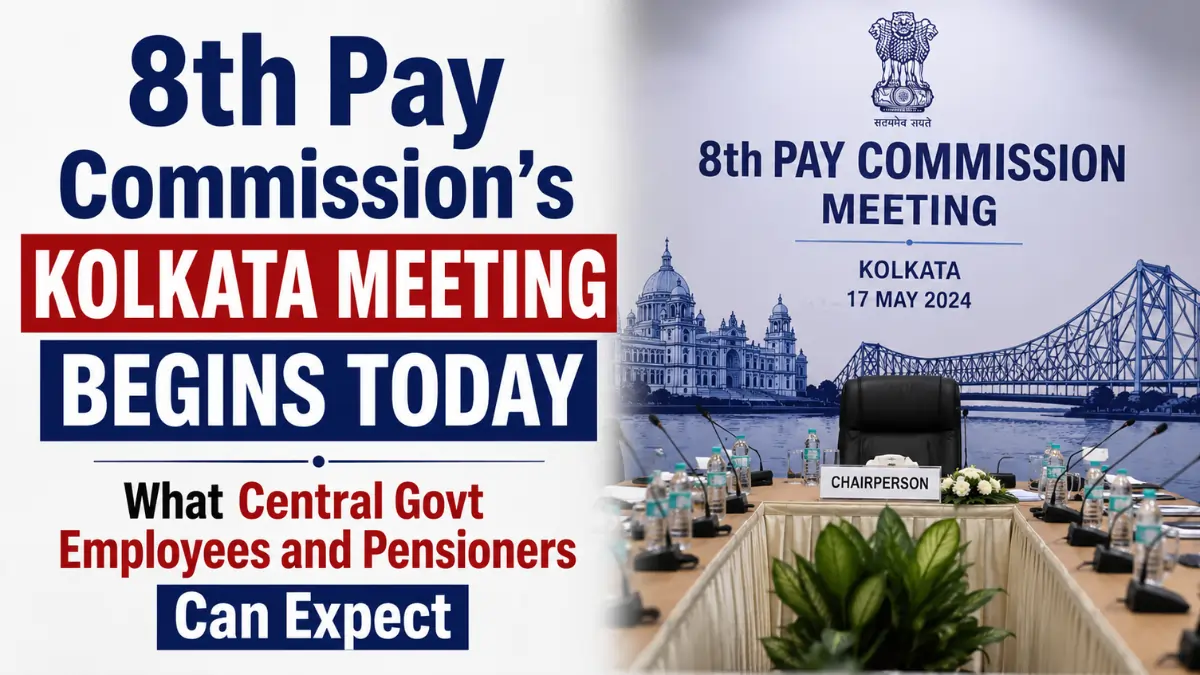
The 8th Pay Commission’s Kolkata meeting begins today, 9 July 2026, opening two days of stakeholder consultations that will run through 10 July. For central government employees and pensioners across West Bengal and the Northeast, this is the first direct hearing the Commission has offered the region — and it arrives as unions walk in with some of the boldest fitment factor demands seen so far in this cycle.
The format is familiar by now. Employee federations, recognised associations, and pensioner bodies sit across the table from the Commission and press their case on salaries, allowances, and pensions before a single word of the final report is drafted. Kolkata is not the first stop, and it will not be the last. That repetition is exactly why this meeting matters: each city adds another layer of demands the Commission must eventually reconcile into one national recommendation.
📌 Also Read: Pension Calculator for Central Government Employees – Basic, Family & Commuted Pension
Join WhatsApp
Join NowJoin Telegram
Join NowA Nationwide Tour That’s Now Reached Its Seventh Stop
Kolkata follows a consultation trail that has already covered most of the country. The Commission held meetings in Delhi, Lucknow, Hyderabad, Srinagar, and Ladakh before arriving in Bhubaneswar on 6–7 July, where it heard from Odisha’s associations, unions, and pensioners. Kolkata is next, and the pattern is deliberate — the Commission is working region by region, giving local federations a chance to raise concerns that a Delhi-only process would likely miss.
That matters because pay commission recommendations have historically been shaped as much by regional detail — HRA city classification, allowance anomalies specific to certain departments — as by the big national numbers like the fitment factor. A union in Kolkata may push a case that never came up in Lucknow or Srinagar, and the final report has to account for all of it.
The Fitment Factor Fight: Why Unions Want Up to 3.8x — and the Government Is Unlikely to Give It
If one number dominates the Kolkata consultations, it will be the fitment factor — the multiplier applied to current basic pay to arrive at the revised figure. Under the 7th Pay Commission, that multiplier was 2.57. This time, most participating unions are expected to seek a range between 2.86 and 3.8, and some of the asks go even further.
The Bharatiya Pratiraksha Mazdoor Sangh (BPMS) has proposed a fitment factor of 4x, which would push the minimum basic pay to ₹72,000 — four times the current ₹18,000. The National Council (Joint Consultative Machinery) Staff Side, the umbrella body that represents central government employees in formal negotiations with the government, has put forward a slightly more conservative but still aggressive figure: 3.833x, translating to a minimum basic pay of roughly ₹69,000.
Run either number against a real employee’s pay slip and the scale becomes clear. A Level 6 employee currently drawing ₹35,400 basic pay would see that figure cross ₹1 lakh under a 3.8x fitment factor — more than triple today’s pay. That is the number unions are walking into Kolkata prepared to defend.
But the Commission’s own Terms of Reference point in a different direction. It has been asked to weigh the government’s fiscal sustainability, the country’s pension liabilities, pay structures at Central Public Sector Undertakings (CPSUs), and private-sector compensation trends before finalising any figure — not just union demands. Independent market trackers have been estimating a realistic range closer to 2.28–2.86x, well below what BPMS and the NC-JCM are asking for in Kolkata. The gap between what’s being demanded and what fiscal arithmetic is likely to allow is, in effect, the real story of this consultation round.
📌 Also Read: 8th Pay Commission Pay Ratio 2026 — The Widening Gap Between the Lowest and Highest Salary
Beyond the Fitment Factor: OPS, HRA, and Pensioner Concerns
The fitment factor will draw the most attention, but it is far from the only issue on the table in Kolkata. The restoration of the Old Pension Scheme (OPS) remains one of the most persistent demands raised at every regional consultation so far, and Kolkata is unlikely to be an exception. Even after the government introduced the Unified Pension Scheme (UPS) as a middle path, several unions have continued pressing for a full return to OPS rather than a hybrid alternative.
House Rent Allowance (HRA) classification is a more regional concern, and it is one where Kolkata’s consultation carries particular weight. Several cities in West Bengal and the Northeast are seeking reclassification into higher HRA tiers — a change that directly increases take-home pay for employees posted in those locations, regardless of what the fitment factor eventually settles at.
Pensioner associations are expected to raise a separate set of concerns: Dearness Relief (DR) parity between past and present retirees, better medical reimbursement, and reforms to the Modified Assured Career Progression (MACP) scheme, which governs how employees receive financial upgradation when regular promotions are delayed. None of these issues will be resolved in the meeting itself, but each becomes part of the written record the Commission carries forward.
If You’re a Central Government Employee or Pensioner in Eastern India
For most readers, the honest answer is: nothing changes today. The Kolkata consultation does not produce an immediate decision on pay, pensions, or allowances — it is an input-gathering exercise, not a negotiation with a signed outcome.
What it does mean is that if your association has submitted a memorandum and secured an appointment, your specific concerns — whether that’s HRA classification for a posting in the Northeast or a department-specific allowance anomaly — are now formally part of what the Commission has to weigh. If you are not affiliated with a federation that participated, you are not excluded from the process; individual employees can still submit views through the Commission’s official portal, though the deadline for memoranda tied to this round of appointments was extended to 15 June 2026, as confirmed in a notification on the Commission’s website dated 29 June.
💡 If your association missed this window, that does not shut the door on future rounds — the Commission’s nationwide consultation schedule is ongoing, and further city visits are expected.
📌 Also Read: Expected DA Hike July 2026 – Free Calculator for Central Government Employees
What Comes Next in the 8th CPC Timeline
The 8th Pay Commission was announced by the government in January 2025 and formally constituted on 3 November 2025, under an 18-month mandate to submit its recommendations — putting the expected report date around mid-2027. Kolkata is one stop in that larger process, not a milestone with its own deadline attached.
The Commission still has to complete its remaining regional consultations, weigh union demands like the BPMS and NC-JCM fitment factor proposals against fiscal and CPSU benchmarks, and draft a report that satisfies its full Terms of Reference before anything reaches implementation. Employees and pensioners tracking the process can get a clearer sense of what that 18-month runway actually looks like month by month in our breakdown of the 8th Pay Commission’s full timeline.
For those who want to see what different fitment factor scenarios — from the conservative 2.28x to the union-demanded 3.8x — would actually mean for their own basic pay, our 8th CPC salary calculator lets you run the numbers directly against your current pay level. It’s worth remembering that any revision here is separate from the Dearness Allowance hikes already in effect — DA was raised to 60% of basic pay from January 2026 under the existing 7th CPC mechanism, and that will keep being revised on its usual cycle until the 8th CPC’s own recommendations take over.
Pensioners specifically weighing the OPS-versus-UPS question raised repeatedly at these consultations can find a fuller comparison in our earlier piece on UPS versus NPS, and employees tracking MACP reform demands can check where they currently stand using our MACP eligibility checker.
📌 Also Read: 8th Pay Commission 2026: Expected Salary, Fitment Factor, Pay Matrix & Latest News
Frequently Asked Questions
Can I still submit a memorandum to the 8th Pay Commission after the Kolkata meeting?
Individual submissions remain possible through the Commission’s official portal even after a particular city’s in-person consultation has concluded, though appointment-linked memoranda for the Kolkata round had a 15 June 2026 deadline. Check the Commission’s website for the current status before submitting.
What is the fitment factor being demanded at the Kolkata consultation?
Most unions are expected to seek a fitment factor between 2.86 and 3.8. The Bharatiya Pratiraksha Mazdoor Sangh (BPMS) has proposed 4x, and the NC-JCM Staff Side has proposed 3.833x — both well above the 2.57x used in the 7th Pay Commission.
Will HRA rates change for cities in West Bengal?
No decision has been made. Reclassification of select cities in West Bengal and the Northeast into higher House Rent Allowance (HRA) tiers is among the demands being raised at the Kolkata consultation, but any change depends on the Commission’s final recommendations.
Is Old Pension Scheme (OPS) restoration part of the 8th CPC discussions?
Yes. OPS restoration remains a recurring demand from employee unions at nearly every regional consultation, including Kolkata, even though the government has already introduced the Unified Pension Scheme (UPS) as an alternative.
When will 8th Pay Commission salaries actually be implemented?
No implementation date has been officially confirmed. The Commission has an 18-month deadline from its 3 November 2025 constitution to submit recommendations, putting its report around mid-2027 — after which the government would need to approve and notify the changes separately.
The Kolkata consultation will not settle any of these questions on its own. But as one more city adds its voice to a Commission that must eventually balance union demands against fiscal reality, it brings the 8th Pay Commission a step closer to the report that will decide how millions of central government employees and pensioners are paid for years to come.
Bookmark Govtserviceinfo.com and join our WhatsApp channel for instant alerts on DA hikes, pay revision orders, and 8th CPC updates.
Disclaimer: This article is based on official notifications from the 8th Central Pay Commission and publicly reported union demands as of 9 July 2026. Fitment factor figures and salary projections are proposals under consideration and have not been approved by the government. Readers are advised to refer to 8cpc.gov.in for official updates.