

The 8th Pay Commission (8th CPC) is expected to bring major changes to the pay structure, allowances, and pensions of over 1 crore Central Government employees and pensioners. Originally anticipated to be implemented from January 1, 2026, the process is now facing multiple delays, raising doubts about its timely rollout.
Many people are now questioning whether the current government genuinely intends to implement the 8th CPC, or if the announcements were merely political moves ahead of the Delhi Assembly Elections 2025. While employees continue to push for updates, several administrative, financial, and political factors have stalled its formation. Here’s a deep dive into the reasons behind the delay, what employees can expect and what could they get.
What is the 8th Pay Commission?
The Central Pay Commission (CPC) is an administrative body set up by the Government of India at regular intervals, typically every ten years since independence. Its primary mandate is to examine and recommend revisions to the salary structure, allowances, and pension schemes of Central Government employees and pensioners, ensuring fair compensation in line with economic conditions and fiscal capacity.
The Eighth Central Pay Commission (8th CPC) will succeed the Seventh Pay Commission, which was implemented in 2016, and is expected to introduce further rationalization in pay and pension structures of 50 lakh central government employees, and 65 lakh pensioners across various government departments.
8th Pay Commission Composition Approved
In a recent Cabinet meeting on 28.10.2025, Union Minister Shri Ashwini Vaishnaw, officially informed the media that the composition of the 8th Central Pay Commission (8th CPC) has been finalised. During the briefing, he confirmed that the Cabinet has approved the appointment of the Chairperson who will head the Commission and oversee its operations. The decision marks a crucial milestone in the 8th CPC process, setting the stage for the formulation of recommendations on salary revision, allowances, and pension structures for central government employees and pensioners. With the Chairperson now named and the Terms of Reference expected to be issued soon, the Commission is anticipated to begin its work in the coming months, aiming for implementation from 1 January 2026.
| Designation | Name |
| Chairperson | Smt. Justice Ranjana Prakash Desai (Former Judge, Supreme Court of India) |
| Member ( Part Time) | Professor Pulak Ghosh (Professor, IIM, Bangalore) |
| Member Secretary | Shri Pankaj Jain (Currently Secretary, Petroleum & Natural Gas) |
8th Pay Commission 2025: Expected Salary Hike and Fitment Factor
Although the 8th Central Pay Commission (8th CPC) has not yet been formally constituted, based on patterns observed in previous commissions and the ongoing demands of employee unions, here are the likely expectations:
The 8th Central Pay Commission (8th CPC) is anticipated to introduce a substantial salary revision for Central Government employees, with projected increases ranging between 30% and 35%. This estimate is based on an expected fitment factor in the range of 1.95 to 2.45, which serves as the basis for recalculating basic pay under the new pay matrix.
Once implemented, the Dearness Allowance (DA)—currently at 58% of basic pay—will be merged and reset to zero. This means that while the revised basic pay will see a considerable jump due to the higher fitment factor, the net rise in take-home salary will effectively amount to around 30% to 35%, as the DA component will no longer be paid separately.
Under the proposed structure, the minimum basic pay could increase from ₹18,000 to approximately ₹35,100, marking a significant upward shift in the central government pay scale.
Illustration:
For example, an employee currently drawing a basic salary of ₹18,000 may see it rise to ₹35,100 at a fitment factor of 1.95, and up to ₹44,100 at 2.45. Similarly, an employee with a basic pay of ₹50,000 could receive a revised salary of about ₹97,500 on the lower end and up to ₹1.23 lakh on the higher end of the estimated 8th CPC pay structure.
8th Pay Commission Salary (Expected)
| Feature | Expected Change |
| Fitment Factor | Likely 1.95 to 2.45 |
| Minimum Basic Pay | Expected ₹35,100 |
| DA Merger | DA to reset after 50% threshold |
| Allowances | Revised HRA, TA, CEA, LTC slabs |
| Pension Benefits | Better benefits for pre-2016 retirees |
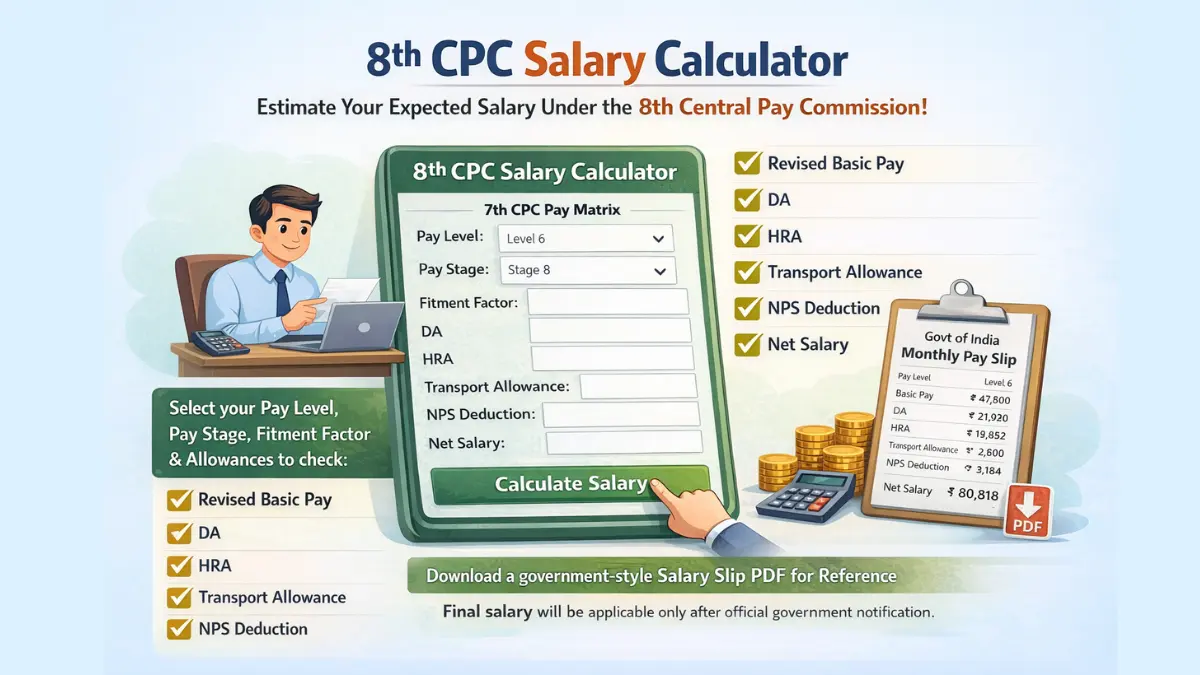
Top Reasons for the Delay in 8th Pay Commission
1. No Terms of Reference (ToR) Finalized
The Terms of Reference—which define the scope, objectives, and guidelines for the Pay Commission—have not yet been finalised. This is the foundational step without which the Commission cannot legally function or recommend anything.
2. Commission Yet to Be Constituted
No chairman or members have been appointed so far. The delay in administrative appointments is directly delaying the commission’s formation and working. implementation from 1st January 2026 deadline seem unrealistic.
3. No Budgetary Allocation
The Union Budget 2025-26 made no provision for implementing 8th CPC recommendations. This suggests that the government is either not ready or planning to postponed rollout to manage fiscal impact.
4. Economic Pressures & Fiscal Deficit
Post-COVID recovery, rising inflation, subsidy burden, and welfare spending have all limited the government’s fiscal space. A new pay commission would likely cost the exchequer over ₹1.5 lakh crore annually, which the Finance Ministry is being cautious about.
5. Delay in Inter-Ministerial Consultations
Inputs are still being sought from various ministries like DoPT, MoF, Defence, and Railways. Without cross-department consensus, the proposal cannot move forward for Cabinet approval.
According to Sanjeev Sanyal, Principal Economic Adviser to the Government of India, the Centre is conducting a massive “mapping exercise” to understand and restructure its workforce before implementing the Pay Commission.
“We are mapping all government departments to identify outdated roles and areas that need more manpower — such as cybersecurity.”
What This Means:
- Mapping to finish by December 2025
- Departmental restructuring (mergers, closures, new roles)
- Then, 8th CPC ToR & pay matrix redesign
This ensures a modernized pay structure for a reformed, future-ready government.
6. No Clear intention of Modi government
In recent years, there had been speculation that the 8th Pay Commission might not be established, as the Modi government was reportedly considering a new mechanism for periodic salary revisions. However, during the Delhi Assembly elections in January 2025, Prime Minister Narendra Modi unexpectedly announced the formation of the commission.
Even if constituted immediately, a Pay Commission typically requires 12 to 18 months to conduct its study, draft recommendations, and finalize its report. Without a confirmed start date, meeting the proposed 2026 implementation timeline appears increasingly uncertain.
Historical Delays in Pay Commission Formation
| Pay Commission | Announced | ToR Notification | Delay |
| 4th CPC | 26 Jul 1983 | 1 Sep 1983 | 1 month |
| 5th CPC | 1 Sep 1993 | 9 Apr 1994 | 7 months |
| 6th CPC | 20 Jul 2006 | 5 Oct 2006 | 2.5 months |
| 7th CPC | 25 Sep 2013 | 28 Feb 2014 | 5 months |
| 8th CPC | 16 Jan 2025 | Pending | 200+ days |
8th CPC Pay Matrix (Projected)
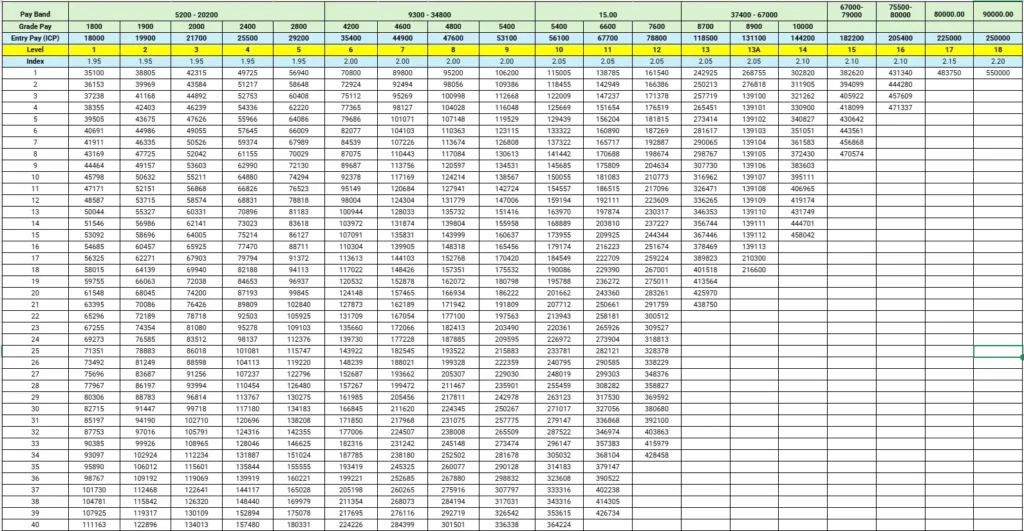
| Pay Matrix Level | 7th CPC Basic Pay | 8CPC (1.95x) | 8CPC (2.45x) |
| Level 1 | ₹18,000 | ₹35,100 | ₹44,100 |
| Level 6 | ₹35,400 | ₹69,030 | ₹86,730 |
| Level 10 | ₹56,100 | ₹1,09,395 | ₹1,37,445 |
| Level 13 | ₹1,23,100 | ₹2,40,045 | ₹3,01,595 |
| Level 15 | ₹1,82,200 | ₹3,55,290 | ₹4,46,390 |
8th Pay Commission FAQs
When will the 8th Pay Commission be implemented?
Tentatively from 1 January 2026, but a 6–12 month delay is likely.
How much salary hike is expected?
Around 30–34%, based on the fitment factor.
Will DA reset to zero after implementation?
Yes, DA will start again from 0% post-implementation.
Will it apply to state government employees?
State governments may adopt CPC recommendations separately.
Is it applicable to pensioners?
Yes. Pensioners will benefit through revised pension formulas.
Why is it delayed?
Administrative restructuring, incomplete ToR, fiscal caution and No clear Intention of Government.
Conclusion
The 8th Pay Commission, though highly anticipated, appears to be caught in a tangle of bureaucratic delays, fiscal caution, and political maneuvering. Without formal notification, it remains uncertain whether the government is genuinely preparing for implementation or using the issue as a pre-election promise.
For millions of government employees and pensioners, the hope is that the 8th CPC will be constituted soon, with genuine intent—beyond political gains—so that fair salary revisions and financial justice can be ensured by 2026.







17 thoughts on “8th Pay Commission (CPC) : Salary Hike, Composition Fitment Factor, Delay Explained, Expected Date & Latest Updates”