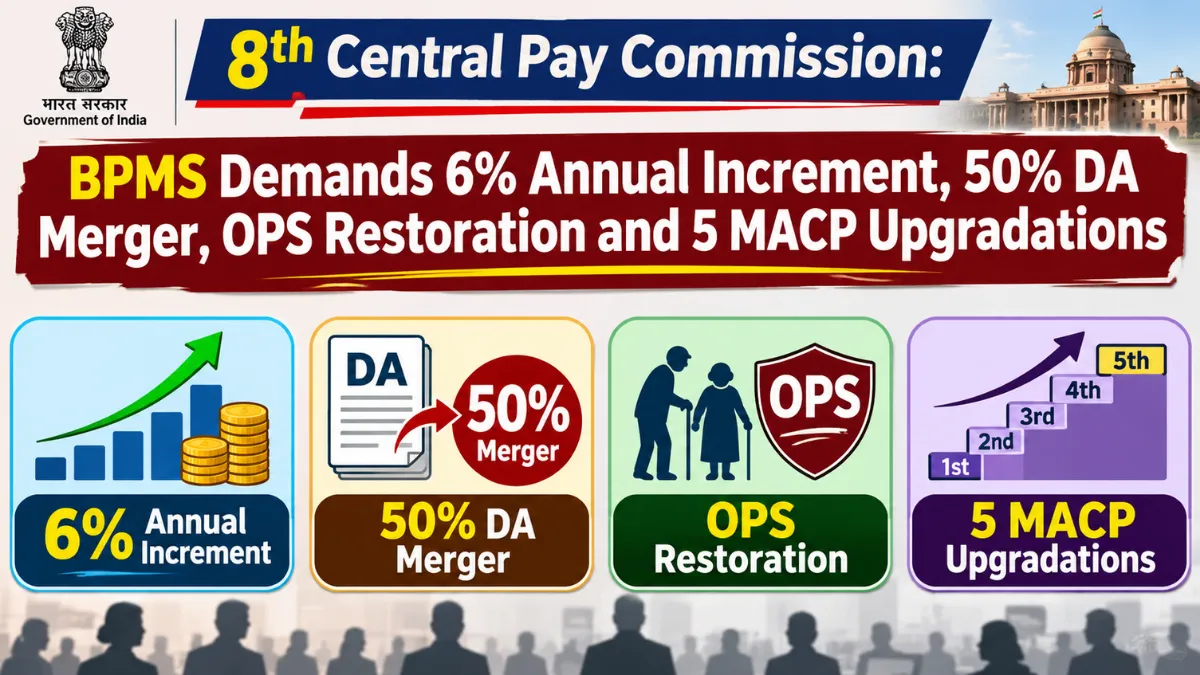
The 8th Pay Commission BPMS demands 2026 now include doubling the annual increment from 3% to 6%, merging 50% of Dearness Allowance (DA) into basic pay and pension, restoring the Old Pension Scheme (OPS), and guaranteeing at least five Modified Assured Career Progression (MACP) upgradations over a 30-year career. The Bharatiya Pratiraksha Mazdoor Sangh (BPMS), a Ministry of Defence-recognised federation of defence workers, placed these points before the 8th Central Pay Commission (CPC) in a letter dated 18 November 2026, ahead of its second-round interaction in New Delhi.
The numbers are easy to grasp. For a Level 6 employee on ₹35,400 basic pay, a 6% increment adds about ₹2,124 a month, against ₹1,062 at today’s 3%. But every item here is a union proposal, not a government decision. The Commission’s report is due by May 2027, and nothing in this letter changes any payslip today.
Join Telegram
Join NowJoin WhatsApp
Join Now8th Pay Commission BPMS Demands 2026 – At a Glance
| Detail | Information |
|---|---|
| Submitted by | Bharatiya Pratiraksha Mazdoor Sangh (BPMS) |
| Submitted to | Chairperson, 8th Central Pay Commission |
| Date of letter | 18 November 2026 |
| Occasion | Second-round interaction with the Commission |
| Headline demands | 6% annual increment; 50% DA merger; OPS restoration; minimum five MACP upgradations |
| Primarily concerns | Defence Civilian Employees (several demands cover all central employees and pensioners) |
| Status | Proposal only; not approved |
| Commission’s report due | May 2027 (18 months from 3 November 2025) |
Why BPMS Is Back Before the 8th CPC Now
BPMS has been here before. In April 2026 it sent a full memorandum seeking a minimum basic pay of ₹72,000 against today’s ₹18,000, with a fitment factor of 4.0. The 18 November letter is a supplement to that document, and BPMS asks the Commission to read the two together.
What stands out is what the new letter leaves out. It asks for a scientific method of fixing minimum pay and a rational fitment factor, but it does not repeat the ₹72,000 figure. Instead it leads with four structural asks on increments, DA, pension and career progression, which change how pay grows across a career and not only where it starts.
That timing makes sense. The Commission, headed by Justice Ranjana Prakash Desai, is still consulting, and unions are using the second round to push the items that compound over decades.
Doubling the Annual Increment: What 6% Would Do to Your Basic Pay
Central employees today earn an annual increment of 3% of basic pay. BPMS says that rate cannot keep up with living costs and asks for 6%. Here is what that gap looks like for a Level 6 employee starting at ₹35,400.
| Years from now | Basic pay at 3% | Basic pay at 6% |
|---|---|---|
| 1 year | ₹36,462 | ₹37,524 |
| 5 years | ₹41,039 | ₹47,373 |
| 10 years | ₹47,574 | ₹63,396 |
Indicative only. Figures ignore pay matrix cell rounding, promotions and DA.
Ten years in, the gap is ₹15,822 a month. That is the difference between an increment that merely tracks prices and one that outruns them. What the letter does not say is what 6% would cost the exchequer, and that is the first question any costing exercise will ask.
The 50% DA Merger: An Old Idea Returning With DA at 63%
BPMS wants 50% of existing DA merged with basic pay and pension before the revised pay and pension structures are fixed. DA stands at 63% from 1 July 2026 after a 3-point revision [Check official Department of Expenditure O.M.], so a merger would turn a large slice of that into permanent basic pay.
Unions usually mean the first 50 percentage points, though the letter’s wording can also be read as half of the DA amount. On the first reading, a Level 6 employee’s basic pay would rise by ₹17,700, from ₹35,400 to ₹53,100. Allowances and retirement benefits calculated on basic pay would then sit on a larger base.
The idea is not new. The 5th CPC era saw 50% of DA merged into pay in 2004, the 6th CPC rejected further mergers, and the 7th CPC did not continue the practice. The shift is notable because DA crossed 50% in January 2024, the traditional trigger, and pressure has built since. No merger has been announced.
Old Pension Scheme Restoration: The Hardest Ask on the List
BPMS asks that the National Pension System (NPS) and the Unified Pension Scheme (UPS) be discontinued for central employees and the defined-benefit OPS restored. It argues that only a guaranteed pension gives adequate social security after retirement.
This is the biggest item on the list and the one least likely to be settled by a pay commission alone. The letter offers no cost estimate or transition plan, and a change in pension architecture is ultimately a government decision. If you are enrolled in NPS or UPS today, nothing changes for you.
A related demand matters to current pensioners. BPMS wants no discrimination in pension revision between those who retire before and after 1 January 2026. For anyone retiring around that date, that is a live question.
📌 Also Read: NPS vs UPS comparison 2026
Five MACP Upgradations: Why Three Is No Longer Enough, Say Unions
Under the current scheme, an employee gets three financial upgradations, after 10, 20 and 30 years of service, or after 10 years in the same level, whichever comes first. BPMS wants every employee to receive at least five over 30 years.
| Current rule | NC-JCM proposal | BPMS letter | |
|---|---|---|---|
| Number of upgradations | 3 | 5 | At least 5 |
| Timing | 10, 20, 30 years | 6, 12, 18, 24, 30 years | Over 30 years (intervals not specified) |
The National Council (Joint Consultative Machinery) staff side, NC-JCM, has put forward the six-year schedule. The 7th CPC saw no justification for raising MACP frequency, so this is a demand the Commission has rejected before.
BPMS pairs it with a Dynamic Promotion Scheme linked to service and merit, a five-year cap on feeder-grade residency, and retrospective effect for delayed Departmental Promotion Committee (DPC) decisions. That matters because stagnation, not the number of MACP steps alone, is what long-serving Group C workers describe.
💡 Not sure where you stand today? Use our MACP eligibility checker to see when your next upgradation is due.
Beyond the Four Headlines: Allowances, Leave and Cadre Fixes
The letter runs well past the headline items. It asks for Risk Allowance of up to ₹10,000 a month for hazardous duties and for Central Government Employees Group Insurance Scheme (CGEGIS) cover to rise from ₹30,000 to at least ₹15 lakh. It also seeks ₹10 lakh under Deposit Linked Insurance and ₹1 crore ex-gratia for fatal accidents on duty.
On leave, BPMS wants 12 days of casual leave, 45 days of paternity leave, and two years of Child Care Leave with full wages. It also proposes extending Children Education Allowance to the post-graduate level and exempting employees and pensioners from CGHS subscriptions.
The defence-specific section is where the federation’s core membership sits. Master Craftsmen would get Selection Grade in Pay Level 7 with Non-Functional Upgradation (NFU) to Level 8, pharmacists would enter at Level 6, and fire-fighting staff would get uniform recruitment rules across establishments. For these cadres, the cadre fixes may matter more than any headline percentage.
If You Are a Defence Civilian Employee, Here Is What This Means for You
If you work in a defence workshop, hospital, canteen or fire service, several of these demands were written with your cadre in mind. You do not need to apply for anything, file any form or change any declaration. This is a representation to the Commission, not a scheme with an application window.
What is worth doing is keeping your service record and APAR history in order, since MACP and promotion benefits depend on them whatever the Commission recommends. Watch what your recognised union circulates after the interaction, and treat any figure quoted as a confirmed raise with caution. If you are a pensioner, the pre- and post-2026 parity demand is the item to follow.
What Comes Next: From Representation to Government Order
The path from here has three stages. The Commission completes its consultations and submits its report, due by May 2027 on the 18-month mandate counted from 3 November 2025. The Union Cabinet then decides which recommendations to accept, and a government notification follows.
The effective date of any new pay structure is [To be announced]. Unions are pressing for 1 January 2026, but that is a demand, not an order. For now, the realistic expectation is that some of these asks will be examined and most will be trimmed.
📌 Also Read: 8th Pay Commission 2026 | DA formula change demand | 8th CPC salary calculator
Important Links
| What | Link |
|---|---|
| BPMS letter dated 18.11.2026 (PDF) | View here |
| Source report | StaffNews |
| DoPT MACP Office Memorandum | View here |
| 8th CPC official website | [Insert official link] |
| Related post | 8th CPC salary calculator |
Frequently Asked Questions
What are BPMS’s main demands to the 8th Pay Commission?
BPMS wants the annual increment raised from 3% to 6%, 50% of DA merged with basic pay and pension, the Old Pension Scheme restored, and at least five MACP upgradations in 30 years. It also seeks higher risk allowance, better insurance cover, more leave and cadre restructuring for defence civilian staff.
Has the 8th Pay Commission accepted a 6% annual increment?
No. The 6% increment is a union demand made in the 18 November 2026 letter. The Commission has not announced any recommendation, and the current rate remains 3%.
Will 50% DA be merged with basic pay in the 8th CPC?
It is unconfirmed. DA merger has been demanded by several unions, but no decision has been announced. Earlier commissions did not continue the practice after 2004.
Will the Old Pension Scheme be restored for central government employees?
There is no such decision. BPMS has asked for NPS and UPS to be discontinued and OPS restored, but the final call would rest with the government, not the Commission alone.
How many MACP upgradations are there now, and will they rise to five?
There are three, at 10, 20 and 30 years of service. BPMS and NC-JCM want five, but this is a demand and the 7th CPC earlier saw no case for more frequent MACP.
When will the 8th Pay Commission submit its report?
The Commission has 18 months from 3 November 2025, which puts the deadline at May 2027. The government has not given an earlier date.
Conclusion
The BPMS letter is a statement of priorities, not a forecast of what the next pay structure will look like. The ideas with some history, such as DA merger, are better placed than the rest, while OPS restoration remains a long shot. For defence civilian employees, the cadre-specific fixes may prove the most practical gains.
Bookmark Govtserviceinfo.com and join our Telegram channel for instant alerts on DA hikes, pay revision orders, and 8th CPC updates.
Disclaimer: This article is based on the BPMS letter dated 18 November 2026 as published by StaffNews, and on media reports on the 8th Central Pay Commission. All demands described are union proposals, not approved government decisions. Govtserviceinfo.com is not affiliated with BPMS, the 8th Central Pay Commission or the Government of India. Readers should verify current information from official government sources before acting on it.