
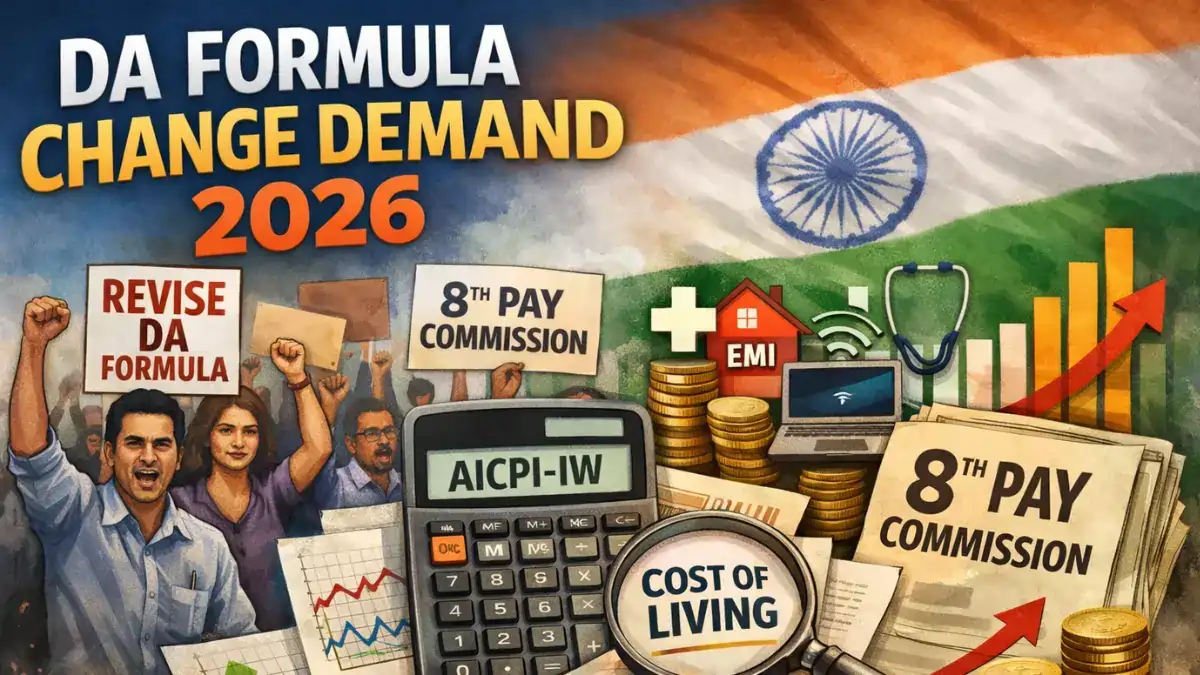
Employee unions are demanding a sweeping overhaul of how Dearness Allowance is calculated — a formula that hasn’t meaningfully changed since 1957. Here’s what’s broken, what’s being demanded, and what it could mean for your monthly salary or pension.
For millions of government employees, the debate around DA formula change demand 2026 is no longer just technical—it’s becoming a question of fairness. Employee unions argue that the current Dearness Allowance calculation method, based on outdated assumptions and the All India Consumer Price Index for Industrial Workers, fails to capture today’s real cost of living. From rising digital expenses to healthcare and education, many essential costs are either underrepresented or ignored. As pressure builds ahead of the 8th Pay Commission, unions are pushing hard for a revised, more realistic formula—one that truly reflects 2026 economic realities and delivers fair compensation to employees and pensioners.
📋 What’s in This Article
Why This Debate Is Heating Up Right Now
Imagine the government calculating your grocery bill based on what things cost in 1957. That’s essentially what central government employee unions are arguing happens with Dearness Allowance — and they want it fixed before the 8th Pay Commission makes its final call.
DA is the monthly inflation buffer built into every central government salary and pension. It gets revised every January and July based on consumer price data. But how that data gets interpreted — and which family model it assumes — is what unions say is deeply flawed.
The All India Trade Union Congress (AITUC), India’s oldest trade union federation, has formally urged the government to revisit the DA calculation framework. Their timing is deliberate: the 8th Pay Commission has just extended its public consultation deadline to March 31, 2026, making this the last real window to push for structural change before recommendations are locked in.
📌 Quick Context
DA currently stands at 58% of basic pay (effective July 2025), with the January 2026 hike expected to push it past 60%.
DA is not just a salary top-up — it also feeds into pension, PF, gratuity, and HRA calculations. A formula change would ripple through every one of these.
The 8th Pay Commission is expected to implement revised pay from January 2026, though final salaries will likely be paid with arrears in mid-2026.
How DA Currently Works
Every month, India’s Labour Bureau publishes the All India Consumer Price Index for Industrial Workers (AICPIN-IW) — a number that tracks how much a fixed basket of goods costs compared to a base year. Think of it as a monthly measure of how fast prices are rising for working-class households.
Twice a year, the government averages out the last 12 months of this index and runs it through a formula. The result is a percentage — and that percentage is your DA rate, applied directly to your basic pay.
So if your basic pay is ₹40,000 and DA is 58%, you receive an extra ₹23,200 every month as DA. That amount changes every six months as inflation data comes in.
| DA Rate | Basic Pay ₹25,000 | Basic Pay ₹40,000 | Basic Pay ₹60,000 |
|---|---|---|---|
| 50% | ₹12,500 | ₹20,000 | ₹30,000 |
| 55% | ₹13,750 | ₹22,000 | ₹33,000 |
| 58% (current) | ₹14,500 | ₹23,200 | ₹34,800 |
| 60% (expected) | ₹15,000 | ₹24,000 | ₹36,000 |
Simple enough in theory. The problem, unions argue, is not the arithmetic — it’s what goes into the basket and whose family the formula assumes you have.
The 1957 Aykroyd Formula: What Is It and Why Unions Call It Outdated
In 1957, nutritionist Wallace Ruddell Aykroyd recommended a framework for calculating minimum wages in India. The government adopted it — and it has been used, in some form, as the foundation for minimum wage and DA calculations ever since.
The Aykroyd Formula rests on three pillars:
🍽️
Nutritional Baseline
A minimum of 2,700 calories per day for a working adult — the nutritional floor, nothing more.
👕
Clothing & Housing
Basic shelter and minimal clothing allowance — conceived in an era before urban rent inflation.
👨👩👦
3-Unit Family Model
Assumes a household of 3 consumption units — roughly a working adult plus one dependent.
“A formula designed for survival in 1957 cannot accurately measure the cost of dignified living in 2025. Internet bills, medical insurance, school fees — none of these existed then.”
— The core argument of employee union submissions to the 8th Pay Commission
Unions point out that modern Indian households regularly include aging parents, school-going children with digital education needs, and urban rental costs that can easily exceed an entire minimum wage. None of this is captured in a 68-year-old formula.
What Unions Are Specifically Demanding
AITUC and allied federations have put forward a detailed set of demands — not just vague complaints. Here’s what they’re actually asking for:
👨👩👴👦
Expand Family Unit from 3 to 5
Include dependent parents in the model, reflecting that multi-generational households are India’s norm — not an exception.
📱
Add Modern Necessities
Internet, digital devices, quality healthcare, and education are no longer luxuries. They should be in the calculation basket.
🏙️
Capture Urban Cost Pressure
Urban rent, commuting, and lifestyle costs in cities like Delhi, Mumbai, and Bengaluru are vastly different from what the 1957 model assumed.
🏥
Better Healthcare Cover
Rising out-of-pocket medical expenses must be factored in — healthcare inflation consistently outpaces general CPI.
Beyond the formula itself, unions have a broader set of asks submitted to the 8th Pay Commission: restoration of the Old Pension Scheme (OPS), a higher fitment factor, improved social security benefits, and — critically — an immediate DA-basic pay merger as interim relief.
The DA-Basic Pay Merger: A Separate but Urgent Demand
Even without a formula change, unions are pushing for one specific action right now: merging the accumulated DA (currently 58–60%) with basic pay.
This has happened before. In 2005, when DA crossed a certain threshold under the 5th Pay Commission, the government merged it into basic pay. During the 6th Pay Commission era, DA actually climbed past 125% — and yet no merger happened. Unions are still bitter about that missed opportunity.
Here’s why they want it now: the 8th Pay Commission is still 18–24 months away from actual implementation. In the meantime, every percentage point of DA exists as a fraction of a smaller base. A merger would immediately raise the effective base — improving gratuity calculations, PF contributions, and pension entitlements.
✅ Why Unions Want Merger Now
- Raises the base for PF, gratuity & pension calculations
- Provides immediate financial relief without waiting for 8th CPC
- Historical precedent exists (2005 merger)
- DA above 50% has traditionally triggered merger discussions
❌ Why Government Is Hesitant
- Adds significant burden to annual salary bill
- Creates complexity with the upcoming 8th CPC restructuring
- No merger happened even at 125% during 6th CPC
- Preferred to handle holistically within pay commission
What Happens to Salaries & Pensions If the Formula Changes
Let’s put real numbers to these demands. The most significant change would come from expanding the consumption unit from 3 to 5 — because that directly determines what the minimum wage should be, which is the floor on which DA is computed.
💰 Potential Salary Impact — Formula Change Scenario
Current minimum pay: ₹18,000/month (7th Pay Commission)
Projected minimum pay (5-unit formula): Could exceed ₹30,000/month — a 66%+ jump
DA on new base: Every future DA hike would be calculated on the higher minimum, compounding the benefit upward
Pension impact: Pensioners receive Dearness Relief at the same rate — so a higher base pension means a proportionally larger DR payout each cycle
| What Changes | Current Position | After Formula Revision |
|---|---|---|
| Minimum basic pay | ₹18,000 | ₹30,000+ |
| Consumption units assumed | 3 units | 5 units |
| Digital/healthcare in basket | Not included | Included |
| DA base (if merged) | ₹18,000–₹2,25,000 | Higher revised basic |
| Fitment factor (8th CPC) | 2.57× (7th CPC) | Likely 2.86×–3.0× |
| Impact on pension DR | DR on existing pension | DR on revised higher pension |
For pensioners, the compounding effect is especially meaningful. A higher basic pension permanently increases the absolute rupee value of every future Dearness Relief revision — even when DR percentages seem small.
Why the Government Can’t Simply Say Yes
The demands are reasonable on paper. But implementing them involves genuine trade-offs that explain why every pay commission since the 5th has taken a cautious approach.
💸
Fiscal Pressure
A jump in minimum pay from ₹18,000 to ₹30,000+ means the salary and pension bill for 50 lakh+ employees and pensioners expands dramatically — every year, permanently.
📊
Data Complexity
Building a new consumption basket that fairly represents workers in Darbhanga and Bengaluru — with wildly different cost structures — is genuinely difficult to do without creating winners and losers.
🗺️
Regional Variation
A 5-unit family model might be accurate for urban Delhi but overshoot reality in smaller towns. A single national formula struggles to capture India’s enormous cost-of-living diversity.
⚖️
Political Balance
Any revision must also not create undue pressure on state governments, which often follow central pay structures with a lag — amplifying the fiscal impact across the entire public sector.
Where Things Stand with the 8th Pay Commission
The 8th Pay Commission was officially announced on 16 January 2025. The commission is gathering inputs through an 18-point questionnaire — the deadline for which has been extended to March 31, 2026. This is exactly why unions are pushing their DA formula demand now rather than later.
🗓️ January 2025
➡️ 8th Pay Commission officially constituted by the Union Cabinet
➡️ Formal process for salary revision begins
🗓️ July 2025
➡️ Dearness Allowance (DA) hiked to 58%
➡️ Crosses key 50% threshold, triggering debate on DA merger with basic pay
🗓️ January 2026
➡️ DA expected to cross 60%
➡️ 8th CPC effective date (technical start)
➡️ Questionnaire submission deadline extended till March 31, 2026
🗓️ Mid to Late 2026 (Expected)
➡️ 8th Pay Commission submits recommendations
➡️ Union Cabinet approval likely
➡️ Revised salaries implemented with arrears from January 2026
🗓️ Post 8th Pay Commission Implementation
➡️ DA reset to 0% on revised basic pay
➡️ New DA calculation formula (if approved) comes into effect
➡️ Major impact on future salary growth and inflation adjustment
⚠️ What’s NOT Confirmed Yet
As of March 2026, there is no official announcement of a DA formula change.
The demand is active and gaining traction — but the government has not accepted, rejected, or responded to it formally.
Any salary projections floating online are based on union demands and expert estimates, not government notifications.
🔑 Key Takeaways for Government Employees & Pensioners
- The DA formula has not officially changed — but the demand is at its most organised and best-timed in years, with the 8th Pay Commission actively taking submissions.
- If the family unit expands from 3 to 5 members, minimum pay could jump from ₹18,000 to over ₹30,000 — the largest structural change since the 6th Pay Commission.
- The DA-basic pay merger (at current 58–60% DA) is a separate, interim demand — and has historical precedent from 2005.
- Even without a formula change, the 8th Pay Commission fitment factor (expected 2.86×–3.0×) will deliver a significant pay hike when it is implemented.
- Pensioners benefit from every structural change through proportionally higher Dearness Relief on a revised base pension.
- Watch for official notifications from the Department of Expenditure and the Pensioners’ Portal — those are the only authoritative sources.
Your Questions Answered
Has the government officially agreed to change the DA formula?
No. As of March 2026, there is no official confirmation. The demand has been formally submitted to the 8th Pay Commission by AITUC and other unions, and the commission’s public consultation is still ongoing. The government will respond through the commission’s final report.
What is the Aykroyd Formula and why does it matter for my DA?
The Aykroyd Formula (1957) sets the framework for minimum wage calculations — it defines what a minimum living standard costs using a 3-unit family model focused on food, clothing, and shelter. Since DA is a percentage of basic pay, and the minimum basic pay flows from this framework, any revision to the formula cascades up into DA calculations.
Will DA be merged with basic pay before the 8th Pay Commission is implemented?
Unions are demanding this as interim relief, but the government has not committed. Historical precedent is mixed — a merger happened in 2005, but not at 125% DA during the 6th Pay Commission. Given the proximity to the 8th CPC, a standalone merger seems unlikely; the restructuring will probably happen within the commission’s framework.
I’m a pensioner. How does a DA formula change affect me?
Pensioners receive Dearness Relief (DR) at the same percentage as active employees. If the formula change leads to a higher basic pension (through the fitment factor applied to your last drawn pay), then every future DR hike — even at the same percentage — delivers a larger absolute rupee amount. The long-term compounding benefit for pensioners is significant.
When will the next DA hike be announced?
The DA hike for January 2026 is expected imminently. Based on AICPIN data trends, a 2–3% increase is likely, taking DA to around 60–61%. The effective date will be January 1, 2026, with arrears for January–March paid once the notification is issued.
Disclaimer: All salary and pension projections in this article are based on union submissions, expert estimates, and historical patterns. No figures represent confirmed government policy. Readers should verify information through official government notifications before making any financial decisions
Read our complete guide on the 8th Pay Commission 2026 to understand salary changes and expected implementation timeline.






4 thoughts on “Is India’s DA Formula Broken? Unions Say Yes — And the 8th Pay Commission May Force a Fix”