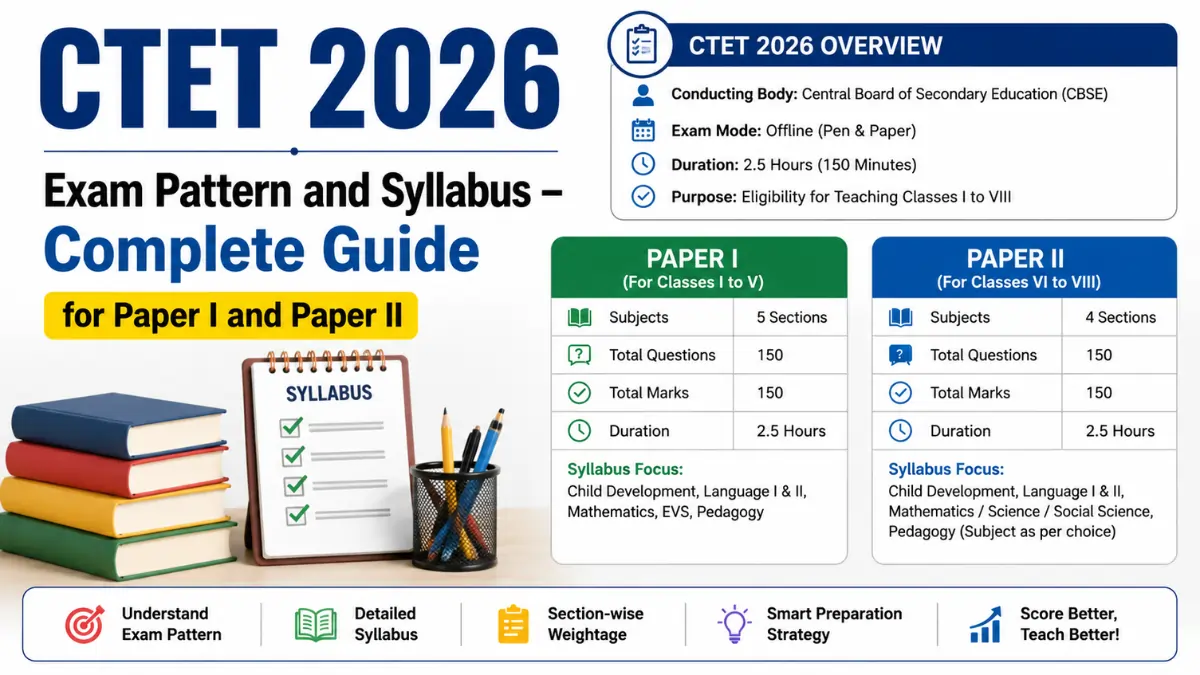
The CTET 2026 exam pattern and syllabus is now officially out, and if you are planning to teach in a central government school, this is the document that decides what you study and how you prepare. The Central Teacher Eligibility Test (CTET) September 2026, conducted by the Central Board of Secondary Education (CBSE), is scheduled for 06 September 2026 (Sunday), with online applications open from 11 May 2026 to 10 June 2026.
This guide breaks down exactly what the exam looks like — the structure of both papers, what each section tests, the subject-wise syllabus, qualifying marks, and what a CTET certificate is actually worth. Whether you are appearing for the first time or attempting to improve your score, here is everything you need to know before you open a textbook.
Track every open notification & never miss a deadline
📌 Also Read: Latest Government Job Notifications 2026 – Full List
Table of Contents
CTET 2026 – Key Details at a Glance
| Detail | Information |
|---|---|
| Conducting Authority | Central Board of Secondary Education (CBSE), Delhi |
| Exam Name | Central Teacher Eligibility Test (CTET) September 2026 |
| Application Window | 11 May 2026 to 10 June 2026 |
| Date of Examination | 06 September 2026 (Sunday) |
| Mode of Exam | Offline (OMR-based) |
| Number of Papers | Two — Paper I and Paper II |
| Question Type | Multiple Choice Questions (MCQs) — No negative marking |
| Official Website | https://ctet.nic.in |
⚠️ Important: If the number of registered candidates increases significantly, the exam may also be conducted on 05 September 2026 (Saturday). The exam date will be allotted to candidates on a random basis.
Two Papers, Two Levels — How CTET 2026 Is Structured
The CTET 2026 exam is divided into two papers, and which paper you sit depends on which class level you want to teach.
Paper I is for candidates who wish to become teachers for Classes I to V (primary stage). Paper II is for those who want to teach Classes VI to VIII (upper primary or elementary stage). If you want to be eligible to teach at both levels, you must appear in both papers — there is no combined paper.
Each paper carries 150 marks and runs for two and a half hours. The entire paper is Multiple Choice Question (MCQ) format, with four options per question. There is no negative marking, which means unattempted questions do not cost you marks.
The exam schedule on 06 September 2026 is as follows: Paper II runs in the morning shift from 09:30 AM to 12:00 Noon, and Paper I runs in the evening shift from 02:30 PM to 05:00 PM. Candidates appearing for both papers must be prepared for a full-day commitment.
Paper I Exam Pattern — What Primary-Level Aspirants Face
Paper I tests your readiness to teach children in the 6–11 age group. The paper has five compulsory sections, each worth 30 marks, adding up to 150 marks total.
| Section | Subject | Questions | Marks |
|---|---|---|---|
| I | Child Development and Pedagogy | 30 | 30 |
| II | Language I (Medium of Instruction) | 30 | 30 |
| III | Language II (Communication Language) | 30 | 30 |
| IV | Mathematics | 30 | 30 |
| V | Environmental Studies (EVS) | 30 | 30 |
| Total | 150 | 150 |
All five sections are compulsory. The question paper is bilingual — Hindi and English — and you can choose any two languages from a list of 27 for Language I and Language II. The only requirement is that Language II must be different from Language I.
Paper II Exam Pattern — What Upper Primary Aspirants Need to Know
Paper II tests your readiness to teach the 11–14 age group. It shares two sections with Paper I — Child Development and Pedagogy, and the two language papers — but the subject section is different and discipline-specific.
| Section | Subject | Questions | Marks |
|---|---|---|---|
| I | Child Development and Pedagogy | 30 | 30 |
| II | Language I | 30 | 30 |
| III | Language II | 30 | 30 |
| IV(a) | Mathematics and Science (for Maths/Science teachers) | 60 | 60 |
| OR | |||
| IV(b) | Social Studies / Social Science (for Social Studies teachers) | 60 | 60 |
| Total | 150 | 150 |
The subject choice in Section IV is the key difference from Paper I. If you intend to teach Mathematics and Science, you pick option (a). If you intend to teach Social Studies or Social Science, you pick option (b). For any other teaching role at the upper primary level, either subject can be chosen. Candidates who do not specify a subject for Paper II will have their application rejected without refund.
📌 Also Read: CBSE CTET September 2026: 22nd Edition Notification Out – Apply Online by 10 June
CTET 2026 Syllabus — Paper I (Classes I to V)
Child Development and Pedagogy (30 Questions)
This section is divided into three sub-areas. The first, Child Development, covers 15 questions and focuses on how children grow and learn — concepts like Piaget’s stages of cognitive development, Kohlberg’s moral development theory, and Vygotsky’s zone of proximal development. It also covers topics such as heredity and environment, gender as a social construct, inclusive education, and school-based assessment practices including Continuous and Comprehensive Evaluation (CCE).
The second sub-area — Inclusive Education and Children with Special Needs — carries 5 questions and tests your understanding of how to address learners from disadvantaged backgrounds and those with learning difficulties or special abilities.
The third sub-area, Learning and Pedagogy, covers 10 questions on how children actually think and learn, common reasons children underperform, motivation, cognition, and the social dimensions of learning.
Mathematics (30 Questions)
The Mathematics section for Paper I is split equally between content and pedagogy. The content questions (15 marks) cover the NCERT syllabus for Classes I–V: geometry, spatial understanding, numbers, the four basic operations, measurement, data handling, patterns, and money. The difficulty can extend up to secondary level.
The pedagogical questions (15 marks) are not about doing sums — they are about understanding the nature of Mathematics as a discipline, how to teach it, how to analyse errors, and how to use community and informal contexts for mathematical learning.
Environmental Studies (30 Questions)
EVS content (15 questions) covers six broad themes from the NCERT Classes I–V syllabus: family and friends (including relationships, animals, and plants), food, shelter, water, travel, and things we make and do.
The pedagogy portion (15 questions) covers concepts like the significance of EVS, its relationship to Science and Social Science, learning principles, experimentation, discussion techniques, and CCE application in EVS.
Language I and Language II (30 Questions Each)
Both language papers test similar competencies but with slightly different emphasis. Language I focuses on proficiency in the medium of instruction and includes reading comprehension of unseen passages (prose and poetry) alongside pedagogy of language development — how children acquire language, the role of listening and speaking, grammar, language skills, and remedial teaching.
Language II focuses on communication and comprehension abilities. Its comprehension section includes two unseen prose passages. The pedagogy section mirrors Language I closely, covering learning and acquisition, principles of teaching, and how to evaluate language proficiency across all four skills: speaking, listening, reading, and writing.
💡 Candidates can choose any two languages from a list of 27, including English, Hindi, Bengali, Tamil, Urdu, Sanskrit, Marathi, Telugu, Kannada, Gujarati, Odia, and others. Language I and Language II must be different.
CTET 2026 Syllabus — Paper II (Classes VI to VIII)
Child Development and Pedagogy (30 Questions)
The Paper II version of this section is very similar to Paper I but is pitched at the 11–14 age group. It covers the same theoretical frameworks — Piaget, Kohlberg, Vygotsky — but applied to the psychology and learning patterns of older children. The questions on inclusive education and learning and pedagogy follow the same structure as Paper I.
Mathematics and Science (60 Questions — for Maths/Science Teachers)
This section carries 60 marks in total, split equally between Mathematics (30 marks) and Science (30 marks). Within each subject, 20 marks are allocated to content and 10 marks to pedagogy.
The Mathematics content covers the NCERT Classes VI–VIII syllabus: number systems (whole numbers, integers, fractions), algebra and ratio, geometry (2D and 3D shapes, symmetry, construction), mensuration, and data handling. The difficulty standard can extend up to the senior secondary level.
The Science content covers food (sources, components), materials of daily use, the living world, moving things and ideas, how things work (electric circuits and magnets), natural phenomena, and natural resources.
Pedagogical questions in both subjects test your understanding of how to teach the subject — aims and objectives, approaches to teaching, evaluation methods, use of teaching aids, and remedial strategies.
Social Studies / Social Science (60 Questions — for Social Studies Teachers)
This is the alternative to the Maths and Science section, for candidates who intend to teach History, Geography, and Civics at the upper primary level. It carries 60 marks: 40 marks of content and 20 marks of pedagogy.
The History content is extensive, covering early societies, the first cities and empires, Delhi Sultanate, Mughal architecture, colonial India, the revolt of 1857, women and reform, the nationalist movement, and India after independence.
Geography includes topics such as the earth in the solar system, the globe, natural and human environments, water, air, agriculture, and natural and human resources.
Social and Political Life covers diversity, democracy, government at local and state levels, the Constitution, Parliament, the judiciary, media, gender, and social justice.
Pedagogical questions cover the nature of Social Science as a discipline, classroom processes, critical thinking, enquiry-based learning, use of primary and secondary sources, project work, and evaluation techniques.
The Language Options — All 27 Available
Candidates for both Paper I and Paper II can select their Language I and Language II from the following list. The language codes must be specified correctly on the application form and matched during the examination — attempting questions in a language not mentioned on your Admit Card results in cancellation.
| Language | Code | Language | Code | Language | Code |
|---|---|---|---|---|---|
| English | 01 | Khasi | 08 | Punjabi | 15 |
| Hindi | 02 | Malayalam | 09 | Sanskrit | 16 |
| Assamese | 03 | Manipuri | 10 | Tamil | 17 |
| Bengali | 04 | Marathi | 11 | Telugu | 18 |
| Garo | 05 | Mizo | 12 | Tibetan | 19 |
| Gujarati | 06 | Nepali | 13 | Urdu | 20 |
| Kannada | 07 | Odia | 14 | Bodo | 21 |
| Dogri | 22 | Kashmiri | 23 | Konkani | 24 |
| Maithili | 25 | Santhali | 26 | Sindhi | 27 |
📌 Also Read: BPSC 72nd CCE Recruitment 2026 – Apply Online for 1230 Bihar Civil Services Posts
Qualifying Marks — What You Need to Pass CTET 2026
A candidate who scores 60% or more — that is, 90 marks out of 150 — is considered to have passed the CTET. This qualifying threshold applies to General and OBC (Non-Creamy Layer) candidates.
For candidates belonging to SC, ST, OBC, and Differently-Abled categories, school managements may offer concessions in accordance with their reservation policies. The NCTE notification also allows a relaxation of up to 5% in the qualifying marks in minimum educational qualifications for eligibility.
Importantly, there is no negative marking in CTET. Every correct answer earns one mark. An unanswered question earns zero. This means you should attempt all 150 questions — leaving any blank is a missed opportunity.
What the CTET Certificate Is — and What It Isn’t
The CTET qualifying certificate is now valid for lifetime, for all categories of candidates. There is no restriction on the number of attempts — you can appear as many times as you like, and if you have already qualified, you can appear again to improve your score.
But here is the critical point that many aspirants miss: passing CTET does not guarantee a job. It is one of the eligibility criteria for appointment — not an appointment itself. The actual recruitment, shortlisting, and verification of eligibility is done by the concerned recruiting agency or appointing authority. CBSE makes this explicit in the bulletin.
✅ CBSE issues mark sheets and eligibility certificates in digital format through DigiLocker. The documents are digitally signed and legally valid under the IT Act, with an encrypted QR code for verification.
Where CTET Is Applicable
CTET applies to schools of the Central Government — including Kendriya Vidyalayas (KVs), Navodaya Vidyalayas (NVs), and Central Tibetan Schools — and to schools under the administrative control of Union Territories such as Chandigarh, Dadra and Nagar Haveli, Daman and Diu, Andaman and Nicobar Islands, Lakshadweep, and the NCT of Delhi.
Private unaided schools affiliated to CBSE may also require CTET as a qualification. State government schools, however, generally require the respective State TET — though a state government may choose to accept CTET if it decides not to conduct its own examination.
If You Are Appearing for CTET 2026 — Your Practical Checklist
If you have decided to apply, here is what you need to do in the weeks ahead.
Applications must be submitted online at https://ctet.nic.in or https://www.cbse.gov.in before 10 June 2026 at 11:59 PM. You will need a scanned photograph (10–100 KB, JPG/JPEG, 3.5 cm × 4.5 cm) and signature (3–30 KB, JPG/JPEG, 3.5 cm × 1.5 cm) ready before starting the form.
The examination fee is ₹1,000 for one paper and ₹1,200 for both papers for General and OBC (NCL) candidates. SC/ST/Differently-Abled candidates pay ₹500 for one paper and ₹600 for both. GST is charged additionally by the bank. Payment is accepted only through debit card, credit card, or net banking. Fee once paid is non-refundable.
⚠️ If you apply for Paper II and do not specify your subject (Mathematics & Science or Social Studies), your application will be rejected and the fee will be forfeited — with no communication from CBSE.
Online corrections to application details are available from 15 June to 18 June 2026. This window is final — no corrections are accepted after this date under any circumstances.
The admit card can be downloaded two days before the examination from the official CTET website. Results are expected to be declared by the end of October 2026 (tentatively).
📌 Also Read: Latest UPSC jobs 2026 notifications
Important Links
| What | Link |
|---|---|
| Official CTET 2026 Notification | https://ctet.nic.in |
| CBSE Official Website | https://www.cbse.gov.in |
| NCTE Website (Eligibility Check) | https://ncte.gov.in |
| CTET Query Email | ctet.cbse@nic.in |
| CTET Helpline | 011-24050477 |
Frequently Asked Questions — CTET 2026 Exam Pattern and Syllabus
What is the CTET 2026 exam pattern for Paper I?
Paper I has five compulsory sections, each with 30 MCQs carrying 1 mark each: Child Development and Pedagogy, Language I, Language II, Mathematics, and Environmental Studies. The total is 150 questions for 150 marks, with a duration of two and a half hours. There is no negative marking.
Is the CTET 2026 syllabus different for Paper I and Paper II?
The Child Development and Pedagogy section and the two language sections are common to both papers, though Paper II questions are pitched at the 11–14 age group rather than 6–11. The main difference is the subject section — Paper I covers Mathematics and EVS, while Paper II covers either Mathematics and Science (60 marks) or Social Studies/Social Science (60 marks), depending on the teaching level.
How many marks do you need to pass CTET 2026?
You need to score at least 60% — that is 90 marks out of 150 — to be declared CTET qualified. This is the threshold for General and OBC (NCL) candidates. Concessions may be available for SC, ST, OBC, and Differently-Abled candidates as per the reservation policy of the appointing school management.
Is there negative marking in CTET 2026?
No. CTET 2026 has no negative marking. Each correct answer earns 1 mark. Incorrect or unanswered questions earn zero. You should attempt all 150 questions.
Can I appear in both Paper I and Paper II in CTET 2026?
Yes. If you want to be eligible to teach both primary (Classes I–V) and upper primary (Classes VI–VIII) levels, you must appear in both papers. Paper II is in the morning shift (09:30 AM–12:00 Noon) and Paper I is in the evening shift (02:30 PM–05:00 PM) on 06 September 2026.
How long is a CTET certificate valid?
The CTET qualifying certificate is valid for a lifetime — for all categories of candidates. There is no expiry on CTET qualification. You can also appear in future attempts to improve your score.
Which schools recognise CTET 2026 qualification?
CTET is recognised by Kendriya Vidyalayas, Navodaya Vidyalayas, Central Tibetan Schools, and schools under Union Territory administrations including Delhi, Chandigarh, and the Andaman and Nicobar Islands. CBSE-affiliated private unaided schools may also require it. State government schools generally require the State TET.
Summing Up…
The CTET 2026 exam pattern is designed to test three things: your understanding of how children learn, your command of the subject you will teach, and your ability to teach it effectively through sound pedagogy. The syllabus is drawn directly from the NCERT curriculum for Classes I–VIII, so a thorough reading of NCERT textbooks — combined with study of Piaget, Vygotsky, and language development theories — remains the most reliable preparation strategy.
With no negative marking, a broad but structured syllabus, and a lifetime valid certificate, CTET represents a one-time investment in eligibility that pays dividends across a teaching career. Apply before 10 June 2026, choose your papers carefully, and plan your preparation around the sections that carry the most weight.
📌 Bookmark Govtserviceinfo.com and join our Telegram channel for instant alerts on CTET admit card release, result declaration, and other government exam updates.
Disclaimer: This article is based on the official CTET September 2026 Information Bulletin published by the Central Board of Secondary Education (CBSE). All details are subject to official announcements from CBSE. Govtserviceinfo.com is not affiliated with CBSE or CTET. Candidates should verify current information from the official CTET website at https://ctet.nic.in before taking any action.