
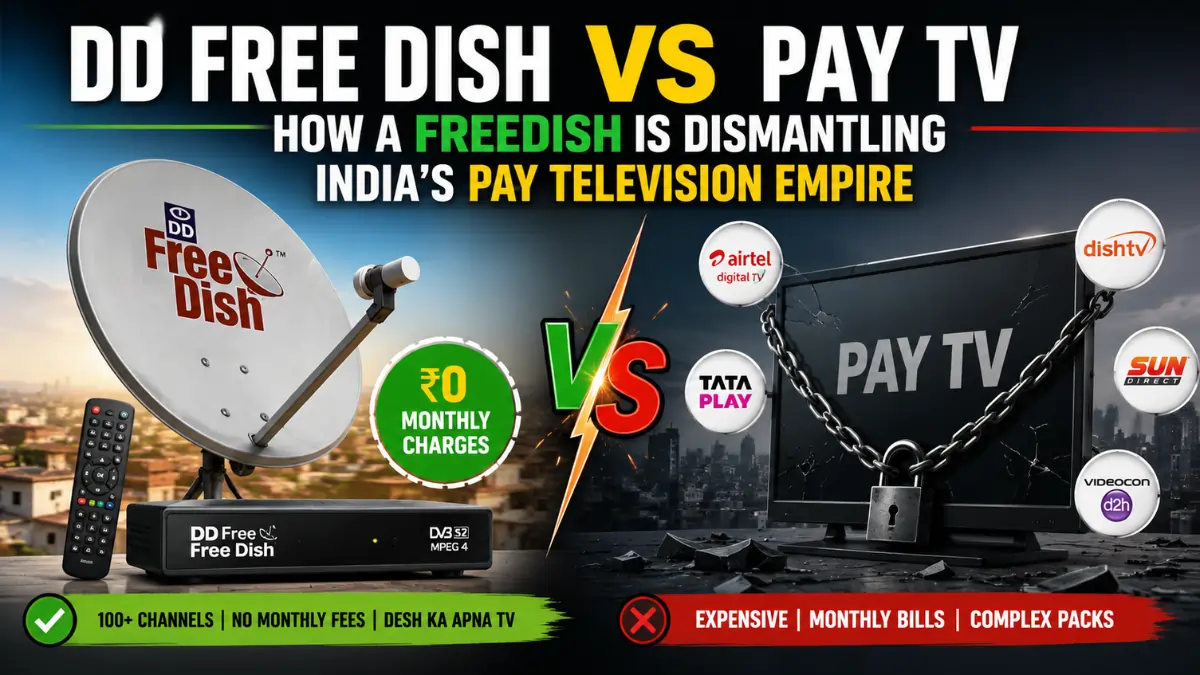
It costs ₹2,000. No monthly bill. No subscription. No contract. And it has just overtaken every single paid DTH operator in India — combined.
DD Free Dish, the government-owned free-to-air (FTA) satellite platform run by Prasar Bharati, has quietly grown into the largest television distribution platform in the country. While media industry conferences in Mumbai debated OTT strategies and connected TV roadmaps, India’s most price-sensitive households simply stopped paying for television altogether — and nobody in the pay-TV boardroom noticed until the numbers became impossible to ignore.
This is not just a disruption story. It is a reckoning.
Table of Contents
The Numbers That Should Alarm Every Pay-TV Executive
Let’s start with the hard data, because the scale of the shift is staggering.
| Metric | Figure | Source |
|---|---|---|
| DD Free Dish estimated households (2025) | 60+ million | Chrome DM / Economic Times |
| Combined pay DTH subscribers (June 2025) | 56.07 million | TRAI |
| Pay DTH subscriber loss (June 2024 – June 2025) | 6.1 million | TRAI |
| Pay TV subscribers in 2018 | 151 million | EY-AIDCF |
| Pay TV subscribers in 2024 | 111 million | EY-AIDCF |
| Projected pay DTH base (FY2026) | Below 51 million | Crisil |
| TV advertising revenue decline forecast (2025) | -1.5% to ₹477.4 billion | WPP |
Read those figures again. Pay TV has lost 40 million subscribers in six years. DD Free Dish has surpassed the combined paying subscriber base of Tata Play, Airtel Digital TV, Dish TV, and Sun Direct — all four operators together.
📌 Also Read: Prasar Bharati WAVES OTT Platform
What Is DD Free Dish — and Why Has It Suddenly Become Unstoppable?
Prasar Bharati launched DD Free Dish in December 2004 as India’s only free-to-air Direct-to-Home (DTH) service. For nearly a decade, it was dismissed as a rural curiosity — a government project serving villages that cable operators hadn’t bothered to reach.
That dismissal was a catastrophic miscalculation.
Here is what makes DD Free Dish structurally different from every other TV platform in India:
- Zero monthly subscription. One-time hardware cost of roughly ₹2,000 covers the set-top box and dish antenna — and that’s it, forever.
- No encryption, no conditional access. Any compatible receiver can access the platform.
- Government ownership. Prasar Bharati does not need to turn a profit. It does not have shareholders demanding quarterly growth.
- Scale ambition. The Ministry of Information and Broadcasting (MIB) has set an explicit target of 5 crore (50 million) homes — a target it has already surpassed if Chrome DM’s estimates are accurate.
💡 Pro Tip: For FMCG advertisers, DD Free Dish’s reach into rural India is now a primary media buy, not an afterthought. Approximately 67% of India’s population lives in rural areas, and around 37% of FMCG consumption originates from these households.
The Great Bifurcation: Two Indias, Two TV Markets
The Indian television market in 2025 has effectively split into two distinct universes — and the gap is widening.
Universe 1: Premium Urban India Affluent, urban households are abandoning linear television for OTT streaming platforms — Netflix, JioHotstar, SonyLIV, Amazon Prime Video. They watch content on demand, on smartphones and smart TVs. They pay premium subscription fees. They are the audience that pay-TV operators desperately need to retain, and they are leaving fastest.
Universe 2: Price-Sensitive India Rural and semi-urban households that cannot afford ₹200–400 monthly subscriptions — or simply choose not to pay them — are migrating to DD Free Dish. This audience is enormous, deeply engaged with television, and growing.
The result? Mainline pay TV channels like Star Plus and Zee TV find themselves squeezed from both ends. Their premium audience has moved to OTT. Their mass audience has moved to Free Dish. And their FTA siblings — Star Utsav, Zee Anmol, Colors Rishtey — now dominate mass viewership while paying no carriage fees to a DTH operator.
As one industry analysis noted, while total Hindi GEC advertising revenue grew modestly to ₹11,500 crore in 2025, almost all of that growth was absorbed by FTA channels. Pay TV channels saw ad growth stagnate near zero.
How This Is Destroying Pay DTH Operators
The quarterly reports from India’s DTH operators in 2025 make for grim reading.
Tata Play, the sector leader, saw its annual loss widen to ₹529.43 crore in FY2024-25, up from ₹354 crore the previous year. Revenue fell 5.46% to ₹4,082 crore. The company has responded by shifting strategy toward content aggregation and OTT bundling — essentially positioning itself less as a satellite TV provider and more as a streaming aggregator.
Airtel Digital TV posted revenue of ₹763 crore in Q1 FY26, down 1.8% year-on-year. Its customer base stands at 15.7 million. Bharti Airtel’s Vice Chairman Gopal Vittal has acknowledged the headwinds while pointing to record market share — a metric that, given the shrinking overall market, feels like winning a race on a sinking ship.
The data from TRAI tells the clearest story: active DTH subscribers fell from 62.17 million in June 2024 to 56.07 million in June 2025. That is more than six million paying customers gone in 12 months. The decline was not sudden — it was consistent every single quarter.
⚠️ The Structural Problem: For cable and DTH operators, every household that migrates to Free Dish is a permanent revenue loss. These subscribers are not returning. The economics of the move are simply too compelling.
📌 Also Read: Tejas Networks Clears Multi-Ministry D2M Broadcasting Trials — India’s Internet-Free Content Dream Just Got Real
The TRAI Regulation That Made Everything Worse
In January 2025, the Telecom Regulatory Authority of India (TRAI) added a layer of regulatory complexity that further strained the ecosystem.
TRAI’s tariff regulation — upheld by the Telecom Disputes Settlement and Appellate Tribunal (TDSAT) in December 2024 — requires that a channel’s pay or free status must remain the same across all distribution platforms. In plain language: a channel that charges subscribers on DTH cannot offer itself free on DD Free Dish.
This sounds straightforward. In practice, it created a crisis.
Many large broadcasters had been running “free” versions of their pay channels on DD Free Dish as a mass-reach strategy — getting revenue from Free Dish’s growing audience while maintaining pay status on DTH. TRAI’s regulation forced them to choose: stay pay everywhere, or go FTA everywhere.
The Indian Broadcasting and Digital Foundation (IBDF) fought back, arguing the regulation was unconstitutional and that DD Free Dish’s non-subscription model made it fundamentally different from other distribution platforms. The Supreme Court dismissed the appeal. The deadline passed. Channels had to comply.
The practical impact: some major broadcasters pulled their FTA versions off Free Dish entirely, at least temporarily. This hurt their mass-market reach but satisfied the regulatory requirement. Others converted their pay channels to FTA across the board — effectively surrendering subscription revenue for advertising scale.
Neither outcome was good for the pay-TV ecosystem.
Is This Market Competition or Regulatory Distortion?
Here is where the analysis gets genuinely uncomfortable for policymakers.
BestMediaInfo.com’s investigation in September 2025 made a pointed argument: India’s TV crisis is “policy-made, not market-made.” The core accusation is that DD Free Dish, as a government platform, competes under a fundamentally different set of rules than private operators.
The concerns raised by industry veterans include:
- DD Free Dish operates a non-addressable system, meaning subscriber numbers cannot be verified. Private operators must comply with strict addressability requirements.
- Private DTH operators pay taxes, licensing fees, and use BIS-certified equipment. Government platforms have distributed set-top boxes without encryption or licensing compliance.
- State-government cable platforms like Tamil Nadu’s TACTV had accumulated over ₹500 crore in unpaid dues to broadcasters as of 2024-25 — a debt acknowledged on the floor of the Tamil Nadu assembly — yet broadcasters feared retaliation if they issued disconnection notices.
- The MIB issued an advisory directing all state governments to exit broadcasting by December 31, 2023. Years later, enforcement remains incomplete.
The industry’s position: “Licensed pay TV platforms are not losing to regular competition, but to unfair, unregulated practices.”
The government’s response: silence. As of the time of writing, no official statement on regulatory parity has been issued.
💡 The Irony: Prime Minister Modi has repeatedly stated that “the government has no business to be in business.” DD Free Dish is government-owned, government-operated, and actively crowding out private investment in television infrastructure.
What Does DD Free Dish’s Growth Mean for Advertisers?
For the advertising industry, DD Free Dish’s rise represents both an opportunity and a strategic headache.
The Opportunity: FTA channels on Free Dish now offer massive reach at CPMs (cost per thousand impressions) that are 35-40% lower than equivalent pay TV placements. For FMCG giants like Hindustan Unilever and P&G targeting rural households, this is an increasingly attractive proposition. EV brands targeting rural buyers, in particular, have emerged as significant spenders on FTA platforms.
The Headache: Reach without precision. DD Free Dish’s non-addressable system makes audience measurement imprecise. Advertisers buying Free Dish inventory are working with estimated, not verified, audience data. As programmatic and data-driven advertising become the industry standard, a platform that cannot deliver addressable measurement is structurally disadvantaged for premium advertising investment.
WPP’s forecast of a 1.5% decline in television advertising revenue in 2025 reflects this tension — the audience is on FTA, but the advertising money increasingly wants to follow precision, not just volume.
The Broader Fallout: Jobs, Regional Content, and the Value Chain
The collapse of pay TV is not just a boardroom problem. It has real consequences for the people who work in television.
According to the EY-AIDCF report on cable TV distribution, the fall of 40 million pay-TV households between 2018 and 2024 resulted in an estimated 114,000 to 195,000 job losses among Local Cable Operators (LCOs) nationwide. Of the 28,000 LCOs surveyed, 93% reported a drop in monthly income since 2018, and nearly 10,000 reported subscriber base declines exceeding 40%.
The ripple effects extend further:
- Regional and local content creators depend on carriage fees and subscription revenue from pay cable. As those revenues collapse, investment in non-Hindi regional content contracts.
- Production houses see commissioning budgets shrink as broadcasters cut costs.
- Technology vendors providing conditional access systems, encryption hardware, and set-top box components face shrinking addressable markets.
As one cable industry expert warned: “If cable collapses, it’s not just operators who suffer. The entire broadcasting value chain, especially regional and local content ecosystems, will take a hit. That’s a social and cultural loss, not just an economic one.”
📌 Also Read: 8th Pay Commission 2026: Expected Salary, Fitment Factor, Pay Matrix & Latest News
Where Does Free Dish Go From Here?
Prasar Bharati is not standing still. The pubcaster has ambitious expansion plans:
- HD channel integration: Prasar Bharati revised its e-auction policy to allow HD channels to participate in Free Dish slot bidding. This is a significant upgrade — Free Dish has historically been an SD-only platform.
- Slot expansion: The number of available slots is planned to increase by 40, accommodating more channels across genres.
- Premium household push: Traditionally a rural platform, Free Dish is now explicitly targeting urban and semi-urban households as a cost-saving alternative to DTH subscriptions. This is a direct competitive move into pay DTH territory.
A FICCI-EY report projects that free TV, led by DD Free Dish, will grow from 49 million homes in 2024 to 57 million by 2030. Given that Chrome DM estimates the base may already be at 60 million, the 2030 projection may already be obsolete.
Frequently Asked Questions
Is DD Free Dish really bigger than all pay DTH operators combined?
Yes, according to estimates from Chrome DM cited by The Economic Times, DD Free Dish has crossed 60 million homes — surpassing the combined active subscriber base of all four pay DTH operators (Tata Play, Airtel Digital TV, Dish TV, and Sun Direct), which stood at approximately 56 to 57 million as of mid-2025.
Why are pay DTH subscribers declining so sharply?
The decline has two main drivers. Affluent households are cutting the cord in favour of OTT streaming platforms like JioHotstar and Netflix. Price-sensitive households are migrating to DD Free Dish, which requires no monthly subscription. Both groups are leaving at the same time, making the decline structural rather than cyclical.
Are major channels leaving DD Free Dish because of TRAI regulations?
TRAI’s tariff regulation, upheld in late 2024, requires channels to maintain the same pay or free status across all platforms. This forced broadcasters with FTA versions of pay channels on Free Dish to make a difficult choice. Some channels pulled out, at least temporarily, while the industry continued to contest the regulation.
Is DD Free Dish available in urban areas?
Yes. While DD Free Dish has historically been associated with rural and semi-urban India, Prasar Bharati has explicitly stated its intention to expand into premium urban households. The platform is available anywhere in India with a compatible set-top box and dish antenna.
What is the future of pay TV in India?
The short-term outlook is challenging. TRAI data shows consistent quarterly declines in pay DTH subscribers, and the Crisil projection of a base falling below 51 million in FY2026 suggests the pressure will intensify. The long-term survival of pay DTH likely depends on successful bundling with OTT services and a pivot toward content aggregation rather than pure distribution.
How does DD Free Dish affect TV advertising?
FTA channels on Free Dish offer very large reach at lower CPMs than pay TV, making them attractive for FMCG and mass-market brands. However, the platform’s non-addressable system limits the precision measurement that modern advertisers increasingly require, which constrains premium advertising investment.
Conclusion: A Reckoning That Cannot Be Deferred
DD Free Dish’s rise is not an accident, and it is not a temporary phenomenon driven by economic hardship. It reflects a structural truth about India’s television market: for a country where nearly half the population lives on less than ₹150 a day, the idea of paying ₹300 a month for television channels will always be contested.
The pay-TV industry’s failure was not in facing competition — it was in failing to anticipate that the government itself would become its most formidable competitor, operating outside the regulatory constraints that private players must navigate.
Whether the outcome is a regulatory correction that creates genuine parity, a strategic reinvention by DTH operators as OTT aggregators, or a continued erosion of the paid broadcast ecosystem — the outcome will shape how hundreds of millions of Indians consume television for the next decade.
The ₹2,000 set-top box has already won the first round. The question is whether anyone in the pay-TV industry has a credible answer for the rest of the fight.
💡 Stay updated on Prasar Bharati news, DD Free Dish policy changes, and government broadcasting developments — bookmark Govtserviceinfo.com and join our Telegram channel for instant alerts.
Disclaimer: This article is based on publicly available industry reports, TRAI data, EY-AIDCF research, and media coverage as of 2025. Subscriber figures from different agencies vary due to measurement methodology differences. Readers are advised to consult official TRAI publications and Prasar Bharati’s official communications for the most current data. Govtserviceinfo.com is not affiliated with Prasar Bharati or any government broadcaster.





3 thoughts on “DD Free Dish vs Pay TV: How a ₹2,000 Set-Top Box Is Dismantling India’s ₹68,000 Crore Television Empire”