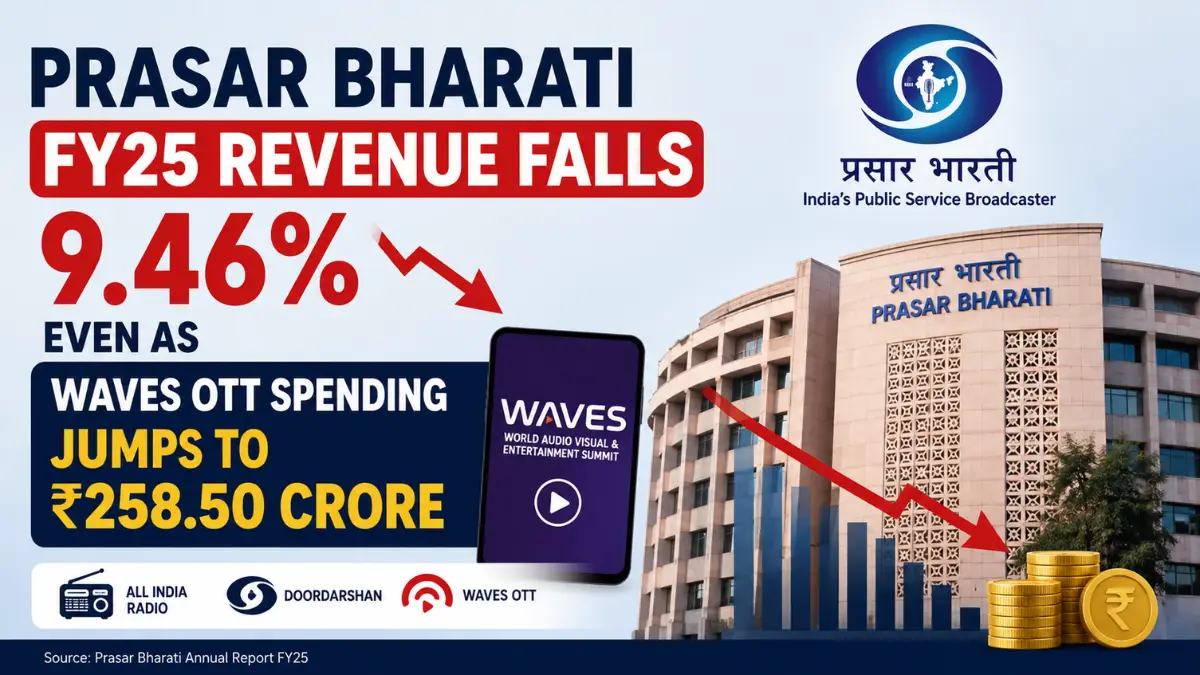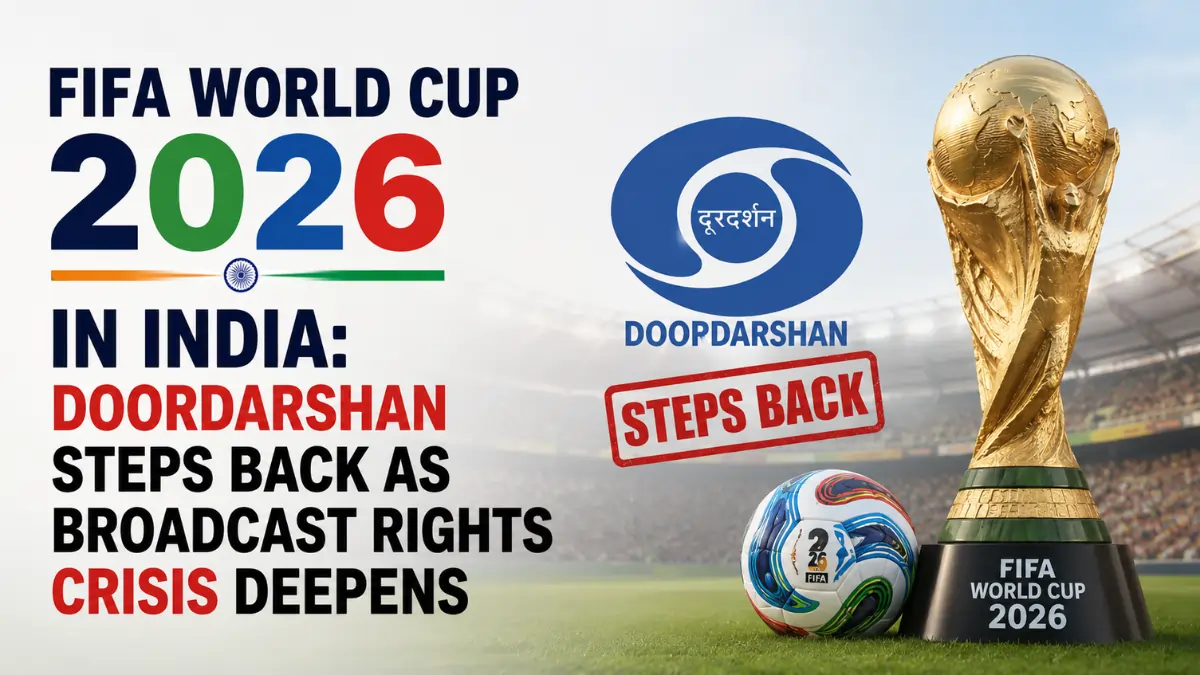
With the FIFA World Cup 2026 just weeks away from its 11 June kickoff in North America, Indian football fans are facing an alarming reality — there is no confirmed broadcaster to air the tournament in India. In a development that underlines just how deep this crisis runs, India’s public service broadcaster Prasar Bharati, the parent body of Doordarshan (DD Sports), has told the Delhi High Court that acquiring the broadcasting rights of the FIFA World Cup 2026 is simply “not its responsibility.” The statement effectively slams the door on the most widely discussed fallback option for millions of Indian fans.
📌 Also Read: 8th Pay commission 49th NC-JCM Meeting 2026 outcomes
Track every open notification & never miss a deadline
How India Ended Up Without a World Cup Broadcaster
The FIFA World Cup 2026 will be the biggest edition of the tournament in history — 48 teams, 104 matches, spread across stadiums in the United States, Canada, and Mexico. Yet for all that scale, India — one of the world’s most digitally engaged football markets — remains one of the only major nations with no official broadcaster locked in.
The breakdown has been primarily commercial. FIFA initially priced the India broadcast rights package (covering both the 2026 and 2030 World Cups as a combined deal) at close to $100 million. The figure found no takers. Sensing a stalemate, FIFA significantly reduced its asking price to approximately $35 million for the combined package. That too failed to close a deal.
The frontrunner in negotiations has been the Reliance Industries-backed Jio Star joint venture, formed from the merger of JioCinema and Star Sports. Jio Star submitted a bid of around $20 million — a figure FIFA rejected as too low. Sony Pictures Networks, another potential candidate, stayed out of the bidding entirely. The result: with fewer than three weeks to the opening whistle, India’s broadcast landscape for the World Cup remains completely unresolved.
The Timing Problem — Why No Private Broadcaster Wants to Bet Big
Understanding why India’s broadcasters are reluctant to meet FIFA’s valuation requires looking at the match schedule. Because the World Cup is hosted in North America, most games will kick off at 12:30 am IST or 3:30 am IST for Indian viewers. For television broadcasters who depend on advertising revenue — revenue that is directly tied to live viewership numbers — those timings are a commercial nightmare.
Lower ratings at midnight translate into lower advertising rates, which in turn make it very difficult to justify paying tens of millions of dollars for rights. This timing problem is not new; it has shaped every rights negotiation since FIFA announced the North American hosting arrangement. But with India not qualifying for the tournament and the matches airing in the dead of night, the business case for a premium bid simply does not add up for private players.
That commercial hesitation is what made Doordarshan appear — at least briefly — as the likeliest alternative. As a public broadcaster funded by the government, DD Sports operates outside the pure advertising-revenue model and has historically served as the platform of last resort for major sporting events under the Sports Broadcasting Signals (Mandatory Sharing with Prasar Bharati) Act, 2007. That law requires private rights holders to share feeds of “sporting events of national importance” with Prasar Bharati. The FIFA World Cup is classified under this category by the Ministry of Information and Broadcasting through a notification dated 09 May 2022.
📌 Also Read: DD Free Dish vs Pay TV: How a ₹2,000 Set-Top Box Is Dismantling India’s ₹68,000 Crore Television Empire
Prasar Bharati Tells the Delhi High Court: “Not Our Problem”
The clearest signal yet that Doordarshan will not step in came on 19 May 2026, when Prasar Bharati submitted its position before Justice Purushaindra Kumar Kaurav of the Delhi High Court. The submissions were in response to a petition filed by advocate Avdhesh Bairwa, who had urged the court to intervene and direct the government and Prasar Bharati to ensure the World Cup is aired on free-to-air public platforms.
Prasar Bharati told the court it bears no legal obligation to go out and purchase commercial broadcasting rights for a tournament like the FIFA World Cup. The broadcaster’s position was unambiguous: buying FIFA’s rights in an open commercial market is not a public service obligation. That stance drew a sharp distinction between its mandatory role under the 2007 Act — which kicks in only when a private broadcaster already holds the rights and must share the feed — and an active duty to acquire those rights itself.
The Delhi High Court had issued notices to the Ministry of Information and Broadcasting and Prasar Bharati on 12 May 2026 after the petition was first filed. Following Prasar Bharati’s position, advocate Bairwa sought to withdraw the petition, retaining the right to approach another competent court for relief.
The Scale of What Indian Fans Stand to Lose
The petition cited a striking number in its submissions: during the FIFA World Cup 2022 in Qatar — a tournament India did not qualify for — Indian fans generated approximately 745.7 million digital engagements. That figure alone makes India one of the most passionate football-following nations in the world, even without a team on the pitch.
For those fans, the prospect of no broadcaster means either paying for FIFA’s own streaming platform, FIFA+, if it offers India access, or relying on pirate streams — neither of which represents an acceptable mainstream solution. The petitioner argued that the absence of a broadcaster would not just deprive fans of entertainment; it would actively undermine the promotion of football as a sport in the country, with knock-on effects for grassroots development and sporting culture.
📌 Also Read: Prasar Bharati D2M Test Report 2026
What Options Remain — and How Much Time Is Left
With the tournament beginning 11 June 2026, the window for a resolution is extremely narrow. Several scenarios remain technically possible.
Jio Star and FIFA could still reach a compromise if either side moves on price. Industry observers suggest a deal in the $25–28 million range might be acceptable to both, though there has been no public indication either party is ready to move.
FanCode, the Dream Sports-owned digital sports streaming platform, has emerged as a dark-horse candidate for digital-only rights. Having built a market for niche international sports with flexible, low-cost match passes, FanCode represents a modern alternative for hardcore fans who are comfortable watching on phones and tablets. A split-rights arrangement — FanCode for digital, with some other arrangement for television — has been floated by analysts.
FIFA could also pivot to making matches available directly through its own FIFA+ platform for the Indian market, bypassing traditional broadcasters entirely. While that would technically give fans access, it would reach only a fraction of the audience that a mainstream television or streaming deal would cover.
⚠️ As of 21 May 2026, no deal has been confirmed. Indian fans should monitor official announcements from Jio Star, FanCode, and the Ministry of Information and Broadcasting in the days ahead.
📌 Also Read: DD Free Dish 97th MPEG-4 e-Auction 2026
Frequently Asked Questions
Will FIFA World Cup 2026 be broadcast in India?
As of 21 May 2026, no broadcaster has officially secured the FIFA World Cup 2026 rights for India. Negotiations are ongoing between FIFA and Jio Star, and other platforms like FanCode have also been discussed as possibilities.
Why did Doordarshan say it is “not responsible” for FIFA World Cup rights?
Prasar Bharati told the Delhi High Court that purchasing commercial broadcast rights in the open market is not a public service obligation. Its duty under the Sports Broadcasting Signals Act, 2007 only applies when a private broadcaster already holds the rights and is required to share the feed.
What was the Delhi High Court petition about?
Advocate Avdhesh Bairwa filed a petition urging the court to direct the Union Government and Prasar Bharati to ensure the FIFA World Cup 2026 is available on free-to-air public platforms like Doordarshan and DD Sports, at least for key matches like the opener, quarter-finals, semi-finals, and final.
Why did private broadcasters not bid for FIFA World Cup 2026 India rights?
Two main reasons: FIFA’s asking price ($35 million for a combined 2026–2030 package) was significantly higher than what Indian broadcasters valued the rights at (around $20 million), and most matches will air at 12:30 am or 3:30 am IST, making advertising revenue projections very weak.
Can I watch FIFA World Cup 2026 on FIFA+ in India?
FIFA+ is a free streaming platform operated by FIFA. It is one option being discussed if no Indian broadcaster finalises a deal, but no official confirmation has been made about its availability or match coverage for Indian audiences.
Disclaimer: This article is based on publicly available information and media reports as of 21 May 2026. Broadcasting arrangements for the FIFA World Cup 2026 in India remain unresolved and subject to change. Readers are advised to follow official announcements from FIFA, Jio Star, and the Ministry of Information and Broadcasting for the latest updates.