
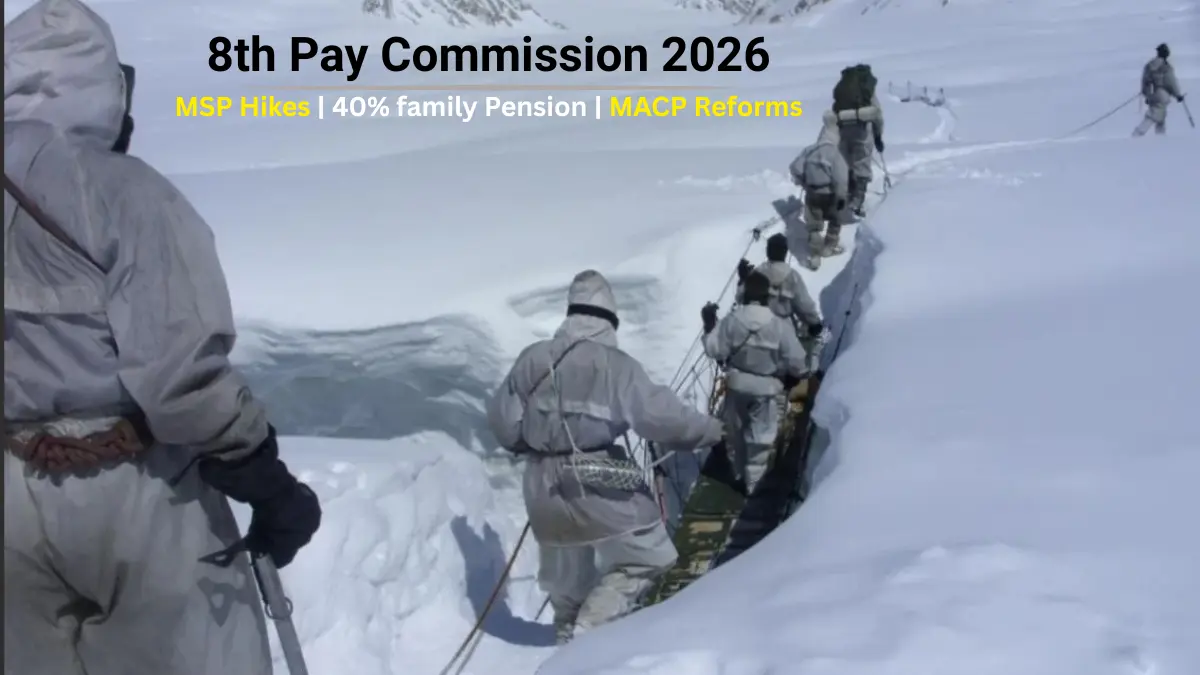
MSP in 8th pay Commission : For many citizens, the 8th Pay Commission (8th CPC) 2026 may appear to be just another routine salary revision.
But for a soldier standing guard in Siachen’s freezing silence…
For a JCO leading his men in difficult terrain far from home…
For a widow raising her children alone after losing her husband in service…
This is not just about numbers on a payslip.
It is about dignity.
It is about security.
It is about recognition of sacrifice.
The 8th Pay Commission is now gradually moving beyond consultation and into serious groundwork. Following the launch of the 18-question public consultation on MyGov, an important development has emerged from the defence establishment.
The Indian Army’s AG Branch (8th Army Pay Commission Cell) has formally submitted detailed recommendations to the Commission. These proposals are not just routine revisions — they aim to address long-standing structural concerns in defence compensation.
This could become one of the most defence-focused submissions in Pay Commission history.
Table of Contents
MSP in 8th pay Commission– Major Increase Proposed
One of the strongest recommendations is for a major increase in Military Service Pay (MSP).
Proposed Increase:
- Jawans (OR) – Around 130% increase
- JCOs – Around 246% increase
- Revised MSP for Officers and MNS
- Attempt to reduce the JCO–OR gap
MSP is not just an allowance. It is compensation for:
- 24/7 readiness
- High-risk operations
- Separation from family
- Harsh field conditions
When a soldier misses festivals, birthdays, and even emergencies back home, MSP is the system’s way of acknowledging that sacrifice.
If accepted, this increase would not just raise monthly income — it would strengthen long-term pension calculations and improve financial stability for veterans.
MACP at 6-12-18 Years: A Ray of Hope Against Career Stagnation
Unlike many civilian jobs, defence promotions depend on limited vacancies. Many capable personnel retire without reaching higher ranks.
| Current MACP: | Proposed by Army: |
| 8 – 16 – 24 years | 6 – 12 – 18 years |
This change could mean:
- Earlier financial upgradation
- Reduced mid-career frustration
- Better last drawn pay before retirement
For someone retiring in early 40s, even one earlier financial jump can change post-retirement life completely.
Join Telegram
Join NowFamily Pension Increase From 30% to 40%: A Lifeline for Widows
Perhaps the most emotionally significant recommendation is increasing Ordinary Family Pension from 30% to 40%.
Imagine a soldier’s family losing its primary earning member.
In such moments, pension is not policy — it is survival.
If last basic pay is ₹50,000:
- At 30% → ₹15,000
- At 40% → ₹20,000
That ₹5,000 difference every month means:
- School fees paid on time
- Medical bills covered
- Dignified living for a grieving family
With Dearness Relief added over time, the impact becomes even larger.
This proposal reflects sensitivity toward the silent strength of defence families.
Click here: Calculate Expected 8th Pay Commission Salary using Calculator
Promotion Pay Fixation: Ending Confusion and Anomalies
Currently, at promotion, personnel must choose between:
- Date of Next Increment (DNI)
- Date of Promotion (DOP)
This often leads to confusion, pay anomalies, and disputes.
The Army has proposed automatic selection of the most beneficial option.
It may sound technical — but it can:
- Prevent senior-junior pay disputes
- Reduce administrative stress
- Ensure fairness without complex calculations
Sometimes, real reform lies in simplifying systems.
Join WhatsApp
Join NowLeave Encashment 450 Days: Recognising Operational Sacrifice
A soldier in field areas cannot always take leave when needed. Operations come first.
Current Limits:
- Leave encashment: 300 days
- LTC leave encashment: 60 days
The proposal suggests:
- Leave encashment ceiling increased from 300 to 450 days
- LTC leave encashment increased from 60 to 120 days
- Leave accumulation de-linked from LTC encashment
For personnel who sacrifice personal time for national duty, this ensures that unused leave converts into meaningful financial support at retirement.
Why These Recommendations Matter More Than a Salary Hike
Historically, armed forces have raised concerns that traditional Pay Commission structures do not fully account for:
- Early retirement age
- Restricted promotion avenues
- Operational hardships
- Separation from family
- Limited second-career stability
Unlike civilian services, most soldiers retire in their 30s and 40s. Therefore, improvements in MSP, MACP, pension, and leave encashment have a multiplier effect over lifetime earnings.
Comparison With 6th & 7th Pay Commission Impact
| Aspect | 6th CPC | 7th CPC | Potential 8th CPC Impact |
|---|---|---|---|
| MSP | Introduced | Revised | Major structural increase proposed |
| MACP | Introduced | Continued | Interval reduction proposed |
| Family Pension | Standardized | Continued | Increase to 40% proposed |
| Leave Encashment | 300 days | Continued | Increase to 450 days proposed |
This indicates the 8th CPC may shift from incremental revision to structural correction.
Fiscal & Policy Angle
If accepted, these proposals will:
- Increase defence salary bill
- Impact pension outflow
- Require financial balancing with fiscal discipline
However, defence expenditure is also a strategic investment. Welfare and morale directly impact operational readiness.
What Defence Personnel Should Do Now
- Participate in MyGov consultation
- Send structured representations through proper channel
- Focus on data-based arguments (comparative analysis, anomaly cases, financial modeling)
- Coordinate through veterans and service associations
Pay Commissions are rare — once in 10 years. Structured input at this stage is crucial.
Broader Implications for Veterans
Since pension is linked to last drawn pay:
- Higher MSP = higher pension
- Earlier MACP = higher retirement pay level
- Improved family pension = long-term widow security
Therefore, these recommendations are relevant not only for serving personnel but also for future veterans.
Strategic Observation
The Army’s recommendations suggest a shift from:
“Salary revision” → to → “Structural defence compensation reform”
If these proposals are strongly backed and accepted, 8th CPC could become a landmark commission for defence personnel.
Frequently Asked Questions (FAQ) – 8th Pay Commission 2026 & Army Recommendations
Q1. What is the Army’s proposal for an increase in MSP in the 8th Pay Commission?
As per the recommendations:
Around 130% increase for Jawans (OR)
Around 246% increase for JCOs
Revised MSP structure for Officers and MNS
Attempt to reduce the JCO–OR pay gap
However, these are recommendations and final approval will depend on the 8th Pay Commission’s decision and government acceptanc
Q2. What is the proposed change in MACP under the 8th Pay Commission?
Currently, MACP is granted at 8, 16, and 24 years of service.
The Army has proposed a revised structure of 6, 12, and 18 years, meaning financial upgradation every 6 years.
If approved, this could significantly reduce career stagnation for defence personnel.
Q3. Has the family pension been increased in the 8th CPC proposal?
Yes, the Army has proposed increasing Ordinary Family Pension (non-attributable cases) from 30% to 40% of last drawn basic pay.
Enhanced family pension rules are proposed to remain unchanged. Final implementation will depend on Commission approval.
Q4. What is the latest 8th Pay Commission update?
The Indian Army’s AG Branch has submitted key recommendations including MSP hike, MACP changes, family pension increase, and leave encashment revision.
Q5. What change is proposed in promotion pay fixation?
Currently, personnel must choose between:
Date of Next Increment (DNI)
Date of Promotion (DOP)
The Army has proposed automatic selection of the most beneficial option, reducing confusion and pay anomalies.
Q6. What is the proposal regarding leave encashment in 8th CPC?
The recommendations include:
Increasing leave encashment ceiling from 300 days to 450 days
Increasing LTC leave encashment from 60 days to 120 days
De-linking leave accumulation from LTC encashment
This aims to benefit personnel who cannot avail leave due to operational commitments.
Q7. Can defence personnel submit suggestions for the 8th Pay Commission?
Yes. The Government has launched an 18-question consultation on MyGov, where employees, pensioners, and citizens can submit suggestions.
Defence personnel can also send structured representations through proper official channels.
Q8. Will MSP increase affect pension calculation?
Yes. Since MSP forms part of pension calculation, any approved increase in MSP could positively impact:
Service pension
Family pension
Retirement benefits
Final impact will depend on how the Commission structures the revised pay matrix.
Q9. Is this MSP and pension increase confirmed?
No. These are recommendations submitted by the Army’s AG Branch. Final decisions will be taken by the 8th Pay Commission and approved by the Government of India.
Q10. Is this final and approved?
No. These are recommendations. Final approval will come after the 8th Pay Commission report and Government decision.
Key Highlights
- MSP hike proposal up to 130%–246%
- MACP proposed at 6-12-18 years
- Family pension increase to 40%
- Automatic beneficial pay fixation
- Leave encashment proposed at 450 days
- LTC leave encashment proposed at 120 days
Read More: 8th Pay Commission Official Website Launched, MyGov Invites Public Views
Read our complete guide on the 8th Pay Commission 2026 to understand salary changes and expected implementation timeline.








3 thoughts on “8th Pay Commission 2026 : Army Proposes 130% MSP Hike, 40% Family Pension for Soldiers”