
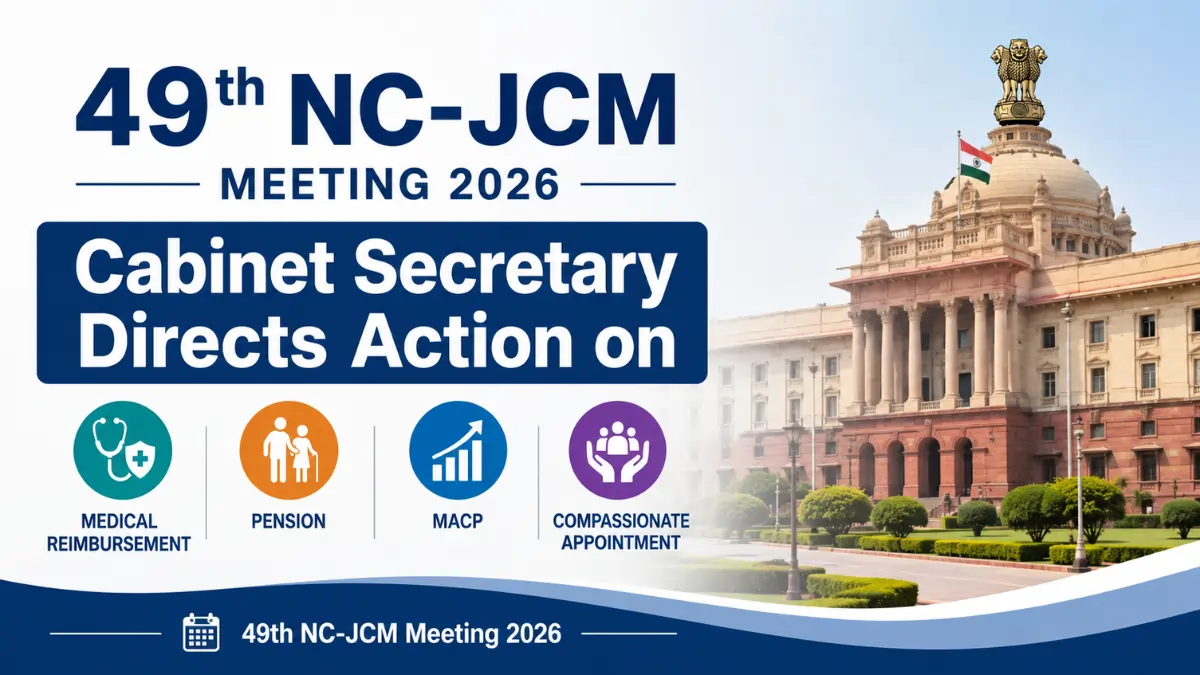
The 49th NC-JCM Meeting 2026 decisions arrived on 11 May 2026 — and for central government employees who have been waiting on demands ranging from CGHS reimbursement to MACP upgradation and compassionate appointment, the outcomes are a mixed but meaningful bag. Cabinet Secretary Shri T.V. Somanathan chaired the National Council — Joint Consultative Machinery (NC-JCM) session, with the Chairperson of the Railway Board, the Secretaries of Expenditure, Personnel, Defence Production, Posts, Education, and Health, and senior officers from multiple ministries on the official side.
The session carried special significance: it was convened on the occasion of the Diamond Jubilee of the JCM Scheme, which completed 60 years of existence in 2026. What made it more notable still is the gap — this was only the 49th meeting in six decades, a frequency far below the three meetings per year the scheme mandates. That context shaped the tone of the entire session, with Staff Side leaders pressing hard for both immediate decisions and a structural commitment to more regular dialogue.
The Meeting That Broke a Long Silence — What the 49th JCM Session Was About
The Joint Consultative Machinery (JCM) scheme was inaugurated on 28 October 1966 as a platform for structured dialogue between the government and its employees. The First and Second Pay Commissions had both recommended such a body, and it took a five-day employee strike before the government finally acted. Sixty years later, the Staff Side’s opening remarks pointed to an uncomfortable irony: a scheme designed for three meetings a year has managed fewer than fifty in its entire history.
Staff Side Secretary Shri Shiva Gopal Mishra and Leader Staff Side Shri M. Raghavaiah led the delegation of 31 members from across ministries — Railways, Defence, Posts, Finance, and others. Before the formal agenda was taken up, they placed 16 additional demands before the Cabinet Secretary, covering everything from AIIMS spouse postings to ex-gratia payments for employees who died during Covid-19 duty. It was a session that tried to do the work of several missed meetings in one sitting.
The formal agenda covered 24 items. On most, the Cabinet Secretary directed examination. On a few, he gave more specific direction — and on one, the compassionate appointment issue for employees recruited before 22 December 2003, he agreed to an immediate commitment.
CGHS and Medical Reimbursement — A 3-Month Deadline and Persistent Gaps
On the largest single concern for most central government employees and pensioners — medical treatment costs — the Cabinet Secretary set a three-month deadline. The Staff Side had argued that employees, their families, and pensioners are entitled to full reimbursement for treatment costs under the Central Government Health Scheme (CGHS) and the Central Services (Medical Attendance) Rules (CS(MA) Rules), as directed by multiple court orders. Items currently excluded from reimbursement lists, they contended, need to be brought within coverage.
The Staff Side also flagged that hearing aid rates have not been revised for more than 12 years — a specific, easily verifiable gap. Cabinet Secretary directed that all the medical reimbursement issues raised be considered and a decision taken within three months.
On the reimbursement of dental implants and dentures, the Staff Side made a clear argument: these are not cosmetic procedures, and the inability to eat or speak without them makes them medically essential. The Cabinet Secretary directed this issue to be examined separately — a softer direction than the three-month CGHS commitment, but an acknowledgement that the current exclusion is worth revisiting.
The ward entitlement revision for employees who retired between 1 January 2016 and 31 January 2017 — and those who retired earlier but had their pension fixed on notional 7th Central Pay Commission (CPC) pay — was similarly directed for examination. What it doesn’t yet settle is a timeline, which is likely to be the next pressure point for retiree associations.
Pension Demands: What Goes to the 8th CPC and What Gets Examined Now
The pension-related agenda items produced a pattern: demands with immediate procedural clarity were directed for resolution, while structural pension reform was pushed to the 8th Pay Commission.
The implementation of Parliamentary Standing Committee recommendations on pension enhancement — including increasing Fixed Medical Allowance (FMA) to ₹3,000 per month for pensioners and expanding CGHS Wellness Centres to all districts — saw a split decision. The FMA enhancement and five-yearly pension revision were referred to the 8th CPC. The CGHS Wellness Centre expansion was handed to the Health Ministry to examine independently. For pensioners hoping for an FMA revision in the near term, that referral to the Pay Commission means the wait continues.
On family pension, two issues stood out. First, the condition under Rule 54(iv) of the CCS (Pension) Rules requiring physically disabled or crippled children to produce income certificates from medical boards or civil authorities — certificates that, the Staff Side noted, these authorities often refuse to issue — was directed to the Department of Pension (DOP&PW) for a “logical and practical decision.” That phrasing from the Cabinet Secretary is significant: it acknowledges the current rule creates a bureaucratic dead end for vulnerable families. Second, the demand that family pension should not be reduced to 30% of the notional pay of a deceased government employee or pensioner was referred to the 8th CPC.
The most concrete pension outcome came on compassionate ground appointments. Where a vacancy sanction or release letter was issued prior to 22 December 2003, the Cabinet Secretary agreed that employees recruited against those vacancies should be treated under the Old Pension Scheme (OPS). On compassionate appointments specifically, where an applicant had applied before 22 December 2003 and met eligibility criteria — even if appointed after 1 January 2004 — the Secretary of the Department of Expenditure and DOP&PW agreed to implement this within a week. For employees or families who have been in limbo on this question, that is the most actionable outcome of the entire session. You can compare OPS and NPS implications here.
MACP, Promotions, and Service Rules — Where Lines Were Drawn
On Modified Assured Career Progression (MACP), the specific issue of Pharmacists who entered service at Grade Pay ₹2,800 in Pay Band-1 and then moved to Grade Pay ₹4,200 via a Fast Track Committee recommendation drew detailed Staff Side argument. Their position: the two-year period in GP ₹2,800 should be treated as a training period, the movement to GP ₹4,200 as a placement (not a promotion), and MACP should therefore be calculated as 1st at GP ₹4,600, 2nd at GP ₹4,800, and 3rd at GP ₹5,400. Cabinet Secretary directed examination of the Fast Track Committee recommendations. Check your MACP eligibility here if you are in a similar position.
On pay fixation under FR-22(1)(a)(i) for employees promoted after availing MACP, the Cabinet Secretary directed examination — with a referral to the 8th CPC if needed. The pay fixation benefit question has lingered for years, and this direction at least puts it formally in the pipeline.
The delayed DPC (Departmental Promotion Committee) and promotion issue produced one of the sharper responses of the session. Staff Side members — particularly from Defence, where Military Engineer Service promotions are delayed by three to five years — pressed hard. The Cabinet Secretary directed DoPT to issue strict instructions to all ministries on conducting DPCs on schedule, and asked the Staff Side from Defence to submit specific cases from MES for examination. Strict instructions are a step; whether they translate to timely promotions is what employees will be watching.
On FR 56(J) and Rule 48 of CCS (Pension) Rules — provisions that allow premature retirement and which Staff Side argued are being misused to target Trade Union leaders — the Cabinet Secretary directed fresh instructions to prevent misuse. The issue of recovery of wrongful or excess payments despite Supreme Court judgment and DoPT instructions also drew a firm direction: strict instructions to all ministries, with a Staff Side request to delegate waiver authority for amounts above ₹2 lakh to concerned ministries for consideration.
Compassionate Appointment — An Immediate Win and Unresolved Questions
The compassionate appointment discussion was among the most contested of the session. The Defence Ministry’s five-year ban on compassionate appointments drew a direct protest from Staff Side. Cabinet Secretary’s response acknowledged the constraint created by Ordnance Factory corporatisation — direct government recruitment is no longer possible in those entities — but stated clearly that compassionate appointment cannot be stopped. Secretary, Department of Personnel, was directed to consult the Law Ministry and issue instructions for compassionate appointments in the new Defence Public Sector Undertakings (DPSUs) within a short period.
On the broader demand to remove the 5% ceiling on compassionate appointments, the Cabinet Secretary was candid: that is a policy matter requiring extensive examination and will not be decided immediately. However, the specific anomalies raised by Defence Staff Side — relating to how the 5% quota is calculated when Armed Forces vacancies are excluded from the denominator, and the inclusion of Group B and A dependants within Group C quota calculations — were directed to DoPT and Ministry of Defence for examination.
The 16 Pre-Agenda Points — What Staff Side Raised Before the Formal Session
Before the formal agenda began, Staff Side placed 16 additional demands on the table. Several are worth noting for specific employee groups.
AIIMS employees across the country have been denied the DoPT spouse posting benefit despite a 2019 Health Ministry Gazette notification explicitly extending central government service rules to them. Cabinet Secretary was asked to direct AIIMS institutions to comply — women employees in particular have resigned from posts due to this gap. On the 8th Pay Commission, the Staff Side reported that it has submitted a detailed memorandum covering minimum pay, fitment factor, increment rate, NPS/UPS withdrawal, and existing pensioner demands. The 8th CPC has already called the Staff Side for a presentation.
Railway Running Staff’s long-pending issue of Kilometrage Allowance exemption from income tax remains unresolved despite a Standing Committee decision in April 2025 that a joint meeting of Railways and Revenue Department be held. See income tax rule changes for 2026 for related context. Ex-gratia payment for railway and other employees who died on Covid-19 duty was also raised. On Ordnance Factory employees, who have been on deemed deputation in the seven DPSUs for five years, the Staff Side requested a formal notification extending their deputation until retirement with full service condition protection.
What This Means for You — Employee by Employee
If you are a central government employee or pensioner waiting on CGHS reimbursement claims, the three-month direction is the most concrete timeline to track. It does not guarantee a specific rate revision, but it commits the government to a decision — which means associations can follow up formally if the deadline passes without action.
If you applied for compassionate appointment before 22 December 2003 and were appointed after 1 January 2004, the agreement to implement OPS coverage within one week is worth following up with your establishment section. The Secretary DoPT/DOP&PW agreement is on record; if your department has not acted on it, this meeting outcome gives you a basis to press the case.
If you are a Defence civilian employee — particularly in MES waiting on a promotion delayed by three to five years — the Cabinet Secretary’s direction to DoPT to issue strict instructions is noted, but the Staff Side was also asked to submit example cases. If your case is an example of this pattern, your association needs to document it and forward it through the Staff Side channel.
If you are a physically disabled child of a deceased government servant being denied family pension due to an income certificate requirement, the direction to DOP&PW for a “logical and practical” decision is directly relevant to you. Track this with the Department of Pension.
What to Watch For in the Months Ahead
The three-month CGHS deadline makes August 2026 the first concrete checkpoint from this meeting. If the CGHS reimbursement revision and inclusion of non-reimbursable items does not come through by then, associations have a documented basis to escalate.
The compassionate appointment OPS implementation — committed to within one week of the meeting — should be visible in an official order from DoPT/DOP&PW by mid-to-late May 2026. The Staff Side has also formally requested that the 8th CPC have regular interaction with constituent organisations across Railways, Defence, Finance, Postal, and CAG. How the Commission structures that engagement will shape how employee demands feed into the pay revision process.
Finally, the Staff Side has asked the Cabinet Secretary to ensure three National Council meetings per year — as the JCM Scheme itself requires — going forward. In 60 years, only 49 meetings have taken place. Whether that rhythm is restored will be among the most watched developments in central government industrial relations in 2026.
Important Links
| What | Link |
|---|---|
| NC-JCM Staff Side Office | nc.jcm.np@gmail.com |
| 8th Pay Commission Updates | Read Here |
| MACP Eligibility Checker | Check Here |
| NPS vs OPS Comparison | Read Here |
| Income Tax Rules 2026 | Read Here |
| 49th Meeting of National Council (JCM) on 11/05/2026 Meeting Minute | Download PDF |
Frequently Asked Questions
What decisions were taken at the 49th NC-JCM meeting on 11 May 2026?
The 49th National Council JCM meeting produced Cabinet Secretary-level directions on 24 agenda items. Key outcomes include a three-month deadline for CGHS reimbursement decisions, an immediate commitment to extend OPS coverage to compassionate appointment cases pre-dating 22 December 2003, directions to DoPT on strict DPC timelines, and referral of several pension demands to the 8th Pay Commission. Most other items were directed for examination by the concerned ministries.
Will CGHS reimbursement rates be revised after the 49th JCM meeting?
The Cabinet Secretary directed that CGHS and CS(MA) Rules medical reimbursement issues — including non-reimbursable items and long-overdue revision of hearing aid rates — be examined and a decision taken within three months. This sets a deadline of around August 2026, but the decision on specific rate revisions will come from the Health Ministry after that examination.
What did Cabinet Secretary say about compassionate appointment under the Old Pension Scheme?
The Cabinet Secretary agreed that employees whose vacancy sanctions were issued before 22 December 2003 should be covered under OPS. For compassionate appointment cases specifically, where the applicant applied before 22 December 2003 and met eligibility criteria, the Secretary DoPT and DOP&PW agreed to implement OPS coverage within one week of the meeting. This is one of the most immediate commitments from the session.
Which demands from the JCM meeting have been referred to the 8th Pay Commission?
Several long-term structural demands were referred to the 8th Pay Commission, including the five-yearly pension enhancement recommendation of the Parliamentary Standing Committee, the increase in FMA to ₹3,000 per month for pensioners, the 30% family pension reduction issue, and the FR-22(1)(a)(i) pay fixation benefit for post-MACP promotions.
When is the next NC-JCM National Council meeting expected?
The JCM Scheme mandates three ordinary meetings per year. The Staff Side formally requested the Cabinet Secretary to ensure this frequency is restored. No specific date for the 50th meeting has been announced, but the commitment to regular meetings — if honoured — means the next session should take place before the end of 2026.
Does the 49th JCM meeting decision on compassionate appointment affect Defence employees?
Yes. The Cabinet Secretary directed that compassionate appointment cannot be stopped even after Ordnance Factory corporatisation, and that Secretary DoPT in consultation with the Law Ministry issue instructions for compassionate appointments in DPSUs within a short period. The ban on compassionate appointments in the Army’s rationalized posts was separately directed to Additional Secretary, Defence for review.
What was raised about AIIMS employees at the 49th NC-JCM meeting?
The Staff Side raised that despite a 2019 Gazette notification extending central government service rules to AIIMS employees, the DoPT spouse posting benefit is not being implemented across AIIMS institutions. Cabinet Secretary was asked to direct all AIIMS to comply with the DoPT order on spouse posting — an issue that has led to resignations from women employees posted away from their families.
Summing Up…
The 49th NC-JCM Meeting 2026 was not a session that resolved every pending demand — no single meeting of this kind can. But it produced a documented record of what the government has committed to examining, what it has agreed to act on immediately, and what it has parked with the 8th Pay Commission. For central government employees and pensioners, that record is the starting point. Tracking whether the three-month CGHS deadline is met, whether the compassionate appointment OPS order is issued as committed, and whether DoPT issues real instructions on DPC timelines — these are the follow-up actions that will determine whether the 49th meeting produces lasting results.
Bookmark Govtserviceinfo.com and join our Telegram channel for instant alerts on NC-JCM updates, 8th Pay Commission developments, and central government service rule changes.
Disclaimer: This article is based on the circular issued by the National Council (Staff Side), JCM, vide No. NC-JCM-2026/49 NC dated 13 May 2026, and the agenda discussion document circulated for the 49th NC-JCM meeting held on 11 May 2026. All details are subject to official orders and notifications from the relevant ministries and departments. Govtserviceinfo.com is not affiliated with the National Council JCM or any government ministry. Readers should verify current information from official government sources before acting on any information published here.





2 thoughts on “49th NC-JCM Meeting 2026: Cabinet Secretary Directs Action on Medical Reimbursement, Pension, MACP and Compassionate Appointment”