
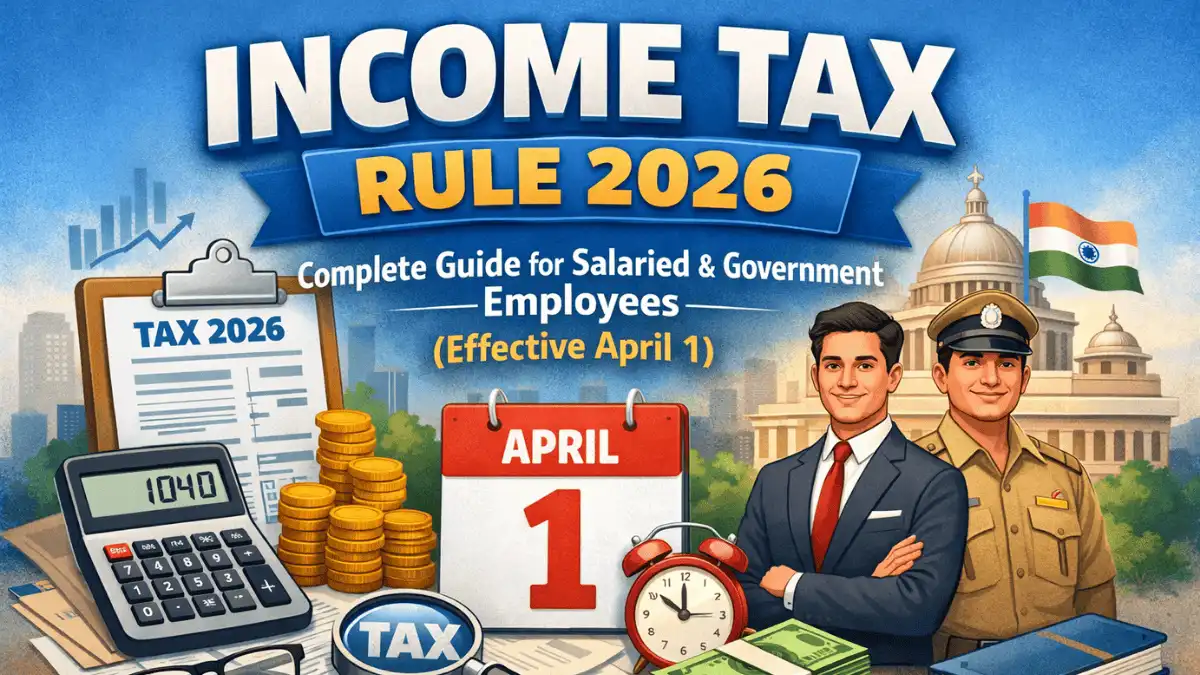
The Income Tax Rules 2026 are here — and from 1 April 2026, India’s entire direct tax framework changes. The Central Board of Direct Taxes (CBDT) has officially notified the Income-tax Rules, 2026 (G.S.R. 198(E), dated 20 March 2026), which bring the Income-tax Act, 2025 into force.
If you are a salaried employee, a central government employee, or someone who claims House Rent Allowance (HRA), pays rent to a family member, or deals in digital assets — you need to read this.
The good news? Tax rates are not changing. But the way taxes are reported, verified, and calculated will be different. This guide breaks down every key change in plain language, so you know exactly what to expect.
Income Tax Rules 2026 – At a Glance
| Detail | Information |
|---|---|
| Issuing Authority | Ministry of Finance, CBDT |
| Notification No. | G.S.R. 198(E) |
| Date of Issue | 20 March 2026 |
| Effective Date | 1 April 2026 |
| Replaces | Income Tax Act, 1961 |
| New Law | Income-tax Act, 2025 (No. 30 of 2025) |
| Applicable To | All taxpayers — salaried, business, NRIs, pensioners |
| Official Website | incometax.gov.in |
Why Is India Getting a New Income Tax Law?
India’s old Income Tax Act, 1961, was over 60 years old. Over the decades, it had been amended hundreds of times. What started as a compact document grew into a dense, jargon-heavy rulebook that even trained tax professionals found difficult to navigate.
The government decided it was time for a fresh start. The Income-tax Act, 2025, does not aim to increase your tax burden — it aims to simplify compliance, make the law easier to read, reduce disputes, and bring tax rules in line with how the modern digital economy works.
The new rules were officially gazetted on 20 March 2026, just before the April 1 deadline.
📌 Also Read: New Income Tax Rules from April 1 – Major Changes for Taxpayers
Key Changes Under the Income Tax Rules 2026
Here is what actually changes from 1 April 2026, explained in plain language.
1. “Tax Year” Replaces Financial Year and Assessment Year
This is one of the most welcome changes for regular taxpayers. Under the old law, you had to deal with two different year concepts:
- Financial Year (FY): April 1 to March 31 — the year in which you earn income
- Assessment Year (AY): The following April 1 to March 31 — the year in which you file your return
This often led to confusion — especially when filling forms and responding to notices. The new law introduces a single concept: the Tax Year, which simply means the 12-month period from 1 April to 31 March in which income is earned.
Going forward, you only need to refer to one year when filing or responding to tax matters. It sounds like a small change, but it removes a major source of confusion for millions of taxpayers.
2. New HRA Disclosure Rules for Salaried Taxpayers
If you claim House Rent Allowance (HRA) and pay rent to a family member — such as your parents, spouse, or siblings — there is an important new rule you must follow from April 1.
The new rule: If your annual rent exceeds ₹1 lakh, you must now formally disclose your relationship with the landlord when claiming HRA.
This is specifically aimed at cases where employees pay rent to close relatives and claim HRA deductions. While such arrangements are legally valid, the government wants to ensure they are genuine and not just tax avoidance exercises.
The disclosure requirement comes through Form 124, which replaces the earlier Form 12BB for HRA claims. The new form asks for:
- Landlord’s name
- Landlord’s PAN number
- Your relationship with the landlord (e.g., parent, spouse, sibling)
⚠️ Important: If you pay rent to a family member and do not disclose this relationship, your HRA claim could be disallowed during scrutiny.
3. HRA Exemption Rates — 8 Metro Cities Now Eligible for 50%
The metro city classification for HRA has been updated and expanded. Under the new rules, eight cities qualify for the higher 50% HRA exemption on salary:
- Mumbai
- Delhi
- Kolkata
- Chennai
- Hyderabad
- Pune
- Ahmedabad
- Bengaluru
Employees living in any other city continue to get the 40% HRA exemption. If you live in one of the newly added cities (Hyderabad, Pune, Ahmedabad, or Bengaluru), this is good news — your HRA exemption calculation now uses the higher 50% rate.
📌 Also Read: Income Tax Calculator FY 2025-26 – Old vs New Regime
How Will My HRA Exemption Change?
For salaried employees in the 8 metro cities, the HRA exemption is the lowest of these three amounts:
| HRA Exemption Component | Amount (Metro City Example – Delhi) |
|---|---|
| Actual HRA received from employer | As per your salary slip |
| 50% of (Basic Pay + DA) | Applicable for metro cities |
| Actual rent paid minus 10% of Basic Pay | e.g., ₹15,000/month – 10% of ₹40,000 = ₹11,000 |
⚠️ These are indicative calculations. Actual exemption depends on your specific salary structure and rent amount.
Wider Definition of Virtual Digital Assets (VDA) – Crypto and NFTs
The new law expands what counts as a Virtual Digital Asset (VDA). This now clearly includes:
- Cryptocurrencies (Bitcoin, Ethereum, etc.)
- Non-Fungible Tokens (NFTs)
- Any other digital assets notified by the government
If you trade in crypto or hold NFTs, your transactions will now come under clearer and stricter reporting and tax rules. Tax officials are also expected to scrutinise digital asset transactions more closely under the new framework.
The tax rate on VDAs — currently 30% flat — is not changing with this law. But the reporting and compliance net is widening.
More Powers for Tax Officials in Digital Searches
As financial activity moves online, the new law gives tax authorities expanded access during search and survey operations. In certain cases, taxpayers may be required to provide access to:
- Email accounts
- Cloud storage (Google Drive, Dropbox, etc.)
- Social media accounts
- Digital trading platforms
The government says this is needed to track undisclosed income in the digital economy. If you have undisclosed digital assets or income, this is a significant development.
What Has Changed in the Dispute Resolution Process?
The new Act retains the Dispute Resolution Panel system but requires written orders with clear reasoning. This is aimed at reducing litigation — especially in cases involving:
- Foreign companies operating in India
- Non-resident taxpayers
- Transfer pricing disputes
The aim is to make tax recovery and appeals more transparent and efficient.
What Remains Unchanged Under Income Tax Rules 2026
This is important. Here is what is NOT changing from April 1:
| Aspect | Status |
|---|---|
| Income Tax Slab Rates | No change |
| Capital Gains Tax Rules | No change |
| Standard Deduction (₹75,000 under new regime) | No change |
| Section 80C Deduction Limit (₹1.5 lakh) | No change |
| Residential Status Criteria | No change |
| NPS Deduction Benefits | No change |
| New vs Old Tax Regime Options | No change |
For most salaried and government employees, April 1 will not change how much tax you pay — only how your taxes are reported and verified.
📌 Also Read: 8th Pay Commission Salary Hikes – Fitment Factor & Pay Matrix Guide
What Does This Mean for Government Employees Specifically?
Central government employees have specific salary structures — Basic Pay, Dearness Allowance (DA), House Rent Allowance (HRA), and Transport Allowance (TA). Here is how the Income Tax Rules 2026 affect you:
HRA Claims: If you live in government accommodation or claim HRA, the Form 124 disclosure requirements apply to you if you pay rent to a family member.
DA and Allowances: No change in how DA, TA, or other government allowances are taxed.
NPS Contributions: No change. Your NPS Tier-1 contributions under Section 80CCD(1B) continue to give you an additional ₹50,000 deduction.
Standard Deduction: The ₹75,000 standard deduction under the new regime remains in place.
Form 16 and ITR Filing: Your employer will issue Form 16 as usual. The new rules may update certain forms, so watch for updates from your Pay & Accounts Office (PAO).
📌 Also Read: Composite Salary Account Package for Central Govt Employees – Benefits Explained
Important Links
| What | Link |
|---|---|
| Official Notification (G.S.R. 198(E)) | Download from Gazette of India |
| Income Tax Department | Visit incometax.gov.in |
| Income Tax Rules 2026 (Full Text) | Download Here |
| Income Tax Calculator (Old vs New Regime) | Use Our Calculator |
Note: Replace the gazette links with the direct PDF URL once the official document is indexed on egazette.gov.in.
Frequently Asked Questions
Do the Income Tax Rules 2026 increase my taxes?
No. The new rules do not change tax rates, slab thresholds, or deduction limits. The same tax you paid in FY 2025-26 will apply under the same rules in FY 2026-27. The Income Tax Rules 2026 are about simplification and stricter compliance — not higher taxes.
What is the difference between the Income-tax Act 2025 and the Income-tax Act 1961?
The Income-tax Act, 1961, governed Indian income tax for over 60 years. The new Income-tax Act, 2025, replaces it entirely. The structure, language, and section numbering have been redone for clarity. Most tax rules, deductions, and rates remain the same, but the new law is easier to read and removes many outdated provisions.
What is Form 124 under Income Tax Rules 2026?
Form 124 is the new form for claiming House Rent Allowance (HRA) deductions. It replaces the earlier Form 12BB. If your annual rent exceeds ₹1 lakh and you pay rent to a family member (parent, spouse, or sibling), Form 124 requires you to disclose your relationship with the landlord along with their PAN.
I live in Hyderabad. Will I now get 50% HRA exemption?
Yes! Under the Income Tax Rules 2026, Hyderabad is now included in the list of metro cities eligible for the 50% HRA exemption. Earlier, only four cities — Mumbai, Delhi, Kolkata, and Chennai — were in this category. The new rules add Hyderabad, Pune, Ahmedabad, and Bengaluru.
What happens to crypto and NFT taxation under the new law?
Tax rates on Virtual Digital Assets (VDAs) like crypto and NFTs have not changed — they continue to be taxed at a flat 30%. However, the definition of VDAs has been expanded, reporting requirements are stricter, and tax authorities now have wider powers to access digital accounts during investigations.
Will the “tax year” concept affect when I file my ITR?
The filing deadline and process are not changing. The “tax year” concept simply replaces the confusing dual system of Financial Year and Assessment Year with a single year reference. You will still file your ITR in July (or October with extension) for the previous tax year.
What should government employees do before April 1, 2026?
If you claim HRA and pay rent to a family member, gather your landlord’s PAN number and be ready to fill Form 124 this financial year. Beyond that, no immediate action is needed — your Pay & Accounts Office will update your salary and tax forms in line with the new rules.
Summing Up…
The Income Tax Rules 2026 mark a structural overhaul, not a tax hike. From 1 April 2026, the six-decade-old Income Tax Act, 1961, is replaced by a cleaner, simpler framework — the Income-tax Act, 2025 — and the Income-tax Rules, 2026 set out how it will be implemented.
For most salaried employees and government employees, the core question is: does it cost you more? The answer is no. Tax slabs, deductions, and rates remain unchanged.
What changes is how you report — especially for HRA claims where you pay rent to family members, for crypto and digital asset transactions, and for anyone who faces a tax dispute or search.
Stay ahead of these changes. Bookmark Govtserviceinfo.com and join our Telegram channel for instant alerts on DA hikes, pay revision orders, income tax changes, and 8th CPC updates.
Disclaimer: This article is for informational purposes only and is based on the Income-tax Rules, 2026, notified by CBDT vide G.S.R. 198(E) dated 20 March 2026, and publicly available information from official sources. Tax rules are subject to further amendments. Readers are advised to consult a qualified tax professional or chartered accountant for advice specific to their situation. Govtserviceinfo.com is not responsible for any financial or legal decisions made based on this article.








1 thought on “Income Tax Rules 2026: Complete Guide for Salaried & Government Employees (Effective April 1)”