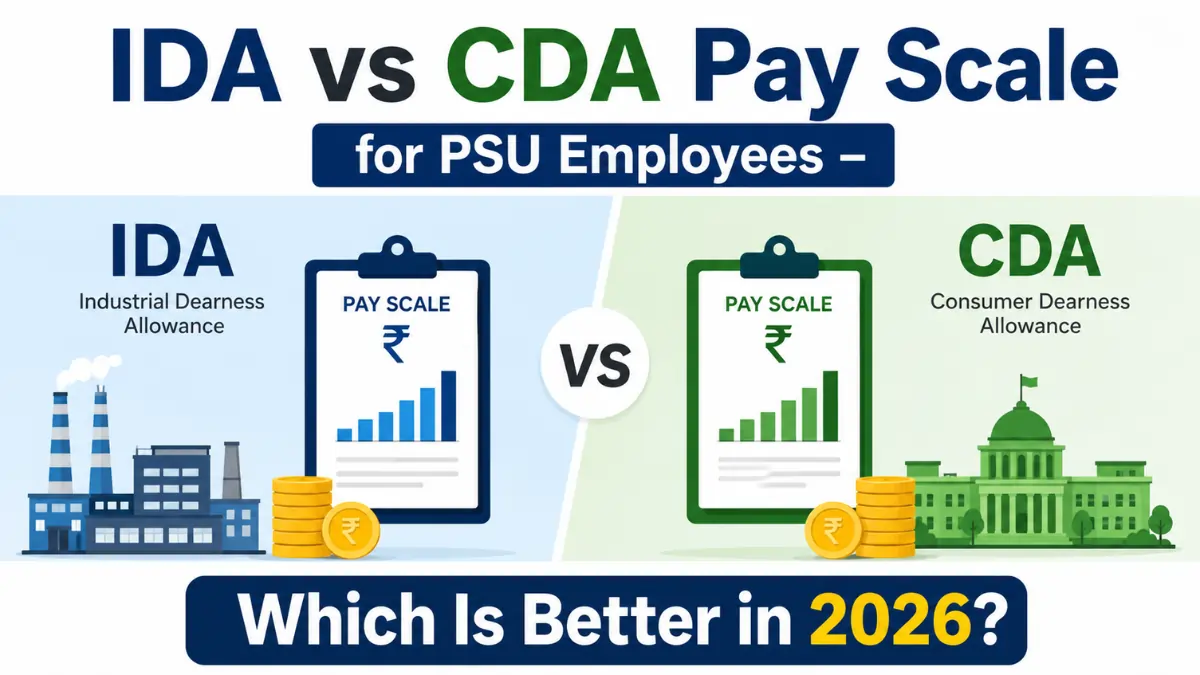
If you work in a Public Sector Undertaking (PSU) or are considering joining one, the IDA vs CDA pay scale debate is one of the most important things you need to understand. Your entire salary structure, Dearness Allowance (DA), pension, and career growth depend on which of these two pay systems your organisation follows.
This is not just a technical payroll difference — it can mean a gap of several thousands of rupees every month, a completely different retirement corpus, and a very different set of service rules. Yet most PSU employees have only a vague idea of how the two systems work.
In this post, we break down the IDA (Industrial Dearness Allowance) and CDA (Central Dearness Allowance) pay scales clearly — how they are structured, how DA is calculated under each, what happens to your pension, and which one works out better for different categories of employees.
Table of Contents
IDA vs CDA Pay Scale – At a Glance
| Parameter | IDA Pay Scale | CDA Pay Scale |
|---|---|---|
| Full Form | Industrial Dearness Allowance | Central Dearness Allowance |
| Applicable To | CPSEs (Central PSU employees on IDA pattern) | Central Government employees & some PSUs |
| DA Revision Frequency | Quarterly (January, April, July, October) | Half-yearly (January, July) |
| DA Basis | Consumer Price Index – Industrial Workers (CPI-IW) | AICPI-IW (All India Consumer Price Index) |
| Pay Commission | Not linked to Pay Commission; revised by DPE | Linked to Central Pay Commission (6th, 7th, 8th CPC) |
| Pay Revision | Every 10 years (by DPE wage revision) | Every 10 years (by Pay Commission) |
| Pension | Contributory (NPS in most cases) | CCS (Pension) Rules or NPS |
| HRA | 24% / 16% / 8% of basic (varies by city) | 27% / 18% / 9% of basic (post-7th CPC) |
| Pay Scales | E0 to E9 (executives); W1-W10 (non-executives) | Pay Levels 1–18 (7th CPC Pay Matrix) |
What Is the CDA Pay Scale?
The Central Dearness Allowance (CDA) pay scale applies to employees governed by Central Government service rules. This includes most Ministry and Department employees, as well as some PSUs that have not migrated to the IDA pattern.
Under CDA, an employee’s salary is structured as:
Basic Pay + DA (% of basic) + HRA + TA + Other Allowances
DA under CDA is revised twice a year — effective January 1 and July 1 — based on the All India Consumer Price Index for Industrial Workers (AICPI-IW). As of January 2026, DA for central government employees stands at 60% of basic pay.
CDA pay scales are tied to Central Pay Commission recommendations. The 7th Pay Commission (7th CPC) set pay levels from Level 1 (₹18,000 basic) to Level 18 (₹2,50,000). The upcoming 8th Pay Commission is expected to revise these pay levels effective January 2026.
📌 Also Read: 8th Pay Commission 2026 – Latest Updates, Timeline and What to Expect
What Is the IDA Pay Scale?
The Industrial Dearness Allowance (IDA) pay scale applies to employees of Central Public Sector Enterprises (CPSEs) — organisations like BHEL, NTPC, SAIL, ONGC, GAIL, HPCL, and hundreds of others under the Department of Public Enterprises (DPE).
Under IDA, the pay structure is:
Basic Pay + DA (% of basic, revised quarterly) + HRA + Other Allowances
The key difference? DA is revised four times a year — every quarter — based on the Consumer Price Index for Industrial Workers (CPI-IW). This means IDA employees get faster compensation for price rise compared to CDA employees.
IDA pay scales for executives follow the E-grade structure: E0, E1, E2 … up to E9. The most recent DPE wage revision effective January 2017 (with 3% annual increment) set the pay structure for executives. A fresh IDA executive joining at E1 level starts at a basic pay of ₹40,000 per month.
📌 Also Read: GAIL Executive Trainee Recruitment 2026 – Apply Online
IDA vs CDA Pay Scale – Key Differences Explained
1. How DA Is Calculated and Revised
This is the most significant practical difference.
Under CDA, DA is revised twice a year. The government calculates the 12-month average of AICPI-IW and announces the revised DA percentage. The effective dates are January 1 and July 1 each year. Any delay in announcement still gets paid as arrears, but the revision itself is biannual.
Under IDA, DA is revised every quarter — four times a year. The quarterly revision uses the monthly CPI-IW data published by the Labour Bureau. IDA employees therefore receive inflation compensation faster and more frequently.
| Feature | IDA DA | CDA DA |
|---|---|---|
| Revision frequency | Quarterly | Half-yearly |
| Index used | CPI-IW (Industrial Workers) | AICPI-IW |
| Current rate (approx.) | Varies by CPSE; often 250%+ of basic | 60% of basic (Jan 2026) |
| Announced by | DPE / CPSE management | Ministry of Finance / Cabinet |
⚠️ Note: The very high DA percentage figure for IDA employees can be misleading. IDA basic pay is typically much lower than CDA basic pay — so the effective salary impact must be compared on absolute (₹) terms, not just percentage.
2. Pay Revision Cycle
Both CDA and IDA employees get a pay revision roughly every ten years.
CDA employees get pay revision through Pay Commission recommendations — the 5th CPC, 6th CPC, 7th CPC, and now the expected 8th Pay Commission. These revisions typically include a fitment factor multiplied to the existing basic pay.
IDA employees get pay revision through DPE wage revision orders. The last major revision was the 3rd Pay Revision for CPSEs, effective January 1, 2017. The 4th Pay Revision for CPSE employees is overdue and under discussion.
💡 Pro Tip: CPSE employees should track DPE notifications on wage revision closely — unlike Pay Commission reports, DPE orders tend to get less media coverage.
3. HRA (House Rent Allowance)
HRA rates differ under IDA and CDA.
CDA HRA (7th CPC rates):
| City Classification | HRA Rate |
|---|---|
| X (metro cities) | 27% of basic pay |
| Y (other large cities) | 18% of basic pay |
| Z (smaller towns) | 9% of basic pay |
IDA HRA (DPE pattern – for executives):
| City Classification | HRA Rate |
|---|---|
| X (metro cities) | 24% of basic pay |
| Y (other large cities) | 16% of basic pay |
| Z (smaller towns) | 8% of basic pay |
CDA employees get higher HRA percentages — 27% vs 24% for metro cities. However, since CDA basic pay post-7th CPC tends to be higher, the absolute HRA amount needs individual calculation.
4. Pension and Retirement Benefits
This is where the two systems diverge most sharply for long-serving employees.
CDA employees who joined before January 1, 2004 are covered under the Old Pension Scheme (OPS) — defined benefit, government-guaranteed pension. Those who joined on or after January 1, 2004 are under the National Pension System (NPS). The government contributes 14% of basic + DA to NPS for CDA employees.
IDA (CPSE) employees are mostly covered under NPS regardless of joining date, though some older PSUs retained their own superannuation / provident fund schemes. The government (as employer) contributes 10%–14% of basic pay to NPS depending on the specific CPSE and applicable order.
📌 Also Read: NPS vs UPS – Which Is Better for Government Employees in 2026?
⚠️ Employees who joined legacy CPSEs before NPS was mandated may still be on defined-benefit pension schemes — check your service rules and appointment letter carefully.
5. Pay Scale Comparison – CDA vs IDA (Approximate Figures)
To make the comparison concrete, here is a side-by-side salary estimate for an entry-level and mid-career employee.
Entry Level (Fresh Graduate/Engineer)
| Component | CDA – Pay Level 7 (₹44,900 basic) | IDA – E1 Grade (₹40,000 basic) |
|---|---|---|
| Basic Pay | ₹44,900 | ₹40,000 |
| DA (60% CDA / ~250% IDA approx.) | ₹26,940 | ₹1,00,000 |
| HRA (X city) | ₹12,123 (27%) | ₹9,600 (24%) |
| Gross (approx.) | ₹84,000+ | ₹1,50,000+ |
Important note: The IDA DA percentage appears very high because it is computed on a lower base pay that was set decades ago and revised periodically. The absolute salary gap is real — IDA executives at reputed CPSEs typically earn more gross salary than equivalent CDA employees — but it varies enormously by organisation, grade, and city of posting.
Mid-Career (15 Years Service)
| Component | CDA – Pay Level 10 (₹56,100 basic) | IDA – E3 Grade (₹60,000 basic) |
|---|---|---|
| Basic Pay | ₹56,100–₹80,000 (with increments) | ₹60,000–₹80,000 (with increments) |
| DA | ~₹48,000 | ~₹1,50,000–₹2,00,000 |
| HRA | ~₹20,000 (X city) | ~₹18,000–₹20,000 (X city) |
| Gross (approx.) | ₹1,30,000–₹1,60,000 | ₹2,30,000–₹2,80,000 |
At the mid-career stage, senior IDA executives at Schedule-A CPSEs typically earn significantly more than their CDA counterparts — this is the key reason why PSU executive roles are seen as financially attractive.
6. Job Security and Service Rules
CDA employees follow Central Civil Services (CCS) Rules, with strong statutory protections. Disciplinary procedures, posting, and transfers are governed by DoPT orders.
IDA (CPSE) employees follow their respective CPSE’s service rules, which are based on DPE model standing orders. While job security is generally good, it is not identical to the statutory protections of CCS rules. Additionally, if a CPSE is declared sick or referred to NCLT, employees face greater uncertainty than their CDA counterparts.
7. Promotions and Career Progression
Under CDA, promotions follow Departmental Promotion Committee (DPC) norms and the Modified Assured Career Progression (MACP) scheme — which guarantees at least three financial upgradations in 30 years of service, even without a regular promotion.
📌 Also Read: MACP Eligibility Checker – Check Your Upgradation Status
Under IDA (CPSE), promotion policies vary by organisation. Many CPSEs have their own promotion timelines. In Schedule-A Navratna and Maharatna CPSEs, promotions can be fast-tracked for high performers. However, there is no universal MACP equivalent — financial upgradation depends on the specific CPSE’s career progression policy.
IDA vs CDA – Which Is Better for PSU Employees?
There is no single correct answer. The right choice depends on what you value most in your career.
IDA pay scale is generally better if you:
- Want higher gross salary, especially at executive levels
- Are joining a well-performing Schedule-A or Maharatna CPSE
- Can handle the absence of a uniform MACP-type assured progression
- Are comfortable with NPS-based retirement
CDA pay scale is generally better if you:
- Prioritise job security and standardised service rules under CCS
- Value the MACP assured career progression guarantee
- Joined before January 2004 and are on OPS — your pension is far more secure
- Prefer the predictability of Central Pay Commission-linked revisions
The honest answer for most employees: If you compare IDA executives at top Maharatna CPSEs (ONGC, NTPC, SAIL, BHEL) with CDA employees at equivalent levels, the IDA executive typically takes home a significantly larger salary — often 30%–50% more at the mid-career stage. The trade-off is that CPSEs can have organisational risks that central government postings do not carry.
Important Links
| Resource | Link |
|---|---|
| DPE (Dept of Public Enterprises) | dpe.gov.in |
| 7th CPC Pay Matrix | 7th CPC Official Report |
| 8th Pay Commission Updates | govtserviceinfo.com/8th-pay-commission-2026/ |
| NPS vs UPS Comparison | govtserviceinfo.com/nps-vs-ups-comparison-2026/ |
| DA Hike January 2026 | govtserviceinfo.com/da-dr-hikes-60-percent-january-2026/ |
| MACP Eligibility Checker | govtserviceinfo.com/macp-eligibility-checker/ |
| PSU Jobs 2026 | govtserviceinfo.com/category/sarkari-naukri/psu-jobs/ |
Frequently Asked Questions
What is the main difference between IDA and CDA pay scale for PSU employees?
The main difference is in how Dearness Allowance (DA) is calculated and revised. CDA DA is revised twice a year (January and July) based on the central government’s AICPI-IW index. IDA DA is revised quarterly (four times a year) based on the CPI-IW index. IDA employees get faster inflation compensation. Additionally, CDA employees follow Central Pay Commission-linked pay scales, while IDA employees follow DPE pay revision orders.
Do all PSU employees follow IDA pay scale?
No. PSU employees can be on either IDA or CDA pattern depending on the organisation and the pay revision order applicable to them. Most Central PSEs (CPSEs) are on IDA pattern. Some PSUs that have not adopted the DPE IDA pattern, or legacy organisations, may still follow CDA rules. Always check your appointment letter or service rules to confirm.
Is the IDA pay scale better than CDA in terms of take-home salary?
For executives at well-performing CPSEs like ONGC, NTPC, BHEL, SAIL, and GAIL, the IDA pay scale typically results in a higher gross and take-home salary compared to equivalent CDA roles — mainly because of the quarterly DA revision and the absolute DA amounts that have accumulated over years of revisions. However, this is not universally true for all PSUs or for non-executive workers.
What happens to IDA employees’ pension after retirement?
Most IDA (CPSE) employees hired after 2004 are covered under the National Pension System (NPS). The CPSE (employer) typically contributes 10%–14% of basic pay to the NPS corpus. Older employees hired before NPS was introduced may still be on the CPSE’s defined benefit superannuation scheme. Employees should verify their retirement benefit structure in their appointment letter.
Is the DA percentage higher under IDA or CDA?
The DA percentage figure is typically much higher under IDA (often 250%+ of basic) compared to CDA (currently 60% of basic as of January 2026). However, this is because IDA basic pay was set at a much lower absolute number when the scale was created. The meaningful comparison is the absolute DA amount in rupees, not the percentage alone.
Will the 8th Pay Commission affect IDA employees?
No — not directly. The 8th Pay Commission will revise pay scales for CDA employees (central government servants). IDA employees get their pay revised through a separate DPE wage revision order, which is independent of Pay Commission cycles. However, DPE often uses the 8th CPC revision as a benchmark trigger to initiate a corresponding revision for CPSE employees.
Can an IDA employee switch to CDA and vice versa?
Switching between IDA and CDA is generally not straightforward and depends on the specific employment rules of the organisation. In some cases — such as when a CPSE employee is absorbed into a central government department or vice versa — a pay fixation exercise is done under applicable rules. This is uncommon and typically requires specific government orders to facilitate.
Conclusion
Understanding the IDA vs CDA pay scale difference is essential for anyone working in or considering a PSU career. In simple terms — IDA employees at top CPSEs tend to earn more gross salary, with quarterly DA adjustments keeping pace with inflation faster. CDA employees enjoy standardised Pay Commission-linked scales, stronger service rule protections, MACP-assured financial upgradations, and, for pre-2004 employees, the invaluable Old Pension Scheme.
The “better” pay scale depends on which CPSE you join, which grade you enter at, and how long you plan to stay. For most engineers and managers targeting Navratna or Maharatna CPSEs, IDA is the higher-paying option. For employees who value security, uniformity, and the MACP guarantee, CDA has its advantages.
Bookmark Govtserviceinfo.com and join our Telegram channel for instant alerts on DA hikes, DPE pay revision orders, 8th Pay Commission updates, and the latest PSU recruitment notifications.
Disclaimer: This article is intended for general informational purposes only. Pay scales, DA rates, and service rules for both IDA and CDA employees are subject to revision by the relevant authorities (DPE, Finance Ministry, and the respective CPSE). Always refer to official DPE circulars, your CPSE’s HR department, or the official notification for authoritative and up-to-date information. Govtserviceinfo.com is not affiliated with any government department or CPSE.