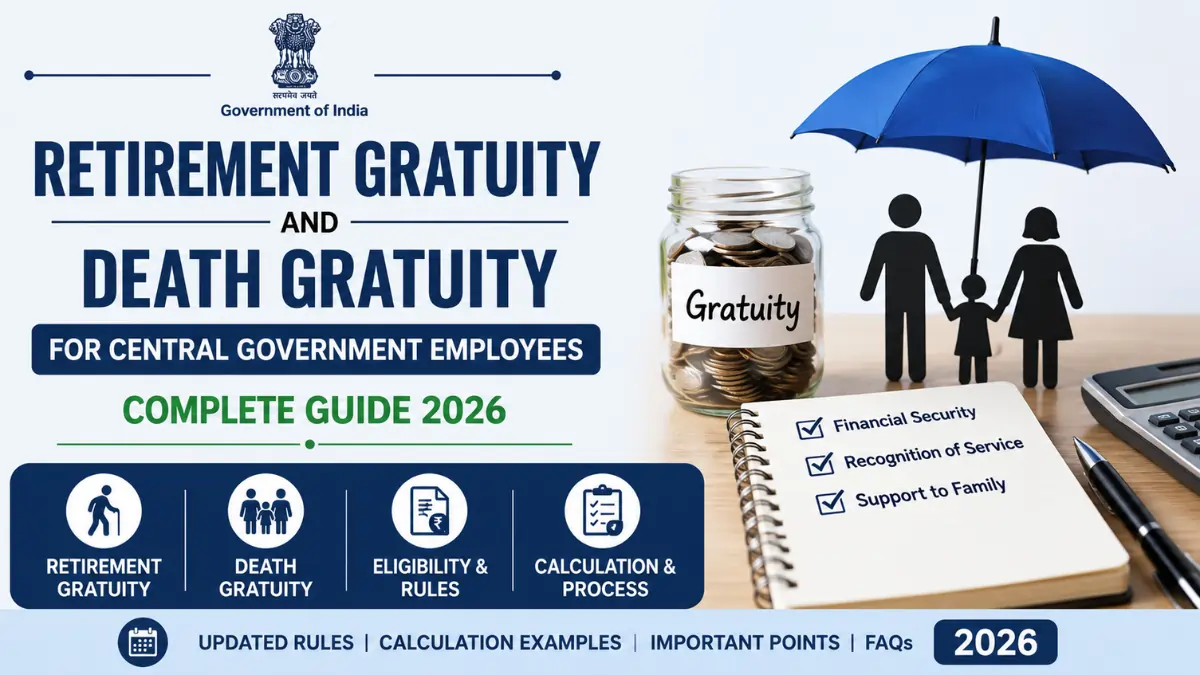
Retirement gratuity and death gratuity are two of the most significant lump-sum payments a central government employee — or their family — will ever receive. Together, they can amount to ₹25,00,000 at the current ceiling, yet thousands of employees retire each year without a clear picture of how either benefit is calculated or what the key differences are. This guide breaks down both types of gratuity under the Central Civil Services (Pension) Rules, 2021 — in plain language, with the actual numbers.
Understanding your gratuity entitlement is not just useful at retirement. It helps you verify that your department’s Pay & Accounts Office has calculated your benefit correctly, plan your post-retirement finances, and in the case of family members, know exactly what to claim — and how — if the employee dies in service.
What Is Gratuity Under CCS Rules — and Why It Changed in 2024
Gratuity under CCS Rules is a one-time lump-sum payment made to a central government employee on retirement, or to the employee’s nominee or family in the event of death while in service. It is separate from pension, commuted pension, and the General Provident Fund (GPF) balance — though all three are settled together at retirement.
The governing rules are contained in the Central Civil Services (Pension) Rules, 2021 — specifically Rule 50 for retirement gratuity and Rule 51 for death gratuity. These rules replaced the CCS (Pension) Rules, 1972, which were in force for nearly five decades.
The most consequential recent change came in January 2024. As per recommendations of the 7th Central Pay Commission (CPC), the ceiling on both retirement gratuity and death gratuity was to be raised by 25% each time Dearness Allowance (DA) crossed a 50% threshold. When DA reached 50% of basic pay with effect from 01 January 2024, the Department of Pension & Pensioners’ Welfare issued an Office Memorandum (OM No. 28/03/2024-P&PW(B)/Gratuity/9559 dated 30 May 2024), enhancing the maximum limit from ₹20,00,000 to ₹25,00,000. This enhancement applies to all employees retiring — or dying in service — on or after 01 January 2024.
⚠️ If you retired on or after 01 January 2024 but your gratuity was calculated at the old ₹20 lakh ceiling, contact your Pay & Accounts Office to claim the arrears.
The shift is notable because it marks the first automatic inflation-indexed revision to gratuity limits in the 7th CPC era — a policy mechanism designed to ensure the benefit does not erode in real value between pay commission cycles.
Retirement Gratuity: Who Gets It and How It Is Calculated
Retirement gratuity under Rule 50 of the CCS (Pension) Rules, 2021 is payable when a central government employee leaves service under any of the following circumstances:
- Superannuation (reaching retirement age)
- Voluntary Retirement Scheme (VRS), provided qualifying service conditions are met
- Compulsory retirement (as a punishment — but gratuity is still payable in this case)
- Invalidation from service due to ill health
- Absorption into a public sector undertaking or autonomous body
The minimum service requirement is five years of qualifying service. Employees who resign before completing five years forfeit their right to retirement gratuity entirely. This is an important distinction from death gratuity, which carries no minimum service floor.
The Retirement Gratuity Formula
The formula under CCS Rules is straightforward, but the details matter:
Retirement Gratuity = ¼ × Emoluments × N
Where:
- Emoluments = Last drawn Basic Pay + Dearness Allowance (DA) as on the date of retirement
- N = Number of completed six-month periods of qualifying service
- Maximum N = 66 (equivalent to 33 years of service)
- Overall ceiling = ₹25,00,000
Note that HRA, Transport Allowance, and other allowances are not counted as emoluments for gratuity purposes. Only Basic Pay and DA are included.
How Qualifying Service Is Counted
Qualifying service is measured in completed six-month periods. A fraction of service equal to three months or more is rounded up to the next completed six-month period. Service of less than three months in the last period is disregarded.
This means an employee with 29 years and 4 months of qualifying service would count 29 years and 4 months as 59 completed half-year periods (since 4 months ≥ 3 months, it rounds up). An employee with 29 years and 2 months would count only 58 completed periods.
Retirement Gratuity: Worked Examples
Example 1 — Pay Level 7, 33 years of service:
- Basic Pay: ₹44,900 | DA @ 60%: ₹26,940 | Emoluments: ₹71,840
- N = 66 (33 years = 66 half-year periods)
- Raw Gratuity = ¼ × ₹71,840 × 66 = ₹11,85,360
- Well within the ₹25 lakh ceiling — full amount payable.
Example 2 — Pay Level 12, 33 years of service:
- Basic Pay: ₹78,800 | DA @ 60%: ₹47,280 | Emoluments: ₹1,26,080
- N = 66
- Raw Gratuity = ¼ × ₹1,26,080 × 66 = ₹20,80,320
- Within the ceiling — full amount payable.
Example 3 — Pay Level 14, 33 years of service:
- Basic Pay: ₹1,44,200 | DA @ 60%: ₹86,520 | Emoluments: ₹2,30,720
- Raw Gratuity = ¼ × ₹2,30,720 × 66 = ₹38,06,880
- Ceiling applies — gratuity payable is ₹25,00,000.
The ceiling kicks in primarily for employees in senior pay levels (Level 12 and above) who have completed close to the maximum qualifying service. For the large majority of Group B and Group C employees, the calculated amount will fall below ₹25 lakh.
📌 Also Read: Use our free CCS Gratuity Calculator to get your exact figure instantly.
Death Gratuity: How It Works When an Employee Dies in Service
Death gratuity under Rule 51 of the CCS (Pension) Rules, 2021 is fundamentally different from retirement gratuity in both its purpose and its calculation. It is paid to the nominee or eligible family members of a government employee who dies while still in service — not to the employee.
There is no minimum service requirement for death gratuity. Even an employee who has completed just one day of service is covered, though the amount will be proportionally small.
The slab-based formula ensures that families of employees who die early in service still receive a meaningful payment, while families of long-serving employees receive an amount comparable to retirement gratuity.
Death Gratuity Slab Table (CCS Pension Rules 2021)
| Qualifying Service | Death Gratuity Payable |
|---|---|
| Less than 1 year | 2 × monthly emoluments |
| 1 year or more but less than 5 years | 6 × monthly emoluments |
| 5 years or more but less than 11 years | 12 × monthly emoluments |
| 11 years or more but less than 20 years | 20 × monthly emoluments |
| 20 years or more | Same formula as Retirement Gratuity: ¼ × emoluments × completed half-year periods |
The ceiling of ₹25,00,000 applies to death gratuity as well.
Death Gratuity: Worked Example
An employee with 8 years of service, Pay Level 6:
- Basic Pay: ₹35,400 | DA @ 60%: ₹21,240 | Emoluments: ₹56,640
- Qualifying service: 8 years → falls in the “5 to 11 years” slab → factor = 12
- Death Gratuity = 12 × ₹56,640 = ₹6,79,680
For an employee with 25 years of service at Pay Level 10:
- Basic Pay: ₹56,100 | DA @ 60%: ₹33,660 | Emoluments: ₹89,760
- Qualifying service: 25 years = 50 completed half-year periods
- Death Gratuity = ¼ × ₹89,760 × 50 = ₹11,22,000
📌 Also Read: How NPS vs UPS affects your retirement benefits — compare now.
Who Can Receive Death Gratuity — and in What Order
Death gratuity is paid to the nominee as designated in the employee’s service records. If no nomination exists, or if the nominee has predeceased the employee, the gratuity is paid to eligible family members in the order of precedence specified under the CCS Pension Rules:
- Wife or husband
- Sons (including adopted sons)
- Unmarried daughters (including adopted daughters)
- Widowed or divorced daughters
- Father
- Mother
- Married daughters (if the above categories are unavailable)
The gratuity is divided equally among the eligible family members in the category that applies, unless the nomination specifies otherwise.
💡 File your nomination now. Many employees have never submitted Form 1 (nomination for gratuity) or have outdated nominations on file. An incorrect or missing nomination delays settlement and can force the family to obtain a succession certificate from a civil court — a process that can take months. Contact your administrative section to verify or update your nomination.
What You Need to Know: How Gratuity Applies to You
Whether this applies to you depends on your employment category and service length. Here is a quick guide.
If you are retiring in 2026 under the Old Pension Scheme (OPS): Your retirement gratuity is calculated under Rule 50 using the formula above. With DA currently at 60%, a Pay Level 10 employee with 30 years of service would receive approximately ¼ × ₹89,760 × 60 = ₹13,46,400 — well within the ceiling.
If you are under the National Pension System (NPS): NPS subscribers are entitled to retirement gratuity and death gratuity on exactly the same terms as OPS employees, under the CCS (Payment of Gratuity under NPS) Rules, 2021. The ₹25 lakh ceiling applies to you equally. The only exception: if you resign from service (other than a technical resignation), your past service is forfeited and you lose gratuity eligibility.
If you opted for the Unified Pension Scheme (UPS) from 01 April 2025: The gratuity rules under UPS are identical to those under CCS (Pension) Rules 2021. The ₹25 lakh ceiling, the five-year minimum service requirement for retirement gratuity, and the death gratuity slabs all apply unchanged.
If you took Voluntary Retirement: Retirement gratuity is payable provided you have completed the minimum qualifying service required for voluntary retirement — generally 20 years for normal VRS, or 10 years in the case of invalidation. The formula is identical to superannuation gratuity.
📌 Also Read: Check your MACP eligibility and how it affects your service count.
Tax Treatment: The One Area Where Government Employees Have a Clear Advantage
Both retirement gratuity and death gratuity received by central government employees are fully exempt from income tax under Section 10(10)(i) of the Income Tax Act, 1961. There is no partial exemption, no threshold, and no tax on any portion — even if the full ₹25 lakh ceiling amount is received.
This is meaningfully better than the treatment for private sector employees, where the tax exemption under Section 10(10)(ii) and 10(10)(iii) is capped at ₹20 lakh (for employees covered under the Payment of Gratuity Act, 1972). Private sector employees receiving gratuity above ₹20 lakh pay income tax on the excess at their applicable slab rate.
Death gratuity received by a nominee or family member is equally exempt — the tax-free status passes to the recipient, not just the original government servant.
Key Differences: Retirement Gratuity vs Death Gratuity at a Glance
| Feature | Retirement Gratuity | Death Gratuity |
|---|---|---|
| When payable | On retirement/superannuation | On death while in service |
| Who receives it | The retiring employee | Nominee/family members |
| Minimum service | 5 years qualifying service | None |
| Formula | ¼ × Emoluments × N | Slab-based (2 to 20 months, or ¼ formula for 20+ years) |
| Maximum | ₹25,00,000 (w.e.f. 01-01-2024) | ₹25,00,000 (w.e.f. 01-01-2024) |
| Governing rule | CCS (Pension) Rules 2021, Rule 50 | CCS (Pension) Rules 2021, Rule 51 |
| Income tax | Fully exempt — Section 10(10)(i) | Fully exempt — Section 10(10)(i) |
| NPS coverage | Yes — same terms | Yes — same terms |
Frequently Asked Questions
What is the minimum service needed to get retirement gratuity?
A central government employee must complete at least five years of qualifying service to be eligible for retirement gratuity under Rule 50 of the CCS (Pension) Rules, 2021. Employees who resign before five years receive no retirement gratuity, though they may receive a service gratuity (a smaller benefit calculated differently) if they have completed at least one year of service.
Is death gratuity different from retirement gratuity in its calculation?
Yes, significantly. Retirement gratuity is always calculated using the formula ¼ × Emoluments × Completed Half-Year Periods, subject to the ₹25 lakh ceiling. Death gratuity uses a slab system — from 2 times the monthly emoluments (for less than one year of service) up to 20 times (for 11 to 20 years), and only switches to the retirement gratuity formula for employees with 20 or more years of service. There is no minimum service requirement for death gratuity.
Has the ₹25 lakh gratuity limit been updated recently?
Yes. The ceiling was enhanced from ₹20,00,000 to ₹25,00,000 with effect from 01 January 2024, after Dearness Allowance reached 50% of basic pay. This enhancement was notified by the Department of Pension & Pensioners’ Welfare vide OM No. 28/03/2024-P&PW(B)/Gratuity/9559 dated 30 May 2024. It applies to both retirement gratuity and death gratuity, and covers OPS, NPS, and UPS employees alike.
Is gratuity taxable for central government employees?
No. Both retirement gratuity and death gratuity received by central government employees are fully exempt from income tax under Section 10(10)(i) of the Income Tax Act, 1961. This full exemption applies to the entire amount — even if it equals the ₹25 lakh ceiling — and there is no upper limit on the exemption for government employees, unlike the ₹20 lakh cap that applies to most private sector employees.
Do NPS employees get the same gratuity as those on the Old Pension Scheme?
Yes. NPS subscribers are entitled to retirement gratuity and death gratuity under the CCS (Payment of Gratuity under NPS) Rules, 2021, on the same terms as OPS employees. The ₹25 lakh ceiling, the five-year minimum service for retirement gratuity, and the death gratuity slabs are identical. The key exception is that NPS employees who resign (not technically resign) forfeit their past qualifying service and lose gratuity eligibility.
When is gratuity actually paid after retirement?
Under CCS Rules, gratuity should be authorised and paid along with the last salary in the retirement month — or within one month of the date of retirement. In practice, the Head of Office is required to initiate the retirement paperwork at least one year before the retirement date. If gratuity is delayed beyond one month without cause, the employee is entitled to interest at the rates prescribed from time to time.
What happens to gratuity if the employee dies before receiving it?
If a retired employee dies within five years of retirement and the sum of pension drawn, commuted pension value, and retirement gratuity is less than 12 times the last monthly emoluments, a residuary gratuity equal to the shortfall is paid to the family. This provision under Rule 50(2) of the CCS Pension Rules acts as a safety net to ensure the family receives at least the equivalent of one year’s pay, even if the retiree passed away shortly after retirement.
Important Links
| Resource | Link |
|---|---|
| CCS (Pension) Rules 2021 — Full Text | pensionersportal.gov.in |
| DoPPW OM on ₹25 Lakh Enhancement | pib.gov.in |
| Pensioners Portal (Claim forms, glossary) | pensionersportal.gov.in |
| CCS Gratuity Calculator (Free Tool) | govtserviceinfo.com/gratuity-calculator |
Summing Up…
Retirement gratuity and death gratuity are rights, not discretionary payments — and knowing the formula, eligibility rules, and current limits means you can verify your entitlement rather than simply accept what your department computes. With the ceiling now at ₹25,00,000 and both benefits fully tax-exempt, gratuity forms a meaningful pillar of any central government employee’s retirement planning.
The most practical step you can take today is to verify your nomination on file with your administrative section and run a quick calculation using your current basic pay and DA to estimate what you are entitled to at retirement.
📌 Also Read: Start planning now — compare NPS vs UPS and see which pension route works for you.
Bookmark GovtServiceInfo.com and join our Telegram channel for instant alerts on DA hikes, pay revision orders, and 8th CPC updates.
Disclaimer: This article explains gratuity rules under the CCS (Pension) Rules, 2021 and the CCS (Payment of Gratuity under NPS) Rules, 2021 for general information purposes only. Figures are illustrative and based on publicly available government rules. For the exact gratuity payable in your specific case, please consult your Pay & Accounts Office or the Department of Pension & Pensioners’ Welfare.