
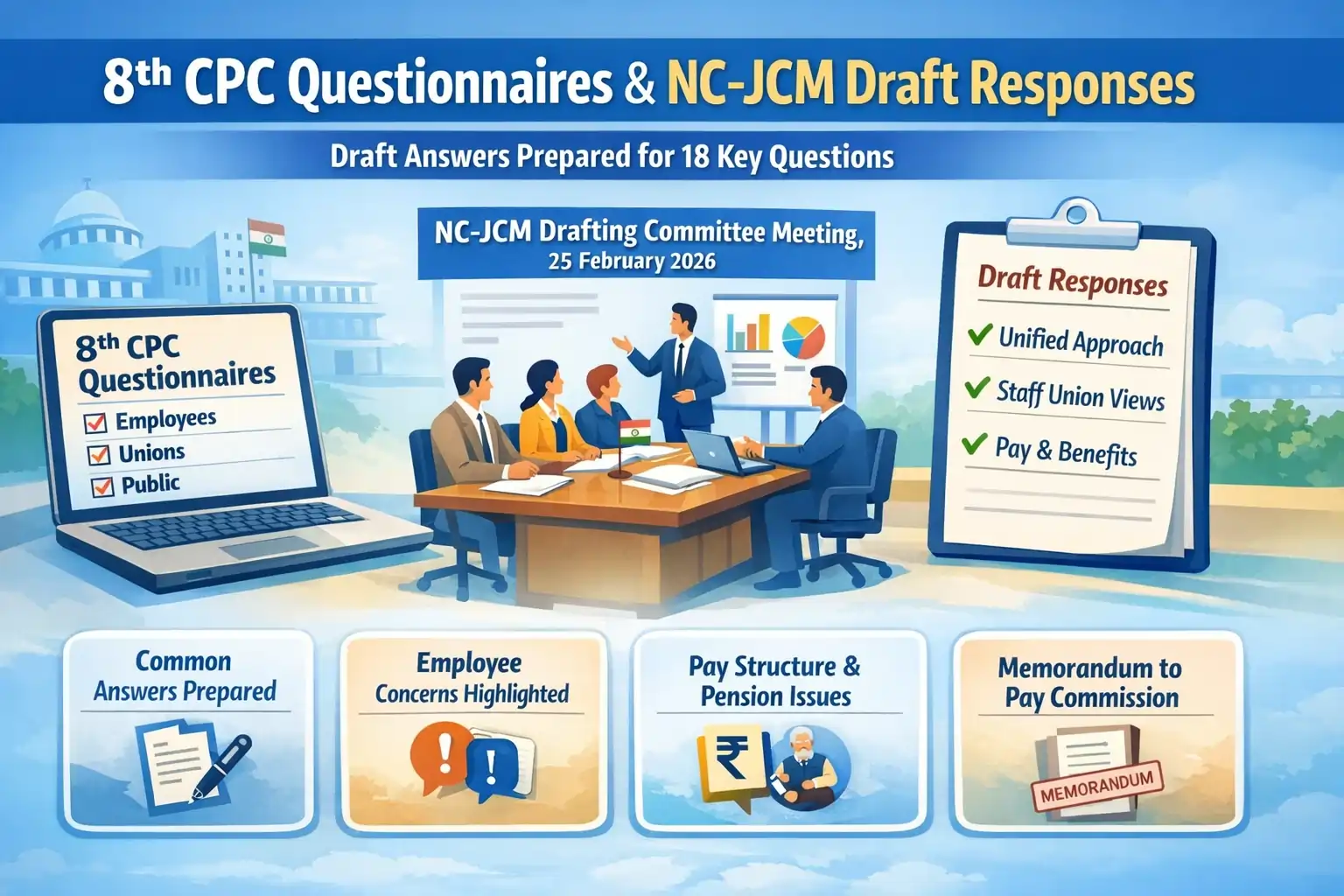
The 8th Central Pay Commission (8th CPC) process has started, and Central Government employees across India are closely following the developments. Many important issues are now being discussed, including pension reforms, changes in Dearness Allowance, and improvements in the salary structure. here’s a comprehensive breakdown of what’s being demanded, proposed, and discussed — straight from the Staff Side of the National Council (JCM) on 8th CPC questionnaire 2026.
The Staff Side of the National Council – Joint Consultative Machinery (NC-JCM) — the official body that represents the entire Central Government workforce — held its 8th CPC Drafting Committee meeting on 25th February 2026 and has formally presented its demands to the Commission.
These are not wishlist items. These are structured, legally grounded, historically backed demands. Here are the 7 most explosive ones — and why they matter to you.
Quick Fact: 8th Pay Commission at a Glance
| Factor | Detail |
| Constituted On | 3rd November 2025 |
| Employees Covered | ~50 Lakh Central Govt Personnel |
| Pensioners Covered | ~70 Lakh Pensioners |
| Includes | Railways, CAPF, Defence, Civilians |
| Previous Commission | 7th CPC — Implemented from 1 Jan 2016 |
| Staff Side Body | NC-JCM (National Council – JCM) |
| Questionnaires Published | 18 Questions on 8th CPC Website |
| Key Demand Letter Date | 25th February 2026 |
NC-JCM Staff Side: Demanding a Seat at the Table
The National Council – Joint Consultative Machinery (NC-JCM), which represents the entire Central Government workforce under the Joint Consultative Machinery and Compulsory Arbitration scheme, has been vocal about its role in the 8th CPC process.
In a letter dated 25 February 2026, Secretary Shiva Gopal Mishra wrote to the Member Secretary of the 8th CPC highlighting a critical concern: nearly four months after the commission’s constitution, the Staff Side has received no communication from the Office of the 8th CPC.
Key Demands from NC-JCM:
- Immediate introductory meeting with the Staff Side on a mutually convenient date — a practice followed by every previous Pay Commission.
- Acceptance of questionnaire responses via email and hard copy, in addition to the online portal. The current portal restricts answers to 200 words per question, which the Staff Side argues is insufficient for addressing complex service matters.
- Acceptance of memorandums from NC-JCM, Federations, Unions, and Associations through email and hard copy — not just the online portal.
The NC-JCM’s memorandum must cover all common service-related issues, including Minimum Pay, Fitment Factor, Pay Scales, Rate of Increment, Promotion Policies, Allowances, Medical Facilities, TA-DA, LTC, Advances, Leave, and Pension.
8th CPC Questionnaire 2026: Staff Side Draft Answers Reveal Key Employee Demands
The 8th Central Pay Commission (8th CPC) has published 18 important questionnaires on its official website. These questions are meant for government employees, staff unions, and the general public so that they can give their views on salary structure, allowances, pension, and service conditions.
To prepare a common response, the National Council–Joint Consultative Machinery (NC-JCM) Drafting Committee held a meeting on 25 February 2026. In this meeting, the committee discussed all the questions issued by the Commission.
After detailed discussion, the committee prepared draft answers for all 18 questions. These draft responses represent the initial position of staff unions and employee representatives on key issues related to the upcoming pay commission.
The draft answers will help employee organisations present a unified and structured response when submitting their memorandum to the Pay Commission.
In simple terms, the committee has tried to ensure that the views of employees are clearly presented before the Pay Commission while finalizing the new pay structure and benefits.
Here are the key positions taken by the committee on the 18 questionnaires.
PENSIONS
Q: The Seventh Pay Commission had assessed that in January, 2014, there were about 47 lakh serving Central Government personnel. This included CAPF, Railways & Defence forces. The number of pensioners was just short of 52 lakh. In 2025-26, the number of Central Government personnel stands at about 50 lakh, which the number of pensioners is almost 70 lakh. The increase in the number of pensions has created additional demands on Government’s Budget. What approaches could help to satisfy reasonable expectations of pensioners whilst keeping the fiscal impact within manageable limits?
⚖️ STAFF SIDE POSITION
The Staff Side delivers a legally powerful, Constitutionally grounded argument. They invoke Supreme Court precedent and Article 21 of the Constitution (Right to Livelihood) to frame pension not as government charity — but as a fundamental deferred right earned through decades of public service. The core argument: switching employees to NPS after January 2004 has created a silent retirement crisis. These employees are now retiring with pensions so small they cannot afford basic living. Asking the 8th CPC to keep pensions “fiscally manageable” is — in the Staff Side’s view — framing a Constitutional obligation as a budgetary inconvenience.
📋 KEY DEMANDS PLACED BEFORE 8th CPC
Restore the Old Pension Scheme (OPS / Defined Benefit Pension) for ALL Central Government employees — without exception Pension must be periodically revised to keep pace with rising cost of living Treat pension as a Constitutional right under Article 21 — not a discretionary government payment Reject any approach that prioritises fiscal management over the dignified retirement of public servants who served for 30+ years
| 🔥 Why This Is The Most Explosive Demand of 2026 70 lakh pensioners. 20+ lakh NPS employees approaching retirement. One Supreme Court-backed argument. If the 8th CPC recommends restoring OPS, it would be the single largest financial policy reversal since NPS was introduced in 2004 — reshaping India’s government employment landscape permanently. |
DEARNESS ALLOWANCE
Q: The Seventh Pay Commission was constituted in 2014 and implemented from 1.1.2016. The period since then has been marked by a lower trajectory of inflation, as compared to earlier decades. This is also reflected in the All India Consumer Price Index (Industrial Workers) which is used for DA calculation. Should the 8th CPC explore a hybrid indexation approach that factors in both inflation protection and formal sector wage growth trends? What proportion might be reasonable for each component, and what implementation considerations would arise? What are your expectations on inflation/CPI increase over the next 10 years?
⚖️ STAFF SIDE POSITIONaq
The Staff Side exposes a structural flaw in how DA is calculated: the AICPI-IW basket uses ration/PDS prices for many goods — prices government employees almost never actually pay. They shop at open retail markets where prices are far higher. This means every DA installment systematically understates the real inflation burden on employees. The Staff Side flatly rejects the hybrid indexation model, calling it a disguised salary cut in real terms. Historical weight is on their side: both the 4th and 6th Pay Commissions already recommended a separate CPI for government employees — a recommendation ignored for decades.
📋 KEY DEMANDS PLACED BEFORE 8th CPC
Reject the hybrid indexation approach entirely — mixing inflation and wage growth trends will dilute DA protection Create a dedicated, standalone Consumer Price Index exclusively for Central Government Employees and Pensioners Base the new index on actual open retail market prices — not PDS or subsidised ration rates Implement the recommendation already made (but ignored) by both the 4th and 6th Pay Commissions on this very issue
| 🔥 The Hidden DA Shortfall That Nobody Talks About Post-COVID inflation in housing, transport and medical costs has been severe — yet the AICPI-IW barely moved because it weights subsidised prices. Government employees have been quietly absorbing real income losses every month. The 8th CPC has an opportunity to fix a formula that has short-changed workers for decades. |
RAILWAYS, CAPF & DEFENCE
Q: Railways, CAPF and Defence forces typically account for about 70% of Central Government personnel. What particular considerations, monetary or non monetary should be factored in while determining their pay & allowances?
⚖️ STAFF SIDE POSITION
Railways, CAPF and Defence together form 70% of all Central Government employees — yet their unique risks, 24×7 operational demands, and life-threatening duties rarely get sufficient weight in pay calculations. The Staff Side invokes the COVID-19 pandemic as the clearest proof of their argument: when the rest of India locked down, these employees kept the country running. They transported essential goods, guarded borders, ran factories. Recognising this in the pay revision is not charity — it is an overdue debt.
📋 KEY DEMANDS PLACED BEFORE 8th CPC
Pay and allowances must explicitly reflect the unique risks, hardships and 24×7 operational demands of Railways, CAPF and Defence personnel Non-monetary benefits — housing, rations, medical care, family welfare — must be strengthened significantly across all three services COVID-19 national service contribution must be formally recognised in the 8th CPC pay revision framework Civilian Defence employees working alongside soldiers must receive pay commensurate with the operational risks they share
| 🔥 20 Million Passengers a Day — What Is That Service Worth? When the entire country was locked down, Railway workers reported to duty. CAPF personnel stood guard. Defence civilians kept factories running. The 8th CPC must answer one question: what salary is appropriate for those who cannot say I’ll work from home? |
SCIENTISTS
Q: Scientists work in certain specialized streams/departments such as Department of Space, Department of Atomic Energy etc. What should be appropriate benchmarks to be kept in mind for fixing their emoluments?
⚖️ STAFF SIDE POSITION
The Staff Side frames scientist pay as a national strategic issue, not just a salary question. ISRO built Chandrayaan. DRDO developed cutting-edge defence systems. DAE powers India’s nuclear programme. If government scientist salaries cannot compete with the private sector or international institutions, India risks losing its best scientific minds — and with them, its technological sovereignty. The 8th CPC must benchmark scientist pay against global standards, not just domestic government grades. The allowance for self-updating must also be substantially increased — continuous learning is not optional for researchers competing with the world.
📋 KEY DEMANDS PLACED BEFORE 8th CPC
Benchmark scientist emoluments against global standards — not just domestic government pay scales Pay must be competitive, transparent and career-linked to support lifelong learning and continuous research Professional development and self-updating allowances must be substantially increased Retain world-class talent in ISRO (Space), DAE (Atomic Energy) and DRDO (Defence R&D) — treat this as a national security priority
| 🔥 India’s Brain Drain Risk Is Real and Growing Every year, government scientists leave for better-paying private or foreign roles. The 8th CPC cannot treat this as a routine pay revision — it must treat it as a national talent retention emergency with direct implications for India’s strategic capabilities. |
ARMED FORCES
Q: Military Service Pay is currently admissible to personnel of Armed Forces. This was in recognition of the special nature of their duties. In that context and given the changing nature of their jobs, how should the pay of soldiers, sailors and Air force personnel be determined? How should it relate to the starting salary in Government or the pay of a constable in CAPF/ Police?
⚖️ STAFF SIDE POSITION
The Staff Side makes two powerful separate arguments simultaneously. First: the current static Military Service Pay (MSP) is outdated — it does not reflect real-time operational risk. It must be replaced with a dynamic Risk and Readiness Premium that always stays at least 25% above CAPF, Police and Civilian entry-level pay. Second: the Agniveer scheme — Fixed Term Employment for soldiers — is branded as exploitative and fundamentally unacceptable. You cannot ask someone to risk their life for a 4-year contract with no pension and uncertain career prospects. The Staff Side demands not just stopping new Agniveer recruitment — but regularising everyone already recruited.
📋 KEY DEMANDS PLACED BEFORE 8th CPC
Replace static Military Service Pay (MSP) with a dynamic Risk & Readiness Premium — set at minimum 25% above CAPF / Police / Civilian Entry Level pay Scrap the Agniveer Fixed Term Employment scheme entirely and immediately Regularise ALL personnel already appointed as Agniveer — no exceptions Provide attractive entry pay with clear, guaranteed career progression for all soldiers, sailors and airforce personnel Strengthen non-monetary benefits across all ranks: Housing, Rations, family welfare and medical facilities
| 🔥 Agniveer: The Policy That Shook Parliament — Now Formally Before the 8th CPC Agniveer has been the most politically charged defence policy in recent years. The NC-JCM’s formal written submission to the 8th CPC demanding its abolition gives constitutional and institutional weight to what was previously only a political debate. If the Commission agrees, it changes Indian defence policy permanently. |
DEFENCE PENSIONS
Q: The nation has many more military pensioners than serving military personnel. In 2025-26, outgo on Defence Pensions is likely to be higher than the outgo on Defence salary and allowances. As overall defence pension bill increases, in line with projections, impact will be visible on equipment and arms purchase, their maintenance and on modernization of defence forces. What changes would you recommend to contain increases in defence manpower costs and its pension bill?
⚖️ STAFF SIDE POSITION
The 8th CPC’s question is framed almost entirely around cost containment — which the Staff Side reads as a veiled suggestion to cut defence pension benefits. The response is brief, firm and moral: you cannot frame the sacrifice of soldiers as a budget optimisation problem. The Staff Side does not oppose gradual, humane reforms — phased retirement age increases, voluntary early retirement with full compensation. But any reform must start from a foundation of honouring service — not minimising its cost.
📋 KEY DEMANDS PLACED BEFORE 8th CPC
The Non-Contributory Old Pension Scheme (OPS) for Armed Forces must continue — this is non-negotiable Support only gradual humane reforms: phased increase in retirement age; voluntary retirement with full fair compensation Create improved reemployment opportunities for veterans to productively utilise their skills post-retirement Cost savings must NEVER be achieved by reducing the dignity or financial security of veterans and their families Recognise that national security capability depends on motivated, well-treated personnel — cuts here have direct strategic consequences
| 🔥 More Pensioners Than Soldiers — A Strategic Warning Hidden in a Budget Question India now spends more on Defence pensions than on active Defence salaries. The government sees a cost problem. Veterans see a promise being questioned. The 8th CPC must find a path — without breaking the trust that makes young Indians willing to join the armed forces in the first place. |
Also Read: 8th CPC News: FNPO Demands ₹54,000 Minimum Pay, 3.00 Fitment Factor, Higher CEA & Transport Allowance
BONUS
Q: Productivity Linked Bonus (PLB) is paid to some employees of Government such as Railways, Postal staff whilst Non-Productivity Linked Bonus is given to specified Central Government employees including some in Armed Forces. How can the Bonus structure be reimagined for rewarding excellence in productivity & performance? Should PLB/ Ad-hoc Bonus continue to be given on uniform basis (e.g. 60 days of salary for all) or be differentiated, based on individual performance?
⚖️ STAFF SIDE POSITION
The Staff Side tackles two separate injustices simultaneously. First: individual performance bonuses are structurally impossible in government — work is collective. Ranking a station master against a guard in Railways makes no sense. Individual performance differentiation is rejected outright. Second: the Rs. 7,000 emolument cap for bonus calculation is years out of date. Worse, in Defence PLB schemes there is no minimum guaranteed bonus when productivity falls — even when the shortfall is caused by the government simply not assigning enough work to its own employees. Punishing workers for the government’s own workload failures is, as the Staff Side says, simply unjust.
📋 KEY DEMANDS PLACED BEFORE 8th CPC
Reject individual performance-based bonus differentiation entirely — government work is collective by nature Guarantee a minimum bonus of 30 days wages in ALL PLB schemes — regardless of whether productivity index meets threshold Productivity shortfalls caused by government’s own failure to provide adequate workload must NOT penalise employees Abolish the stagnant Rs. 7,000 monthly emolument ceiling — calculate bonus on ACTUAL Basic Pay + DA of each employee Extend minimum guaranteed bonus protection explicitly to Defence PLB schemes without further delay
| 🔥 Punished for the Government’s Own Failure — The PLB Scandal Explained Imagine working in an Ordnance Factory. The government gives you less work than your capacity. Your productivity index falls. You lose your bonus. You did nothing wrong — but you pay the price. That is exactly what current PLB rules allow. The Staff Side calls it what it is: unjust. The 8th CPC must fix it now. |
REFORMS IN STAFFING
Q: Contractual appointments in the form of lateral entry have been tried during the last few years. Do you think this should be expanded and other practices such as part-time work, flexi time etc. be introduced in Government at middle/ higher levels to tap a bigger talent pool? What could be the pros and cons of doing so?
⚖️ STAFF SIDE POSITION
The Staff Side delivers its most politically pointed answer. The 8th CPC’s question is sympathetically framed toward modernisation — presenting lateral entry and contractualisation as progressive ways to ‘tap a bigger talent pool.’ The Staff Side’s response dismantles this framing entirely. Sovereign, continuous government functions require permanence — not flexibility. Constitutional accountability, institutional memory and public trust cannot be built on rotating contract staff. The Staff Side identifies the entire policy of corporatisation and privatisation of core public services as fundamentally dangerous to governance quality — and demands it be reversed, not expanded.
📋 KEY DEMANDS PLACED BEFORE 8th CPC
Do NOT expand lateral entry, contractual hiring, flexi-time or part-time models in core government departments Declare permanent, stable workforce as the non-negotiable foundation of Indian governance Functions that are continuous, sovereign and skill-dependent must stay under direct government administrative control Reverse the policy of indiscriminate corporatisation and privatisation of core public service sectors Governance accountability, transparency and institutional continuity cannot be delivered through contract or fixed-term staff
| 🔥 The Talent Pool Argument vs. The Accountability Argument The government argues lateral entry brings in fresh talent. The Staff Side argues it brings in unaccountable, impermanent people into roles that require constitutional accountability. Who is right? The 8th CPC’s answer will define the nature of Indian public service for the next decade. |
Summary
| Topic | Core Staff Side Demand |
| Pensions (194w) | Restore Old Pension Scheme — NPS retirees deserve Constitutional dignity |
| Dearness Allowance (170w) | Reject hybrid DA; create separate CPI based on retail market prices |
| Railways, CAPF & Defence (147w) | Pay must reflect 24×7 risk and COVID-era national service contributions |
| Scientists (101w) | Global benchmark pay to stop brain drain from ISRO, DAE and DRDO |
| Armed Forces (121w) | Dynamic Risk Premium at 25%+ above CAPF; scrap Agniveer entirely |
| Defence Pensions (81w) | OPS for Armed Forces is non-negotiable; only humane reforms — zero benefit cuts |
| Bonus (199w) | Guaranteed 30-day minimum bonus; calculated on actual Basic Pay+DA not Rs.7000 cap |
| Staffing Reforms (163w) | No contractualisation; permanent workforce is the foundation of accountable governance |
This is not a minor procedural complaint. The Staff Side of NC-JCM represents the voice of over 50 lakh Central Government employees. Excluding them from the process — intentionally or otherwise — raises serious questions about whose interests the 8th CPC is truly designed to serve.
What Should You Do Right Now?
The NC-JCM has urged all affiliated unions, associations, and individual government employees to take the following steps immediately:
- Log into the official 8th CPC website and submit your answers to all 18 questionnaires
- Use the unified positions prepared by the NC-JCM Drafting Committee — a single, coordinated voice carries more weight
- Share this information with colleagues — the more employees who respond, the stronger the signal to the Commission
- Watch for the finalised 8th CPC Memorandum, expected to be ready by the first week of April 2026
The Stakes Have Never Been Higher
The 8th Pay Commission’s recommendations will shape the financial lives of over 12 crore Indians — employees, pensioners, and their families. From restoring the Old Pension Scheme, to scrapping Agniveer, to ending the outdated DA formula, the demands of the NC-JCM Staff Side are bold, specific, and rooted in decades of legitimate grievance.
The question now is: Will the 8th CPC listen?
The Staff Side has done its job. It has documented the demands, prepared the memorandum, and formally requested a seat at the table. The Commission’s response — or silence — will be watched by millions.
Source: NC-JCM Staff Side | National Council – Joint Consultative Machinery for Central Government Employees
Disclaimer: Based on official NC-JCM Staff Side communications and 8th CPC Drafting Committee documents (February 2026). Final recommendations will be made by the 8th CPC to the Government of India.
Also Read: 8th Pay Commission 2026: Army Proposes 130% MSP Hike, 40% Family Pension for Soldiers
Read our complete guide on the 8th Pay Commission 2026 to understand salary changes and expected implementation timeline.








5 thoughts on “8th Pay Commission 2026: NC-JCM Staff Side Demands — OPS, DA, Agniveer & More”