
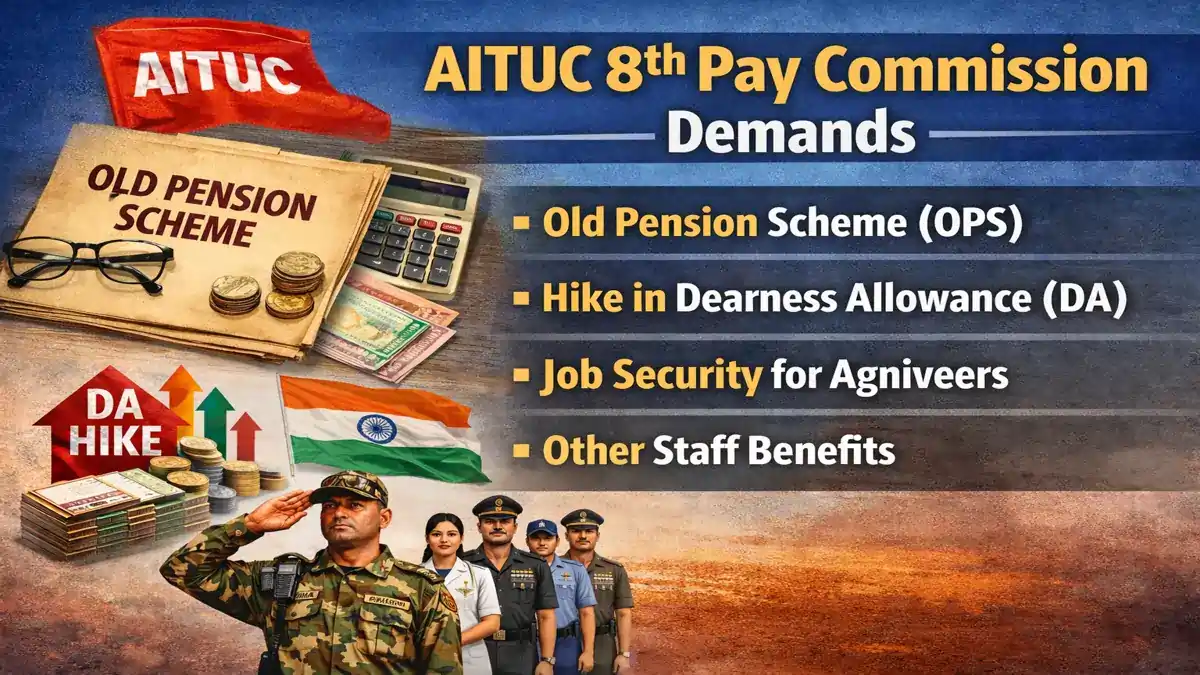
What India’s biggest trade union AITUC Demands on 8th Pay Commission 2026 — and what it means for 1.25 crore central employees and pensioners
If you are a central government employee or a pensioner, the next few months are going to matter a lot to you. The 8th Pay Commission is currently in the process of gathering suggestions from employees, unions, and government departments. The portal was opened on March 5, 2026, and submissions are accepted till April 30, 2026.
One of the most important voices in this process is the All India Trade Union Congress (AITUC) — one of India’s oldest and largest central trade unions. AITUC has formally placed 12 key demands before the Commission. These demands go well beyond just a salary hike — they cover pension reform, career progression, women’s welfare, healthcare, and much more.
In this article, we break down every single demand in plain, easy-to-understand language — so you know exactly what is being asked for on your behalf.
Table of Contents
Background: Why AITUC’s Role Matters
AITUC — the All India Trade Union Congress — was founded in 1920 and is one of the country’s most influential labour organisations. At its National Working Committee meeting held in Bhubaneswar on March 14–15, 2026, AITUC passed 18 resolutions. Among them, the demands related to the 8th Pay Commission were among the most significant.
The 8th Pay Commission was officially constituted in November 2025. Its job is to revise the pay structure, allowances, and pension for all central government employees. It is expected to submit its report by mid-2027. Once approved, the revised pay structure will affect nearly 1.25 crore people — employees and pensioners combined.
⚡ Key Context
AITUC has not just submitted a wish list — it has argued with data, precedents, and real-life cost calculations why each demand is fair and justified.
Complete Analysis of AITUC Demands on 8th Pay Commission 2026
Demand 1: Fitment Factor of 3.0
🔢 What Is a Fitment Factor?
A fitment factor is the number by which your current basic pay is multiplied to arrive at your new revised basic pay. The 7th Pay Commission used a fitment factor of 2.57, which increased the minimum basic pay from ₹7,000 to ₹18,000. AITUC is now demanding a fitment factor of 3.0 for the 8th Pay Commission.
If a 3.0 fitment factor is applied, the minimum basic pay of ₹18,000 would jump to approximately ₹54,000. This would be one of the biggest single salary revisions in the history of India’s central pay structure. AITUC argues that rising living costs, inflation, and the economic demands of modern family life make this increase not just fair but necessary.
💡 Simple Math
Current Minimum Basic Pay: ₹18,000 × 3.0 = ₹54,000 (proposed). That’s a jump of ₹36,000 — a 200% increase in basic pay.
Demand 2: Restore the Old Pension Scheme (OPS)
🏦 OPS vs NPS — What’s the Difference?
Under the Old Pension Scheme (OPS), a retired employee is guaranteed a fixed monthly pension (usually 50% of the last drawn salary), fully funded by the government. Under the National Pension System (NPS), introduced in 2004, the pension amount depends on market performance — meaning it is uncertain and not guaranteed.
AITUC is firmly demanding that the government scrap the NPS and restore OPS for all central government employees. The union argues that a government job comes with the expectation of post-retirement security, and a market-linked pension defeats that purpose entirely.
This is widely considered the most politically sensitive demand in the list. Several state governments — including Rajasthan, Himachal Pradesh, and Punjab — have already moved back to OPS, creating pressure on the central government to follow suit.
Demand 3: Annual Increment Raised to at Least 6%
📈 Current Increment Rate: Just 3%
Right now, central government employees get an annual increment of 3% of their basic pay. AITUC is demanding this be increased to a minimum of 6% per year — double the current rate.
The reason is simple: inflation eats into purchasing power every year. A 3% raise when prices are rising at a comparable or higher rate means employees are effectively earning less in real terms year after year. Doubling the increment rate to 6% would help employees maintain and improve their standard of living over their careers.
Demand 4: A New Formula for Dearness Allowance (DA)
📊 Why the Current DA Formula Needs a Rethink
DA is the allowance paid to compensate employees for the impact of inflation. It is revised twice a year — in January and July. However, AITUC argues that the current formula for calculating DA does not fully capture the real cost of living, especially for a family.
AITUC has demanded two major changes in how DA is calculated. First, the minimum pay should be calculated based on a family of five members, not the current three units. Second, modern expenses like internet connectivity should be included in the cost calculations, as they are no longer a luxury but a basic need for daily life and work.
This is a forward-thinking demand that reflects how life in India has fundamentally changed in the digital age.
Demand 5: Leave Encashment Limit Raised to 450 Days
📅 What Is Leave Encashment?
At the time of retirement, a government employee can convert their unused leave into cash — this is called leave encashment. Currently, the maximum limit for this is 300 days. AITUC wants this raised to 450 days.
Many senior employees accumulate leave throughout their careers but do not take it due to workload or duty obligations. Raising the encashment limit to 450 days would ensure they are fairly compensated for the leave they sacrificed, improving their financial security at the time of retirement.
Demand 6: Cashless Medical Facilities
🏥 Health Should Not Come with a Bill Shock
Currently, many government employees have to pay out-of-pocket for medical treatment and then apply for reimbursement — a process that can be slow, complicated, and financially stressful. AITUC is demanding fully cashless medical treatment for all central government employees and their families.
In emergencies, the last thing a family should worry about is arranging money upfront. Cashless health facilities — where hospitals are directly billed by the government — would provide real peace of mind and reduce financial hardship during medical emergencies.
Demand 7: Menstrual Leave for Women Employees
👩 A Progressive Workplace Demand
AITUC has demanded that women government employees be granted paid menstrual leave. This is a formal acknowledgement that menstruation can cause physical discomfort and that women should not have to use their sick leave or casual leave to manage a natural biological process.
Several countries and some private companies in India have already introduced this benefit. AITUC is pushing for this to become a standard entitlement in the central government service, setting a benchmark for the rest of the country’s workforce.
Demand 8: Enhanced Paternity Leave
👨👧 Fathers Need Time Too
Currently, male central government employees are entitled to 15 days of paternity leave. AITUC is demanding this be substantially increased to allow fathers to play a meaningful role in early childcare and to support their partners during and after childbirth.
This demand reflects a broader shift toward gender-equal parenting policies. When fathers are able to take meaningful leave, it reduces the burden on mothers, supports child development, and promotes a healthier work-life balance for the entire family.
Demand 9: Higher Risk Allowances — Up to ₹2 Crore Accident Cover
⚠️ Dangerous Jobs Deserve Better Compensation
Many central government employees — defence personnel, paramilitary forces, forest guards, railway workers — work in genuinely dangerous conditions. AITUC has demanded that risk allowances be significantly increased and that accident cover of up to ₹2 crore be provided in case of death during service.
The current compensation levels for such employees are widely considered inadequate given the risks they face. A ₹2 crore accident cover would ensure that families of employees who lose their lives in the line of duty receive meaningful financial support.
Demand 10: Fill 15 Lakh Vacant Government Posts
🏛️ Empty Seats, Overworked Employees
AITUC has highlighted a serious problem: there are approximately 15 lakh (1.5 million) vacant posts in central government departments right now. These vacancies are placing extra burden on existing employees, reducing service quality, and leaving thousands of qualified candidates without jobs.
The union is demanding that the government fill all these posts through regular recruitment — not contractual or outsourced hiring — within a set timeframe. This would not only reduce workload on current employees but would also boost employment across the country.
Demand 11: Guaranteed 5 Promotions in a 30-Year Career
🚀 Career Growth Shouldn’t Be a Lottery
Right now, the Modified Assured Career Progression (MACP) scheme gives employees only 3 assured promotions over a 30-year career. AITUC — along with the National Council JCM Staff Side — is demanding this be revised to guarantee at least 5 promotions over the same period.
In many departments, due to fewer higher posts and departmental mergers, employees end up stuck at the same grade for decades. AITUC argues that this is demoralising and unfair, and that a structured promotion pathway must be created to ensure career growth for everyone — not just those lucky enough to be in departments with frequent openings.
Demand 12: Revised Pay Effective from January 1, 2026
📆 Don’t Delay the Benefits
AITUC is clearly demanding that all salary revisions, allowances, and pension benefits under the 8th Pay Commission be made effective from January 1, 2026 — the date the 7th Pay Commission’s tenure ended. Furthermore, it insists that even if the formal implementation happens later (as the report will only be submitted by mid-2027), all employees and pensioners must receive full arrears from January 1, 2026.
This is backed by precedent. When the 7th Pay Commission was implemented in June 2016 (the report was submitted in November 2015), arrears were paid from January 1, 2016. AITUC is simply asking for the same treatment now.
⚠️ Why This Matters
A delay in the effective date could cost employees tens of thousands of rupees in lost arrears. AITUC is fighting to make sure that doesn’t happen.
Quick Comparison: What Exists vs What AITUC Wants
| Parameter | Current (7th CPC) | AITUC Demand (8th CPC) |
|---|---|---|
| Fitment Factor | 2.57 | 3.0 |
| Minimum Basic Pay | ₹18,000/month | ~₹54,000/month |
| Annual Increment | 3% | Minimum 6% |
| Pension System | NPS (market-linked) | OPS (guaranteed) |
| Leave Encashment | 300 days | 450 days |
| Promotions (30 yrs) | 3 (MACP) | 5 |
| Medical Facility | Reimbursement-based | Cashless |
| Accident Cover | Limited | Up to ₹2 Crore |
| Menstrual Leave | Not applicable | Paid leave (introduced) |
| DA Calculation Base | 3-unit family | 5-unit family + internet |
| Effective Date | TBD by government | January 1, 2026 |
What This Means for You — The Real Impact
If even a significant portion of these demands are accepted, the financial and quality-of-life impact on central government employees would be transformative. Here is what you stand to gain:
💰 Much Higher Take-Home Pay
A fitment factor of 3.0 combined with a 6% annual increment means substantially higher monthly earnings right from January 2026.
🔒 Secure Retirement
OPS restoration would give you a fixed, guaranteed pension — no more depending on stock market performance for your retirement income.
🏥 Stress-Free Healthcare
Cashless medical facilities mean you can focus entirely on getting better — not on arranging hospital bills upfront.
🗓️ Better Leave Benefits
Higher leave encashment limits mean more money in hand at retirement for the leave you earned but never took.
🗓️ Better Leave Benefits
Higher leave encashment limits mean more money in hand at retirement for the leave you earned but never took.
👨👩👧 Stronger Family Support
Better paternity leave and menstrual leave show a move towards a more humane, family-friendly government workplace.
Frequently Asked Questions (FAQs)
When will the 8th Pay Commission submit its report?
The 8th Pay Commission was formed in November 2025 and is expected to submit its report within 18 months — around mid-2027. After that, the Union Cabinet will review and approve the recommendations, likely resulting in implementation later in 2027 with arrears from January 1, 2026.
Will the fitment factor definitely be 3.0?
Not necessarily. AITUC is demanding 3.0, but the final fitment factor will be decided by the Commission after considering demands from all stakeholders, the government’s financial position, and macroeconomic factors. The 7th Pay Commission set it at 2.57 after similar demands for higher numbers. Some experts expect a fitment factor of 2.86 to 3.0
How can I submit my own suggestions to the 8th Pay Commission?
You can submit your suggestions online through the official portals: 8cpc.gov.in or innovateindia.mygov.in. The portal is open till April 30, 2026. You need to log in with your email or mobile number. Note that submissions via email or physical letters will not be accepted.
What is MACP and how will it change under 8th CPC?
MACP stands for Modified Assured Career Progression. Currently, it gives employees 3 promotions at 10, 20, and 30 years of service. AITUC and the JCM Staff Side are demanding this be expanded to 5 assured promotions, with a clearer promotion hierarchy to remove the bottlenecks that leave many employees stagnant for years
Does the 8th Pay Commission affect pensioners too?
Yes. The 8th Pay Commission covers approximately 77 lakh (7.7 million) pensioners along with 48.67 lakh active employees. Pensioners will benefit from revised pension calculations, DA revisions, and — if AITUC’s demand is accepted — the restoration of OPS for those currently under NPS.
What is AITUC’s stance on the 4 Labour Codes?
At its March 2026 National Working Committee meeting, AITUC also passed resolutions opposing the implementation of the 4 Labour Codes, which it argues dilute workers’ rights and reduce union power. While this is separate from the 8th Pay Commission demands, it shows AITUC’s broader stance on labour rights in India.
Conclusion: A Comprehensive Demand, A Critical Moment
AITUC’s 12 demands to the 8th Pay Commission are not just about salary. They represent a vision for what a fair, modern, and humane government service should look like. From securing retirement through OPS to protecting women employees with menstrual leave, from filling 15 lakh vacant posts to ensuring accident cover of ₹2 crore for those in dangerous roles — these demands touch every aspect of a government employee’s working and personal life.
Whether all 12 demands will be accepted is a different question — the government will weigh these against fiscal constraints and economic realities. But what AITUC has done is set a strong, evidence-backed baseline for negotiations. The more awareness employees and pensioners have about these demands, the stronger the case becomes for a fair and timely revision.
Watch this space — GovtServiceInfo.com will continue to bring you the latest updates as the 8th Pay Commission moves closer to submitting its report.
Read our complete guide on the 8th Pay Commission 2026 to understand salary changes and expected implementation timeline.







1 thought on “AITUC’s 12 Key Demands to the 8th Pay Commission — A Complete Analysis”