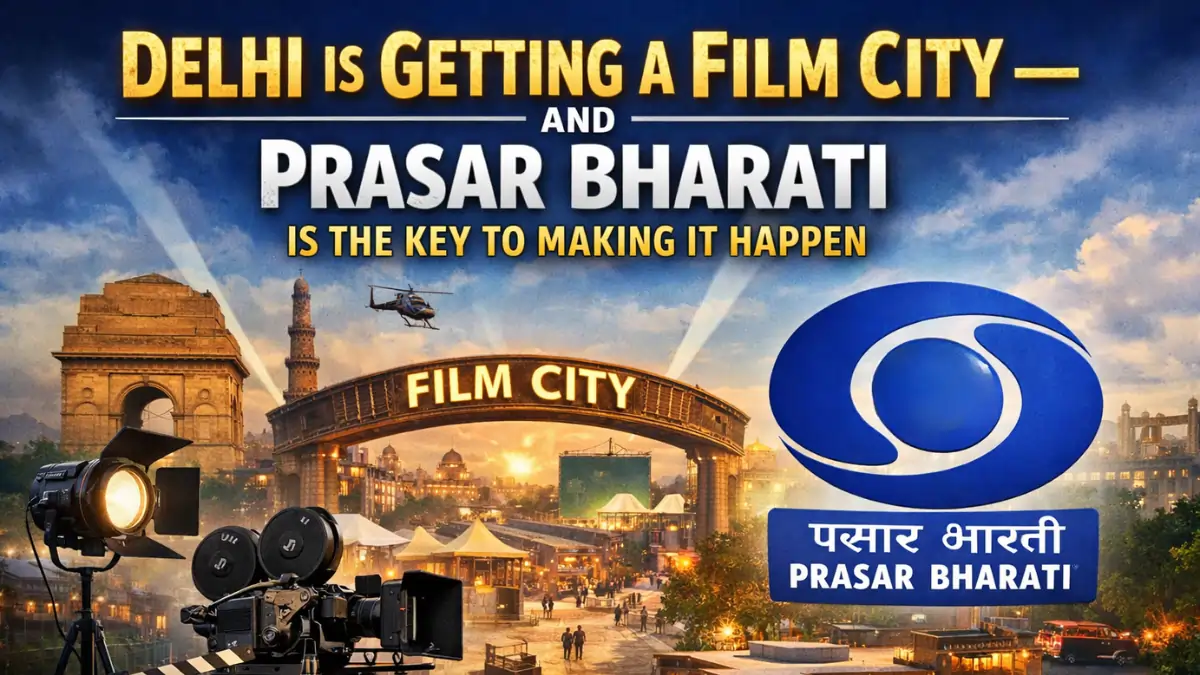
The Delhi Film City Prasar Bharati MoU signed on 27 March 2026 is the most ambitious media infrastructure announcement the national capital has seen in years. On the sidelines of the International Film Festival of Delhi (IFFD) at Bharat Mandapam, Delhi’s Tourism and Transportation Development Corporation (DTTDC) and Prasar Bharati — India’s public broadcaster — formally agreed to jointly develop Delhi into a global hub for film, television, animation, visual effects, gaming, and digital content creation. The central government is expected to make available approximately 486 acres of land to anchor the project.
For a city that has long been a cultural and administrative powerhouse but rarely a production powerhouse, this agreement marks a genuine inflection point. Mumbai, Hyderabad, and the Noida-Greater Noida belt have dominated physical media infrastructure for decades. Delhi’s entry — backed by both state authority and a national public broadcaster — changes that equation in ways worth examining carefully.
📌 Also Read: DD Free Dish 97th MPEG-4 e-Auction 2026 -39 Channels list
Table of Contents
What the DTTDC–Prasar Bharati MoU Actually Says
The Memorandum of Understanding (MoU) was signed between the Delhi Tourism and Transportation Development Corporation Limited (DTTDC) and Prasar Bharati at the inaugural International Film Festival of Delhi (IFFD), which ran from 25 to 31 March 2026 across venues in the capital. The agreement, formalised at Bharat Mandapam, is the formal legal architecture for a project that has been discussed in policy circles for some time.
At its core, the MoU commits both organisations to work toward the creation of an integrated media and entertainment hub — one that brings together film production, television broadcasting, animation, visual effects, gaming and comics (AVGC) under a single platform. The plan includes the construction of modern production studios, post-production facilities, and dedicated AVGC hubs, alongside an ecosystem for skill development, training, and innovation.
Critically, the two parties will form a joint coordination committee with members from both DTTDC and Prasar Bharati to oversee the planning, funding, and execution of the project. That committee structure matters: it signals this is not simply a land deal but a co-governance model where the national broadcaster will have ongoing operational involvement, not just ceremonial association.
💡 The land earmarked for the project — approximately 486 acres — is expected to come from the central government, with Prasar Bharati facilitating access as part of its contribution to the joint venture.
Why Prasar Bharati — and Why Now?
Prasar Bharati’s involvement is not incidental. The public broadcaster has spent the last 18 months in a period of aggressive digital transformation that makes it a natural anchor tenant for a media hub of this kind.
In November 2024, Prasar Bharati launched WAVES, its own over-the-top (OTT) platform, at the 55th International Film Festival of India in Goa. WAVES offers content across 12-plus Indian languages, spanning over 80 genres — from classic Doordarshan serials to new originals, live TV, radio, e-books, and gaming. By early 2026, the platform had moved to centralise all content acquisition through its Waves Bazaar portal, creating a structured pipeline for independent filmmakers, production houses, and digital creators to supply content to both WAVES OTT and Doordarshan’s linear channels.
In January 2026, Prasar Bharati launched Creator’s Corner on DD News — a daily slot featuring content from independent digital creators, positioning the public broadcaster as a discovery platform for India’s growing creator economy. By March 2026, Minister of Information and Broadcasting Ashwini Vaishnaw unveiled MyWAVES, a citizen-creator layer within WAVES OTT that allows users to upload and share short videos, vertical content, and episodic formats in multiple Indian languages.
Read alongside the Delhi Film City MoU, this trajectory tells a coherent story. Prasar Bharati is no longer positioning itself as a passive broadcaster. It is building the infrastructure — physical and digital — to become the backbone of India’s publicly anchored creative economy. A dedicated production hub in Delhi gives it the physical capacity to match its digital ambition.
What Gets Built: Studios, AVGC, and Skill Centres
The project envisions what Tourism Minister Kapil Mishra described as “a single platform where creativity, technology, and innovation can flourish under one roof.” In practice, that translates into several distinct components:
Production studios and post-production facilities will form the core of the physical infrastructure — purpose-built spaces designed to support the full lifecycle of film and television production, from pre-production through sound design and colour grading.
An AVGC hub targeting animation, visual effects, gaming and comics is a particularly significant element. India’s AVGC sector has been identified as a high-growth export opportunity, and dedicated physical infrastructure in the capital — linked to a public broadcaster — provides both a training ground and a production base for a sector that currently clusters primarily in Bangalore, Mumbai, and Pune.
Skill development and training infrastructure is built into the MoU as a core component, not an afterthought. Officials confirmed that the project is expected to generate employment for young people, and the training ecosystem is designed to feed directly into the production facilities — creating a pipeline from education to industry within a single campus.
Chief Minister Rekha Gupta described the initiative as aligning with Prime Minister Narendra Modi’s Make in India vision, and as a contribution to the country’s broader creative economy — what the Ministry of Information and Broadcasting has begun calling the Orange Economy, the creative and cultural industries that combine talent, technology, and intellectual property.
📌 Also Read: DD Free Dish Auction 2026 Winner List: 55 Channels list
What This Means for Delhi’s Creative Economy
Until now, a Delhi-based filmmaker, animator, or content creator who needed professional-grade studio infrastructure had two practical choices: travel to Mumbai, or work with the limited private facilities scattered across the NCR. Neither was ideal. The costs were high, the logistics were difficult, and the ecosystem — the density of producers, directors, technicians, and post-production houses that makes Mumbai’s industry so productive — simply did not exist in the capital in the same form.
A film city of the scale envisioned here — 486 acres, backed by both the Delhi government and a national public broadcaster — has the potential to change that. If the infrastructure is built to international standards and the AVGC hub attracts training partnerships with film schools and technology companies, Delhi could develop the kind of cluster effect that makes Mumbai’s Andheri and Hyderabad’s Ramoji Film City so productive.
✅ For freelance content creators and digital producers already working in Delhi, the WAVES OTT connection is particularly significant. Prasar Bharati’s Waves Bazaar portal already accepts proposals for web series, short films, and digital content. A local production hub tied to that acquisition pipeline means Delhi-based creators would have both the infrastructure to produce and a distribution channel through WAVES and Doordarshan — without leaving the city.
⚠️ For context, the Noida International Film City project — a comparable initiative in Greater Noida’s Sector 21 along the Yamuna Expressway — was originally scheduled to begin construction in June 2025 but has faced delays. Delhi’s project benefits from stronger central government involvement and a cleaner institutional structure, but it will need to maintain momentum to avoid a similar fate.
The Bigger Picture: India’s Public Media Is Going on Offence
The timing of this MoU — signed at Delhi’s first-ever international film festival, attended by filmmakers, producers, and industry professionals from across the country — is not coincidental.
The Ministry of Information and Broadcasting has been executing a coherent strategy across multiple fronts. WAVES OTT was launched to give Prasar Bharati a digital presence. Creator’s Corner and MyWAVES were built to pull creators onto that platform. The Waves Bazaar portal was created to professionalise content acquisition. And now, a physical Film City in the national capital provides the production infrastructure that ties all of it together.
What this signals is that Indian public media is moving from a defensive posture — trying to stay relevant in the face of private streaming dominance — to an offensive one. Rather than simply competing with Netflix, Disney+ Hotstar, or JioStar on content, Prasar Bharati is trying to build an ecosystem where it controls the infrastructure, the distribution, and increasingly the creator pipeline.
For the country’s media industry, that is a structural shift worth watching. For Delhi’s creative professionals, it is an opportunity that has not existed before.
📌 Also Read: Prasar Bharati Teams Up with Aamir Khan Production for Documentary on President Droupadi Murmu
Frequently Asked Questions
What is the Prasar Bharati–Delhi Film City MoU, and when was it signed?
The MoU was signed on 27 March 2026 between the Delhi Tourism and Transportation Development Corporation (DTTDC) and Prasar Bharati at Bharat Mandapam during the International Film Festival Delhi (IFFD). The agreement commits both organisations to develop Delhi into an integrated hub for film, television, digital media, and AVGC industries.
How much land has been earmarked for the Delhi Film City project?
Approximately 486 acres of land is expected to be made available by the central government for the project. Prasar Bharati is facilitating land access as part of the joint arrangement with the Delhi government.
What does AVGC stand for and why is it part of this project?
AVGC stands for Animation, Visual Effects, Gaming, and Comics. It is one of India’s highest-growth export sectors in the creative economy. Including a dedicated AVGC hub in the Delhi Film City aligns with the government’s National AVGC-XR Mission, which aims to develop India as a global content production destination.
Will the Delhi Film City create jobs, and what kind of skill training will be available?
Yes — job creation is an explicit goal of the project. The MoU includes plans for skill development centres, training facilities, and innovation infrastructure within the campus, designed to create a pipeline from training into production employment, particularly for young people in the Delhi-NCR region.
Who is overseeing the planning and execution of the project?
A joint coordination committee comprising members from both DTTDC and Prasar Bharati will be formed to manage the planning, funding, and implementation of the project. This structure gives both the Delhi government and the national broadcaster ongoing governance roles.
How does this compare to the Noida Film City project?
The Noida International Film City, planned in Greater Noida’s Sector 21, was announced earlier but has faced delays since its originally planned June 2025 construction start. Delhi’s project has stronger central government backing through Prasar Bharati’s direct involvement, though both projects remain in early stages. Timelines for Delhi’s Film City have not yet been officially announced.
How is Prasar Bharati’s WAVES OTT platform connected to the Delhi Film City plan?
WAVES is Prasar Bharati’s own OTT platform, launched in November 2024, which accepts content from independent creators through its Waves Bazaar portal. A production hub in Delhi tied to Prasar Bharati would give local creators both infrastructure to produce content and a ready distribution channel through WAVES and Doordarshan’s linear network.
What Comes Next
The MoU is a framework agreement — the real test will be in execution. The immediate next steps include the formation of the joint coordination committee, finalisation of the land allocation process, and the appointment of architects and project consultants for the master plan.
No official construction timeline has been announced as of 29 March 2026. Observers will watch for the release of a Detailed Project Report (DPR) and the tendering process for studio construction as the first concrete indicators of progress.
For Prasar Bharati, the Delhi Film City project is also a test of whether its broader digital transformation strategy can translate into physical infrastructure. The organisation has moved quickly on WAVES, Creator’s Corner, and MyWAVES over the past 18 months — a comparable pace of execution on the Film City would represent a genuine transformation of India’s public media landscape.
📌 Also Read: Prasar Bharati Creator’s Corner
Important Links
| Resource | Link |
|---|---|
| Prasar Bharati Official Website | prasarbharati.gov.in |
| WAVES OTT Platform | wavespb.com |
| DD News (Official) | ddnews.gov.in |
| Delhi Tourism & DTTDC | delhitourism.gov.in |
| WAVES OTT on Smart TVs | /waves-ott-app-preinstall-smart-tvs-india/ |
Disclaimer: This article is based on publicly available information from official government sources, PTI, ANI, and DD News. Project timelines, land areas, and institutional details are as reported at the time of publication (29 March 2026). Official announcements from DTTDC and Prasar Bharati should be referred to for the most current details on project execution.