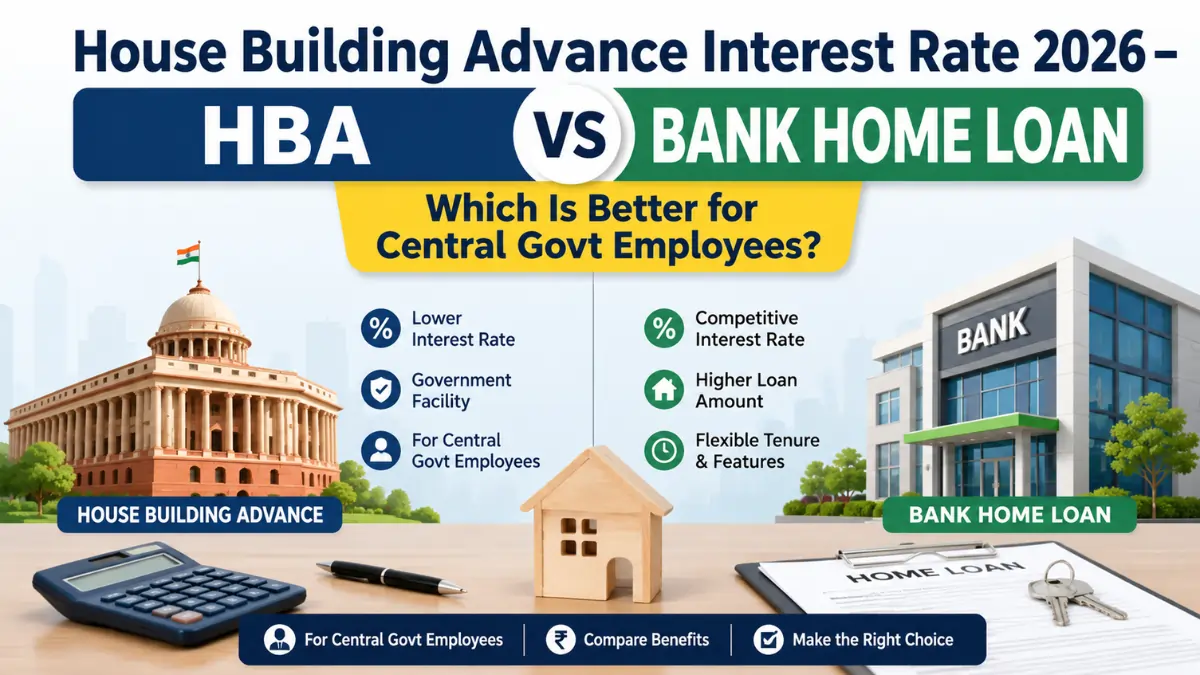
If you are a central government employee thinking about buying or building a house, the House Building Advance (HBA) interest rate for 2026 is a number you need to know. From 1 April 2026, the Government of India has fixed the HBA interest rate at 7.1% per annum. That is a rate most banks simply cannot match on a standard home loan today.
But is HBA always the better deal? The answer is not straightforward. There are strict eligibility rules, advance limits, and repayment conditions that may not suit every employee’s situation. Meanwhile, leading banks and public sector lenders are offering competitive home loan rates — with several starting as low as 7.10% to 7.25% at the best end, and going up to 13% or more at the higher end depending on your credit profile.
This article gives you a clear, honest comparison of HBA versus bank home loans so you can make the right decision for your family.
Table of Contents
House Building Advance 2026 – At a Glance
| Detail | Information |
|---|---|
| Scheme Name | House Building Advance (HBA) |
| Administering Authority | Ministry of Housing & Urban Affairs, Government of India |
| Applicable To | Permanent central government employees |
| Current HBA Interest Rate | 7.1% per annum (effective 1 April 2026) |
| Charging Method | Simple interest during construction; compound interest thereafter |
| Maximum Advance Amount | ₹25 lakh (or 34 months’ basic pay, whichever is less) |
| Maximum Repayment Period | 20 years (240 months) |
| Official Website | housing.gov.in |
What Is the House Building Advance (HBA) for Central Govt Employees?
The House Building Advance (HBA) is a government-funded housing loan available exclusively to permanent central government employees. It is not a subsidy — it is a loan you repay — but it comes at a significantly lower interest rate than what banks typically offer.
The scheme allows eligible employees to borrow money to:
- Purchase a ready-built house or flat
- Build a new house on a plot they already own
- Purchase a plot and build on it
- Extend or add to an existing house
The Finance Ministry reviews the HBA interest rate periodically and fixes it as a percentage of the prevailing rate charged under the General Provident Fund (GPF). For 2026, the rate has been set at 7.1% per annum. While a handful of banks now advertise minimum rates close to 7.10%–7.25%, those rates apply only to the very best-qualified borrowers. For most government employees, HBA remains the more predictable and often cheaper option — especially after factoring in processing fees, which banks charge at 0.15% to 3% of the loan amount.
HBA Interest Rate History – How 7.1% Compares
Understanding the current rate requires context. The HBA rate has tracked broader interest rate trends in India.
| Period | HBA Interest Rate |
|---|---|
| 2019–20 | 8.5% per annum |
| 2020–21 | 7.9% per annum |
| 2021–22 | 7.1% per annum |
| 2022–23 | 7.1% per annum |
| 2023–24 | 7.1% per annum |
| 2024–25 | 7.1% per annum |
| 1 April 2026 onwards | 7.1% per annum |
💡 The rate has held steady at 7.1% for several consecutive years. This consistency makes financial planning predictable for government employees.
HBA Eligibility – Who Can Apply in 2026?
Not every central government employee qualifies for the House Building Advance. The eligibility criteria are specific.
Basic Eligibility Conditions
| Criterion | Requirement |
|---|---|
| Employment Status | Must be a permanent central government employee |
| Service Completed | Minimum 5 years of continuous regular service |
| Property Ownership | Neither the employee nor spouse/minor child should own a pucca house in the posting city |
| Previous HBA | If earlier HBA was taken, it must be fully repaid |
| Ceiling on Advance | Lesser of ₹25 lakh or 34 months’ basic pay |
| Second HBA | Allowed only for extension/enlargement of existing house |
Who Is NOT Eligible?
- Contractual or daily-wage government workers
- Temporary employees (even if serving for many years without regularisation)
- Employees whose spouse or dependent children already own a house at the place of posting
- Employees with an existing HBA balance outstanding
⚠️ Important: Many employees assume that long service automatically qualifies them. It does not. Only permanent employees (those with a formal order of regularisation) are covered under the HBA scheme.
📌 Also Read: MACP Eligibility Checker — Check Your MACP Status Instantly 2026
HBA Loan Limit and Calculation – How Much Can You Get?
The maximum HBA you can get is the lower of:
- ₹25 lakh (absolute ceiling)
- 34 months’ basic pay (at the time of application)
HBA Amount by Pay Level
| 7th CPC Pay Level | Basic Pay (Entry) | Maximum HBA |
|---|---|---|
| Level 1 | ₹18,000 | ₹6,12,000 |
| Level 4 | ₹25,500 | ₹8,67,000 |
| Level 6 | ₹35,400 | ₹12,03,600 |
| Level 7 | ₹44,900 | ₹15,26,600 |
| Level 10 | ₹56,100 | ₹19,07,400 |
| Level 12 | ₹78,800 | ₹25,00,000 |
| Level 13 and above | ₹1,18,500+ | ₹25,00,000 |
*Capped at ₹25 lakh ceiling.
⚠️ The HBA amount often falls well short of current property prices — especially in metros like Delhi, Mumbai, or Bengaluru. Most employees end up supplementing HBA with a bank top-up loan.
HBA Repayment Rules – What You Need to Know
The repayment structure of HBA is different from a standard bank EMI loan, and this is where many employees get confused.
Key Repayment Rules
- Repayment period: Maximum 20 years (240 monthly instalments), but must be before retirement
- Principal first: The entire principal is recovered first in monthly instalments; interest is recovered separately afterwards
- Simple interest during construction: If the loan is for construction, simple interest applies during the construction period (maximum 18 months)
- Compound interest after: Once construction is complete (or from date of disbursement for purchase), compound interest at 7.1% applies
- Recovery from salary: HBA instalments are deducted directly from the employee’s monthly salary
- Minimum instalment: Principal recovery instalment must not exceed 40% of basic pay + Dearness Allowance (DA)
HBA vs Bank Loan — EMI Comparison
Assume a loan of ₹20 lakh at 7.1% (HBA) versus ₹20 lakh at 8.25% (SBI’s government employee rate), both for 20 years:
| Parameter | HBA @ 7.1% | SBI Home Loan @ 7.25% |
|---|---|---|
| Loan Amount | ₹20,00,000 | ₹20,00,000 |
| Processing Fee | Nil | NIL |
| Tenure | 20 years | 20 years |
| Monthly EMI (approx.) | ₹15,540 | ₹15,808 |
| Total Interest Paid | ₹17,29,600 | ₹17,93,805 |
| Total Savings with HBA | — | ₹64,205 |
💡 Even comparing HBA against SBI’s best government employee rate of 7.25%, the saving over 20 years is over ₹64,205 on a ₹20 lakh loan. Compare against ICICI or Axis (8.60%+) and the gap widens to ₹5–6 lakh.
📌 Also Read: Outcome of 49th NC-JCM Meeting 2026 held on 11 May 2026
Bank Home Loan Interest Rates 2026 – All Major Lenders Compared
Here is where the comparison gets genuinely interesting. Several public sector banks now advertise minimum rates that look close to HBA’s 7.1% — but the devil is always in the detail. Let’s go through every major lender with accurate current data.
Public Sector Banks – Home Loan Rates (May 2026)
| Bank | Interest Rate Range | Processing Fee for Govt Employees |
|---|---|---|
| Central Bank of India | 7.10% – 9.40% | NIL |
| Bank of India | 7.10% – 10.25% | NIL |
| Indian Overseas Bank | 7.10% – 8.75% | NIL |
| Bank of Maharashtra | 7.10% – 9.90% | NIL |
| Union Bank of India | 7.15% – 9.50% | 0.50% (max ₹15,000) |
| Canara Bank | 7.15% – 10.25% | NIL |
| Indian Bank | 7.15% – 9.55% | NIL |
| UCO Bank | 7.15% – 9.50% | NIL |
| State Bank of India (SBI) | 7.25% – 8.75% | NIL |
| Saraswat Bank | 7.35% – 8.90% | NIL |
| Punjab National Bank (PNB) | 7.40% – 9.80% | NIL |
| IDBI Bank | 7.55% – 10.75% | NIL |
| Punjab & Sind Bank | 7.55% – 9.75% | NIL |
| HSBC Bank | 7.70% – 12.50% | NIL |
| Bank of Baroda | 7.20% – 9.25% | NIL |
Private Sector Banks – Home Loan Rates (May 2026)
| Bank | Interest Rate Range | Processing Fee |
|---|---|---|
| HDFC Bank | 7.90% – 13.00% | 0.50% or ₹3,300 |
| Kotak Mahindra Bank | 7.99% onwards | Up to 2% |
| IndusInd Bank | 7.90% – 9.60% | Up to 1.5% |
| Tamilnad Mercantile Bank | 8.10% – 9.50% | 0.50% |
| Karnataka Bank | 8.15% – 11.50% | As per branch |
| Axis Bank | 8.25% – 11.90% | Up to 1% or ₹10,000 |
| South Indian Bank | 8.25% – 10.50% | 0.50% (min ₹10,000) |
| Bandhan Bank | 8.35% – 12.50% | Up to 1% |
| Karur Vysya Bank | 8.40% – 10.90% | ₹2,500–₹7,500 |
| ICICI Bank | 8.60% – 11.75% | Up to 2% |
| Federal Bank | 8.60% – 10.00% | 0.50% |
| Jammu & Kashmir Bank | 8.50% – 9.85% | 0.25% |
| Dhanlaxmi Bank | 8.50% – 9.25% | 1% (max ₹10,000) |
| Yes Bank | 8.75% – 11.50% | 1.5% or ₹10,000 |
| IDFC First Bank | 8.75% onwards | Up to 3% |
⚠️ These rates are indicative as of May 2026. Bank rates are linked to EBLR/MCLR and can change with RBI repo rate decisions. Always verify current rates directly with the lender before applying.
The Truth About “7.10%” Bank Rates
You may have noticed that Central Bank of India, Bank of India, Indian Overseas Bank, and Bank of Maharashtra all advertise a minimum rate of 7.10% — matching HBA exactly. So is the advantage gone?
Not quite. Here’s what those minimum rates actually mean in practice:
- They are for the highest credit-score borrowers only — typically CIBIL score 800+ with impeccable repayment history
- They usually apply to loans below ₹30 lakh in specific priority categories (women borrowers, green home loans, etc.)
- They are floating rates — linked to EBLR or MCLR, so they can go up if RBI raises the repo rate
- HBA at 7.1% is fixed by government order for the financial year — not subject to mid-year revision
So while the advertised minimum rate may look identical, the effective cost of a bank loan almost always ends up higher than HBA once fees and rate variability are factored in.
Banks don’t offer the same rate to everyone. The rate you actually get depends on:
- Your CIBIL score — A score above 750 typically gets the best rate; below 650 means higher rates or rejection
- Employment type — Government employees and salaried professionals usually get better rates than self-employed
- Loan-to-value (LTV) ratio — Borrowing less than 80% of the property value typically gets you a better rate
- Loan amount — Very large loans (above ₹75 lakh) sometimes attract a higher rate
- Lender relationship — Existing salary account holders often get preferential pricing
- Gender — Most banks offer 0.05–0.10% lower rates for women borrowers
HBA vs Bank Home Loan – Detailed Comparison
Now let’s put it all side by side. This is the comparison central government employees actually need.
| Feature | House Building Advance (HBA) | Bank Home Loan |
|---|---|---|
| Interest Rate | 7.1% (fixed by Government) | 7.1% – 10.65% (varies) |
| Rate Type | Fixed (reviewed annually) | Usually floating (MCLR/EBLR linked) |
| Maximum Loan Amount | ₹25 lakh | ₹5 crore + (varies by bank) |
| Tenure | Up to 20 years (before retirement) | Up to 30 years |
| Processing Fee | Nil | 0.25%–1% of loan amount (₹5,000–₹30,000+) |
| Prepayment Penalty | Nil | Nil (for floating rate loans) |
| Tax Benefit | Section 24 (interest), Section 80C (principal) | Section 24 (interest), Section 80C (principal) |
| Eligibility | Permanent central govt employees only | Any salaried / self-employed individual |
| Credit Score Required | Not applicable | 750+ preferred |
| Disbursement Speed | Slower (government process) | Faster (10–20 working days) |
| Collateral | Mortgage of property to government | Mortgage of property to bank |
| Top-Up Facility | Not available | Available |
| Joint Loan | Not available | Available (with spouse / co-borrower) |
| Insurance | Not mandatory (but recommended) | Bank may insist on home loan insurance |
Which Offers Better Value – HBA or Bank Home Loan?
The honest answer: it depends on your situation. Here is a simple framework to help you decide.
✅ HBA Is the Better Choice If…
- You need ₹25 lakh or less and your salary supports the EMI
- You are at least 10–15 years away from retirement (so the 20-year tenure fits)
- You are buying in a Tier-2 or Tier-3 city where ₹25 lakh is meaningful
- You value the certainty of a government-administered loan over the flexibility of a bank loan
- You want to save significantly on total interest over the loan life
✅ Bank Home Loan Is Better If…
- Your property costs significantly more than ₹25 lakh (common in metro cities)
- You want a longer tenure (25–30 years) for lower monthly EMIs
- You need the loan quickly and can’t wait for HBA disbursement
- You are a temporary/contract employee and not eligible for HBA
- You want a joint loan with a spouse to boost the eligible amount
- You want features like an overdraft facility or top-up loan
The Smart Strategy: HBA + Bank Top-Up
Many experienced government employees use both. They take the maximum HBA at 7.1%, and supplement the remaining property cost with a bank top-up loan. This keeps the overall blended interest rate lower than taking a single large bank loan.
Example:
- Property value: ₹55 lakh
- HBA component: ₹25 lakh @ 7.1%
- Bank top-up loan: ₹30 lakh @ 7.75%
- Blended rate: approximately 7.45%
This is significantly cheaper than borrowing the full ₹55 lakh from a bank at 7.6%.
📌 Also Read: 8th Pay Commission 2026: Expected Salary, Fitment Factor, Pay Matrix & Latest News
Limitations of HBA – What the Government Won’t Tell You Upfront
The HBA scheme has several real-world limitations that employees often discover only after they apply.
1. The ₹25 Lakh Cap Is Woefully Low for Metro Cities
In cities like Delhi, Mumbai, Bengaluru, Pune, or Hyderabad, ₹25 lakh barely covers a down payment on a 2BHK flat. The cap has not been revised since 2017, despite significant property price inflation.
2. Only Permanent Employees Qualify
Contractual, temporary, or re-employed employees — even those who have worked for the government for 10–15 years — are not eligible. This is a major exclusion given how widely contractual employment is used today.
3. 5 Years of Service Minimum
Newly recruited employees must wait 5 years before they can access HBA. During this period, if they need housing, a bank loan is their only option.
4. Cannot Be Used for a Second Home or Investment Property
HBA is strictly for the employee’s own residence. You cannot use it to buy a second home, rental property, or house for a family member. The property must be in the employee’s name (or jointly with spouse).
5. Slow Disbursement Process
Government loan processing takes time. Administrative approvals, property verification, legal scrutiny, and disbursement can take 3–6 months in many departments. Banks typically disburse in 2–4 weeks.
6. No Top-Up After Disbursal
Unlike bank home loans that allow a top-up loan for renovation or additional needs, HBA does not have this facility. Once sanctioned and disbursed, you cannot go back for more.
7. Must Complete Construction Within 18 Months
If the loan is for construction, the building must be completed within 18 months of the first instalment. Missing this deadline can attract penal interest.
8. EMI Deduction May Constrain Monthly Take-Home
Since HBA repayment is recovered directly from salary, a large HBA can significantly reduce your monthly in-hand pay — especially at lower pay levels. The 40% of (basic + DA) cap helps, but employees close to retirement may find their salary after deductions uncomfortably tight.
9. Property Cannot Be Sold Without Government Clearance
Since the property is mortgaged to the Government of India during repayment, you cannot sell, transfer, or sublet the property without prior written permission from your department. This limits flexibility.
10. No Balance Transfer Option
If interest rates fall significantly in the future, you cannot transfer your HBA to a cheaper rate elsewhere. You are locked in at 7.1% (subject to annual government revision). With a bank loan, you can always refinance to a better rate.
Income Tax Benefits – HBA vs Bank Home Loan
Both HBA and bank home loans give you the same tax deductions under the Income Tax Act. There is no disadvantage either way on this count.
| Tax Section | Benefit | Applicable To |
|---|---|---|
| Section 80C | Principal repayment deduction up to ₹1.5 lakh per year | Both HBA and bank home loan |
| Section 24(b) | Interest deduction up to ₹2 lakh per year (self-occupied) | Both HBA and bank home loan |
| Section 80EEA | Additional ₹1.5 lakh interest deduction for affordable housing | Bank loans (affordable housing category) |
💡 If your property qualifies as “affordable housing” (stamp duty value ≤ ₹45 lakh), you may get an additional ₹1.5 lakh interest deduction under Section 80EEA with a bank loan — a benefit not separately available with HBA.
How to Apply for HBA in 2026 – Step by Step
- Check your eligibility — confirm you are a permanent employee with at least 5 years of regular service
- Download the HBA application form from the Ministry of Housing & Urban Affairs website or your department’s HR portal
- Fill in property details — include plot number, construction plan, property valuation certificate
- Get the form countersigned by your Drawing & Disbursing Officer (DDO)
- Submit to your PAO / Accounts Office along with all property documents
- Legal scrutiny of property documents — the government will verify title deeds, encumbrance certificate
- Sanction order issued by the competent authority in your department
- Disbursement — released in instalments (for construction) or as a lump sum (for purchase)
- Mortgage deed execution — property is mortgaged to the President of India until full repayment
Important Links
| What | Link |
|---|---|
| HBA Guidelines – Ministry of Housing & Urban Affairs | Visit Here |
| 7th CPC Pay Matrix | Check Here |
| Income Tax Section 80C Deductions | View Here |
| DoPT Official Website | Visit Here |
| NPS Calculator for Government Employees 2026 | Claculate Here |
| 8th CPC Salary Calculator – 2026 | Calculate Here |
Frequently Asked Questions
What is the current HBA interest rate for central government employees in 2026?
The HBA (House Building Advance) interest rate from 1 April 2026 is 7.1% per annum. This rate is set by the Government of India and reviewed annually. It applies on a compound interest basis after the construction period (or from disbursement for property purchases).
Can I take both HBA and a bank home loan for the same property?
Yes, you can. Many central government employees take the maximum HBA (up to ₹25 lakh) and supplement it with a bank home loan for the remaining property cost. This is a legal and common approach, and it lowers your overall blended interest cost.
Is HBA available for temporary or contractual central government employees?
No. HBA is available only to permanent central government employees who have completed at least 5 years of continuous regular service. Contractual, daily-wage, or temporary employees are not eligible regardless of how long they have served.
What happens to HBA if I retire before completing repayment?
If you retire before fully repaying the HBA, the outstanding balance is recovered from your retirement dues — including gratuity, leave encashment, and other terminal benefits. This is important to factor in if you take HBA close to retirement.
Which bank offers the lowest home loan rate for government employees in 2026?
As of May 2026, Central Bank of India, Bank of India, Indian Overseas Bank, and Bank of Maharashtra all advertise a minimum rate of 7.10% — the same as HBA. However, these minimum rates apply only to the highest credit score borrowers in specific loan categories. For most borrowers, effective rates start around 7.25%–7.55% at public sector banks. SBI offers 7.25% as its minimum, with a low processing fee of 0.35% (capped at ₹10,000), making it one of the most practical choices if you need to supplement your HBA.
Is HBA better than SBI home loan for a central government employee?
For eligible employees, HBA at 7.1% is cheaper or on par with the best bank rates — and comes with zero processing fee. SBI’s minimum rate of 7.25% is close, but add the processing fee (0.35%) and floating rate risk and HBA still wins on total cost. If you need more than ₹25 lakh, combining HBA with an SBI or PNB top-up (both among the lowest-fee public sector lenders) gives you the best blended rate.
Can I claim tax deductions on HBA repayment?
Yes. Both the principal repayment (under Section 80C, up to ₹1.5 lakh per year) and interest payment (under Section 24(b), up to ₹2 lakh per year for self-occupied property) are eligible for income tax deductions on HBA — the same as with a bank home loan.
Conclusion
The House Building Advance at 7.1% per annum remains one of the best financial benefits available to permanent central government employees in 2026. While a handful of public sector banks now advertise minimum rates at 7.10%–7.15%, those rates come with processing fees, floating rate risk, and strict credit score requirements. HBA has no processing fee and a government-fixed rate — making its effective cost lower for most borrowers.
That said, HBA is not perfect for every situation. The ₹25 lakh cap, the 5-year service requirement, slow processing, and the restriction to permanent employees are real constraints. For metro city properties that cost ₹50 lakh or more, HBA alone will not be sufficient.
The smartest approach for most government employees is to take the maximum HBA first and then top up with a low-fee public sector bank loan — SBI, PNB, Canara Bank, or Union Bank — at the most competitive rate available. This blended approach gives you the best of both worlds.
Have questions about how HBA fits into your specific salary and retirement timeline? Drop them in the comments — we read every one.
Disclaimer
The information in this article is based on publicly available government guidelines, official HBA rules, and bank-published interest rates as of May 2026. Bank interest rates are subject to change based on RBI monetary policy and individual bank decisions. HBA interest rates are revised annually by the Government of India. This article is for general information purposes only and does not constitute financial or legal advice. Readers are advised to verify all details with their department’s HR/accounts office and the relevant bank before making any financial decision. Govtserviceinfo.com is not responsible for any decisions taken based on this article.