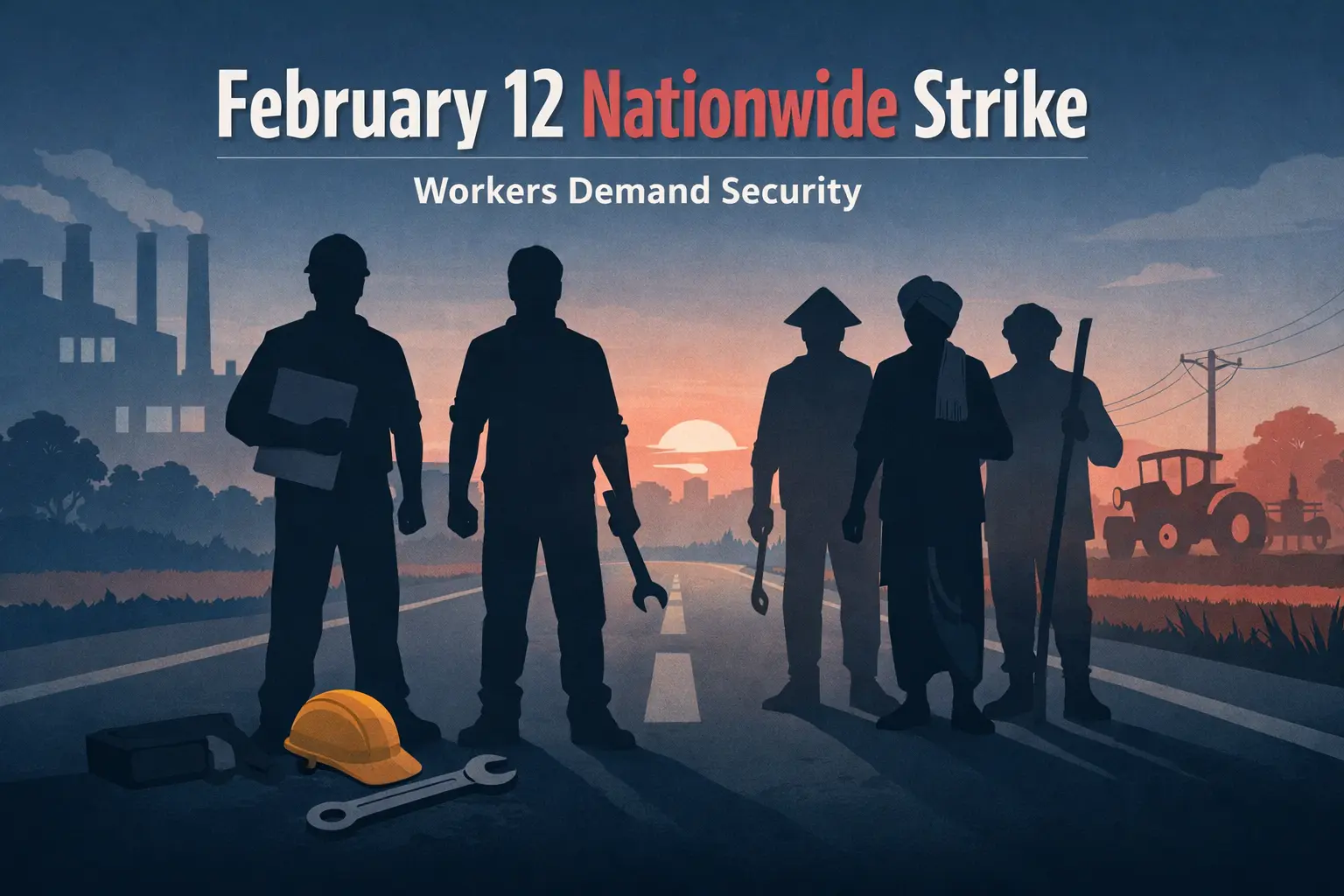
On February 12, India will witness something far bigger than a one-day strike. Crores of workers across the country — from factories and banks to telecom offices and anganwadi centres are preparing to tools down. Central trade unions, along with farmers’ organisations, have called for a nationwide general strike (Bharat Bandh).
The demand is clear repeal the new labour codes and roll back policies that, workers believe, weaken job security and dilute long-standing labour rights.
It reflects something deeper —
- growing anxiety among workers,
- widening distrust between labour and the government, and
- fear about the future of jobs, wages, and social security.
Behind the headlines are ordinary people asking a simple question:
Where do we stand in this changing economy?
This article explains what is really happening, why it matters, and what workers should understand beyond the daily news cycle.
Why February 12 Feels Different This Time
The February 12 strike is a coordinated nationwide protest led by a joint platform of central trade unions (e.g., INTUC, AITUC, CITU, SEWA, AICCTU, UTUC, and others), with active support from several farmers’ groups.
Trade union leaders claim participation from millions of workers across almost every state, particularly from sectors such as:
- Public Sector Units (PSUs)
- Banking and insurance
- Transport services
- Telecom sector, including BSNL employees
- Contract and scheme workers like ASHA, Anganwadi, and Mid-Day Meal staff
The protest will include:
- Work stoppages
- Demonstrations and rallies
- Road protests in selected areas
Not all unions are participating, but the scale of mobilisation itself signals widespread dissatisfaction among organised labour.
Discontent is widespread, deep, and no longer silent.
Join Telegram
Join NowWhy Labour Codes Are at the Centre of Protest
At the heart of the strike is opposition to the four new labour codes, which replaced 29 existing labour laws.
While the government describes these changes as reforms aimed at simplification and efficiency, workers on the ground experience them very differently.
What Workers Fear Most
Trade unions argue that the labour codes:
- Make hire-and-fire easier, especially in larger establishments
- Reduce the strength of collective bargaining and unions
- Delay or weaken social security benefits
- Increase insecurity for contract and gig workers
One of the most controversial changes is the higher threshold for layoffs and retrenchment, which unions say shifts power towards employers while limiting worker protection.
Many workers say they were never meaningfully consulted. Laws that will decide their future were passed — but their voices never reached the table.
These reforms feel less like “simplification” and more like a quiet dilution of rights earned over decades.
Why Farmers Have Joined Hands With Workers
This is not just a workers’ protest.
Farmers’ organisations have extended support because they see the labour codes as part of a broader economic shift — one that they believe prioritises large corporates over small producers and wage earners.
Shared concerns include:
- Policy changes taken without ground-level consultation
- Reduced government support mechanisms
- Rising cost of living with stagnant or uncertain incomes
This labour–farmer unity is significant. It reflects a common fear that economic growth is happening, but not evenly and not securely.
That shared anxiety has created unusual unity across sectors.
What Ordinary People Are Saying Online
On platforms like Reddit and social media, reactions are intense and divided.
Some people say:
“Strikes are the only language governments listen to.”
Others argue:
“Reforms are necessary, even if they are painful.”
But buried beneath the debate is something deeper — a crisis of trust.
Workers don’t just fear change.
They fear being invisible during change.
Join WhatsApp
Join NowWill Daily Life Be Affected on February 12?
It depends on where you live.
Possible impacts include:
- Partial disruption in banking and PSUs
- Fewer buses, autos, or cabs in some cities
- Slower government and administrative services
Emergency services, hospitals, and essential utilities are expected to function, but local disruption may vary.
For many workers, however, inconvenience is a small price compared to remaining silent.
Why This Strike Matters Even If You’re Not Participating
Even if you go to work on February 12, this strike still concerns you.
Because the questions it raises are bigger:
- What kind of jobs will exist in the next decade?
- Will workers have stability or only flexibility?
- Can growth be called progress if people feel insecure?
Strikes don’t appear overnight.
They grow when conversations stop and listening ends.
What Workers Can Do Beyond the Strike
A one-day strike creates attention — but real change needs continuity.
Workers can:
- Understand how the labour codes affect their specific sector
- Raise concerns through recognised unions and lawful channels
- Keep records of workplace changes affecting wages or conditions
- Stay informed — not just angry
Awareness protects dignity.
Frequently Asked Question on February 12w Nationwide strike
Q. Why is there a nationwide strike on February 12?
Workers and trade unions are protesting new labour codes, fearing job insecurity and weakened workers’ rights.
Q. Who has called the February 12 Bharat Bandh?
Central trade unions with support from farmers’ organisations.
Q. Will banks and transport be affected on February 12?
Some disruption is possible, depending on region and participation.
A Quiet Truth Behind the February 12 Strike
Most workers do not want to protest. They want to work — with security, respect, and clarity.
The February 12 nationwide strike is a reminder that when people step out of their jobs to stand on the streets, it’s usually because they felt unheard for too long.
Whether the government listens or not, this moment marks something important:
India’s workers are asking to be part of the conversation about their own future.
Disclaimer:
This article is for informational purposes only, based on publicly available reports and discussions. It does not endorse or oppose any organisation, policy, or political view. Readers are advised to verify details independently.
Read More: Nationwide Strike on 12 February 2026 Over 8th CPC, NPS, DA Arrears