
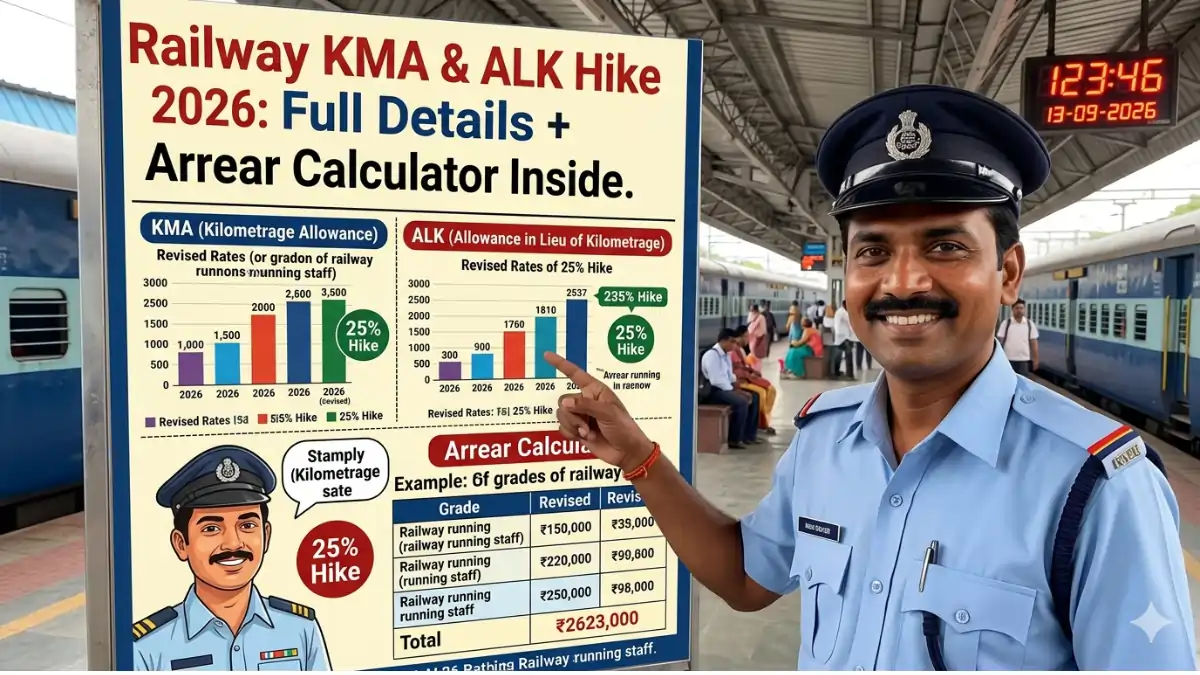
Kilometreage Allowance (KMA) and Allowance in Lieu of Kilometreage (ALK) for Indian Railways running staff have been revised upward with effect from 01 January 2024, following the Railway Board circular No. E(P&A)II/2013/RS-14 (Part-2), RBE No. 85/2026, issued on 20 March 2026. The revision is a direct consequence of Dearness Allowance (DA) crossing the 50% threshold, a benchmark that has historically triggered a fresh round of allowance rationalization. For a Loco Pilot (Mail) category employee, the per-100-km rate now stands at ₹606 — a notable jump from the 2019 rates — putting real additional money in the hands of the workforce that keeps India’s trains moving.
💡 Key Trigger: DA reaching 50% w.e.f. 01.01.2024 is the reason these revised rates apply from that date. The same DA milestone has historically been the standard trigger for revision of running allowances, consistent with 7th CPC framework norms.
Why This Revision Happened — and Why It Took This Long
The last major revision of KMA and ALK rates under the 7th Central Pay Commission (CPC) framework was notified through RBE No. 85/2019, dated 28 May 2019, with effect from 01 July 2017. That order was itself the product of a long bilateral negotiation process between Railway Board and the two recognised federations — the All India Railwaymen’s Federation (AIRF) and the National Federation of Indian Railwaymen (NFIR) — after the Ministry of Finance, through its Resolution of 06 July 2017, handed back the responsibility of determining running allowance rates to the Railways.
The current revision follows the same path. Both AIRF and NFIR had been pressing Railway Board for a fresh enhancement, arguing that the static rates in place since 2019 had been eroded by inflation. The matter was examined in Railway Board’s office in consultation with the Finance Directorate, referred to the Ministry of Finance (Department of Expenditure) for concurrence, and finally cleared — resulting in the 20 March 2026 circular. The timing is not coincidental: with DA touching 50% of basic pay from 01 January 2024, there was both a policy precedent and an administrative obligation to act.
⚠️ Note on Arrears: Since the revised rates are effective from 01.01.2024 but the order was issued on 20.03.2026, running staff are entitled to arrears covering over two years. The arrear calculator below helps you estimate this amount.
The Revised Rate Tables — What Changed for Loco Running Staff
The circular covers two broad categories: Loco Running Staff and Traffic Running Staff. The table below presents the revised rates alongside the 2019 benchmark, giving a clear picture of the enhancement.
| Category | Grade Pay / Level | KMA per 100 km (₹) — 2024 | ALK per 160 km (₹) — 2024 |
|---|---|---|---|
| Loco Pilot (Mail) | 4200/6 | 606 | 969 |
| Loco Pilot (Passenger) / Sr. Motorman | 4200/6 | 600 | 960 |
| Loco Pilot (Goods) | 4200/6 | 594 | 951 |
| Loco Pilot (Shunting) Gr. I | 4200/6 | 461 | 737 |
| Loco Pilot (Shunting) Gr. II | 2400/4 | 447 | 715 |
| Sr. FM-1 / Sr. Asstt. Loco Pilot | 2400/4 | 447 / 287 (shunting) | 715 |
| FM-1 / Asstt. Loco Pilot | 1900/2 | 430 / 277 (shunting) | 688 |
| Sr. Second Fireman | 1900/2 | 430 / 277 (shunting) | 688 |
| Second Fireman | 1800/1 | 362 / 216 (shunting) | 579 |
| Mail / Express Guard | 4200/6 | 549 | 878 |
| Sr. Passenger Guard | 4200/6 | 543 | 869 |
| Sr. Goods Guard | 4200/6 | 543 | 869 |
| Goods Guard | 2800/5 | 537 | 859 |
| Sr. Asstt. Guard / Sr. Brakesman | 2400/4 | 320 | 512 |
| Asstt. Guard / Brakesman | 1900/2 | 305 | 488 |
*2019 rates are approximate reference figures from RBE 85/2019. The 2024 rates are as per the official RBE 85/2026 dated 20.03.2026.
Understanding KMA and ALK — What These Allowances Actually Are
Not every railway employee gets these allowances. They apply exclusively to running staff — those who physically operate or accompany trains. The Indian Railway Establishment Manual (IREM), Chapter 9, defines the framework in Rule 901 onwards.
Kilometreage Allowance (KMA) is the primary running allowance, paid per 100 km of track covered during actual running duties. It compensates running staff for the fact that they are not eligible for the Daily Allowance (DA on tour) that other government employees receive, and also serves as an incentive for higher train throughput. The allowance is calculated at the applicable rate multiplied by the actual kilometres operated, divided by 100.
Allowance in Lieu of Kilometreage (ALK), on the other hand, applies when running staff are on non-running duties — attending medical examinations, training courses, union meetings, law courts, transfer journeys, joining time, and several other specified activities. At headquarters, ALK equals the pay element of running allowance (30% of basic pay). When such non-running duties are performed at outstations, ALK is calculated on notional kilometres of 160 km per day, at the rates in the circular.
✅ Activities where ALK is payable include: Medical examinations, transfer journeys, joining time, refresher courses & training in carriage sheds, attending enquiries or law courts, trade union meetings, First Aid and Ambulance classes, Territorial Army camps, and Staff Loan Society/Welfare meetings.
What This Means If You Are a Running Staff Member
If you are a Loco Pilot (Mail) currently at Pay Level 6, your KMA rate has moved from ₹530 to ₹606 per 100 km. On a month where you run 3,000 km, your running allowance alone moves from ₹15,900 to ₹18,180 — a gain of ₹2,280 per month from this category alone. Over the 27 months of arrears (January 2024 to March 2026), that accumulates to a significant sum.
For Mail/Express Guards (now officially re-designated as Train Managers as per RBE No. 7/2022, effective 13 January 2022), the KMA rate rises from ₹479 to ₹549 per 100 km. On a comparable monthly run of 2,800 km, that translates to monthly earnings jumping from ₹13,412 to ₹15,372 — an increase of nearly ₹2,000 per month. The arrear component over two years is equally meaningful.
The ALK enhancement matters even more for those frequently on non-running duties. A Loco Pilot (Goods) at Level 6 now draws ₹951 per 160 km on ALK days, up from approximately ₹832. For a month with 10 ALK days, that is ₹9,510 versus ₹8,320 — a monthly gain of ₹1,190 from ALK alone.
The other terms and conditions governing admissibility of both KMA and ALK remain unchanged as confirmed by Para 3 of the circular. This means existing eligibility criteria, the list of qualifying non-running activities for ALK, and the formula for calculating KMA continue as before.
The Arrears Question — How Far Back Does This Go?
The circular specifies the effective date as 01.01.2024. The order itself was issued on 20 March 2026. That means running staff are entitled to arrears covering 27 full months — from January 2024 through March 2026. The exact arrear for any individual depends on two variables: the monthly kilometres run (for KMA) and the number of non-running duty days (for ALK).
The arrear calculator below computes this automatically. Enter your category, average monthly kilometres, and average ALK days per month, and the tool calculates both your revised monthly income and the estimated arrear for the full backdate period. The tool also shows a month-by-month breakdown.
KMA & ALK Arrear Calculator
Kilometreage Allowance & ALK — Revised Rates w.e.f. 01.01.2024
The Policy Pattern — How Running Allowances Are Set in India
Running allowances occupy a unique place in Indian Railways’ pay structure. Unlike most central government allowances that are directly recommended and revised by Pay Commissions, KMA and ALK have historically been decided through bilateral negotiations between Railway Board and the federations. The 7th CPC itself acknowledged this in its report, noting that successive Pay Commissions had “refrained from giving any express recommendations on the methodology/formula for calculation of the rates of Kilometreage Allowance/ALK.”
The Ministry of Finance’s 2017 Resolution formalized this practice — requiring that rates be fixed through federation consultations and then sent for Finance Ministry concurrence before notification. This two-step process adds time but ensures that the rates have both union buy-in and fiscal clearance. The current revision follows exactly this path, with Railway Board confirming Finance Ministry concurrence in Para 4 of the circular. It marks the second revision of these rates since the 7th CPC framework took effect, following the 2019 order.
Read alongside the broader trajectory of DA-linked allowance revisions across central government services, this order signals a maturing pattern: as DA crosses preset thresholds (25%, 50%), the government systematically recalibrates allowances that were frozen at their original 7th CPC revision rates. Running staff, who had waited since 2019, are the latest beneficiaries of this cycle.
Others Free Tools
| Resource | Link |
|---|---|
| Income Tax Calculator FY 2025-26 | Click here to Calculate |
| Gratuity Calculator | Click here to Calculate |
| LTC Calculator 2026 | Click here to Calculate |
| 8th CPC Salary Calculator | Click here to Calculate |
| DA Hike Calculator | Click here to Calculate |
| NPS vs UPS Comparison | Click here to Calculate |
| MACP Eligibility Checker | Click here to Calculate |
| DA Calculator 2026 | Click here to Calculate |
| NPS Corpus Estimator For Govt Employees | Click here to Calculate |
| Pension Calculator for CG Employee | Click here to Calculate |
| Age Calculator | Click here to Calculate |
Frequently Asked Questions
From which date do the revised KMA and ALK rates apply?
The revised rates apply with effect from 01 January 2024, as specified in RBE No. 85/2026 dated 20 March 2026. This date is tied to Dearness Allowance reaching 50% of basic pay from that date.
How are running allowance arrears calculated for the period January 2024 to March 2026?
Arrears are calculated as: (New Rate − Old Rate) per 100 km × actual km run per month, totalled across each month from January 2024. For ALK days, the difference in ALK per 160 km × notional 160 km per ALK day × number of ALK days per month is aggregated over the same period. The calculator above automates this estimation.
What is the new KMA rate for Loco Pilot (Mail) and Goods Guard after the 2026 revision?
A Loco Pilot (Mail) at Grade Pay 4200 / Level 6 now earns ₹606 per 100 km and an ALK of ₹969 per 160 km. A Goods Guard at Grade Pay 2800 / Level 5 earns ₹537 per 100 km and ALK of ₹859 per 160 km.
Are Guards now called Train Managers, and does this order apply to them?
Yes. The post of Guard was re-designated as Train Manager vide Railway Board’s letter dated 13 January 2022 (RBE No. 7/2022). The current circular explicitly notes this re-designation and confirms that the revised KMA and ALK rates apply to all traffic running staff including those now designated as Train Managers.
Do the revised KMA and ALK rates apply to Loco Inspectors?
Loco Inspectors who are governed by the scheme under Board’s letter No. E(P&A)II/83/RS-10(iv) dated 25.11.1992 have a separate provision under which an additional 30% of basic pay is reckoned for pensionary benefits. The running allowance rate changes in the current circular do not directly alter the Loco Inspector scheme but apply to all eligible running staff categories listed in the table.
Has the pay element percentage in Running Allowance (30% of basic pay) changed?
No. The pay element in running allowance remains at 30% of basic pay under the Railway Services (Revised Pay) Rules, 2016. This was fixed by RBE No. 85/2019 and has not been altered by the current order. The current revision only changes the per-kilometre and ALK rates.
Will there be another revision when DA crosses 75%?
There is no automatic statutory guarantee, but the historical pattern strongly suggests so. Each prior major revision — in 2008 (6th CPC), 2017/2019 (7th CPC), and now 2024/2026 — has occurred after a significant DA movement. If the 8th Pay Commission framework retains a similar DA-linked trigger, another revision could follow when DA crosses the next significant threshold under a revised pay scale.
The Railway Board’s decision to formalise the revision through a dated circular with explicit Ministry of Finance concurrence — rather than leaving it as an administrative understanding — gives the enhanced rates the full force of a government order. Running staff across all Indian Railways and Production Units are entitled to claim the difference from their respective Pay & Accounts Offices, and divisions have been asked to implement the revision accordingly. The distribution of the circular to all Chief Commissioners of Railway Safety, RDSO, the five Railway Training Institutes, and all 17 RRBs signals that implementation is expected to be both rapid and uniform.
Disclaimer: This article is for informational purposes only, based on RBE No. 85/2026 dated 20.03.2026 and publicly available railway establishment rules. The arrear calculator is an estimation tool. For authoritative arrear computation and salary disbursement, running staff should contact their Divisional Pay & Accounts Office or Personnel Branch. govtserviceinfo.com is not responsible for any discrepancies between estimated and actual arrear amounts.
🔗Related Tools Section (Paste at bottom)
Explore our other free tools for Central Government employees:
- DA Calculator 2026 — Calculate your Dearness Allowance at the latest 60% rate
- MACP Eligibility Checker — Know instantly if you are due for MACP career progression benefit
- NPS vs UPS Calculator — Make an informed, one-time pension scheme choice
- 8TH CPC Calculator — Calculate your 8th Pay Commission Salary using accurate calculator
- LTC Calculator 2026 — Calculate Leave Travel Concession reimbursement for the new block






7 thoughts on “Big Update! Railway KMA & ALK Hike 2026: Full Details + Arrear Calculator Inside”